Play store

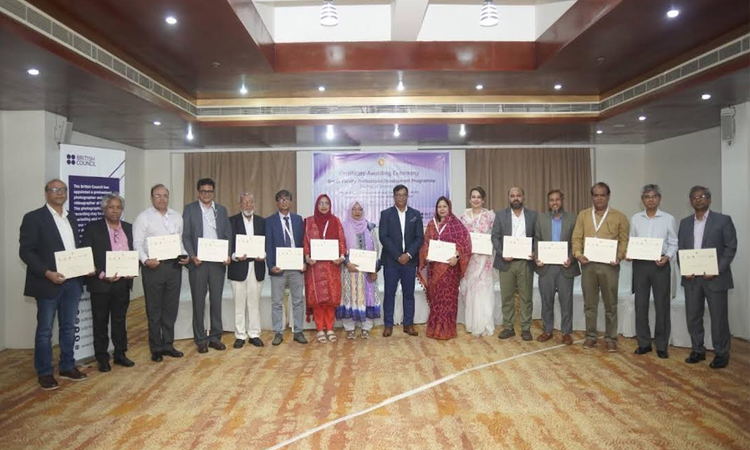
The University Grants Commission (UGC) of Bangladesh is working to establish a sustainable, self-reliant professional development system for university teachers to enhance the quality of higher education and strengthen academic leadership across the country.
As part of this initiative, the UGC has completed the first phase of preparing 15 senior faculty members from public and private universities as “Master Trainers”, who will subsequently train additional instructors and contribute to the professional development of thousands of university teachers nationwide.
Speaking at the certificate awarding ceremony for the first batch of the “Training of Trainers (ToT)” programme under the Senior Faculty Professional Development Programme, UGC Chairman Professor Dr. Mamun Ahmed said the initiative marks the beginning of a transformative journey toward building a robust academic leadership framework in Bangladesh’s higher education sector.
The ceremony was held on Wednesday at a hotel in Cox’s Bazar under the Higher Education Acceleration and Transformation (HEAT) Project.
“Ensuring quality in higher education requires competent and visionary academic leadership,” Dr. Mamun said. “This programme is not merely the conclusion of a training course; rather, it represents the beginning of a new chapter in developing academic leadership in Bangladesh.”
He said the newly certified Master Trainers would play a vital role in promoting professional development, improving teaching quality, strengthening research leadership, enhancing institutional governance and building organizational capacity within their respective universities.
The UGC chairman said that in the next phase of the HEAT Project, more national-level trainers would be developed. Through a network of Master Trainers and National Trainers, thousands of university teachers across the country will gradually receive training in modern teaching methodologies, quality assurance, research leadership, curriculum development and industry-academia collaboration.
He emphasized that the initiative aims to reduce long-term dependence on foreign expertise by developing a sustainable, homegrown system of faculty development.
“By building a pool of highly skilled trainers within the country, we are establishing a self-reliant professional development framework that will enable universities to nurture future academic leaders through their own institutional capacities,” he said.
Among others, Professor Dr. Borhan Uddin Khan of the Department of Law at the University of Dhaka, British Council Bangladesh Country Director Stephen Forbes, HEAT Project Director Professor Dr. Asaduzzaman, Advance HE consultant Dr. Ben Brabyn, local consultants, the 15 Master Trainers from public and private universities, and officials of the HEAT Project attended the event.
The 10-day training programme covered six key areas of higher education development, including strategic governance, quality assurance, internationalization, curriculum development, teaching and assessment methodologies, research leadership, and industry-academia collaboration.
The initiative is expected to contribute significantly to strengthening institutional capacity and improving the overall quality and global competitiveness of Bangladesh’s higher education sector.