


 Play store

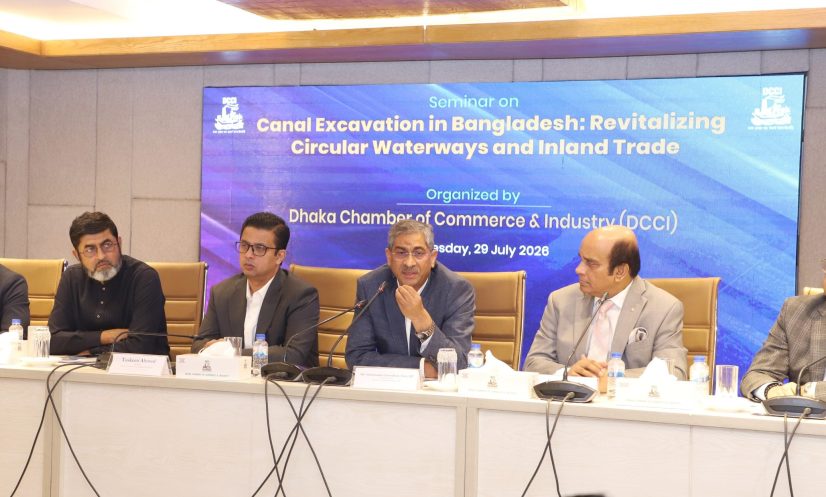
The Dhaka Chamber of Commerce & Industry (DCCI) has called for an immediate and integrated strategy to restore Bangladesh’s dwindling canal and river network, emphasizing that revitalizing circular waterways could cut freight transport costs by up to 60 percent for local businesses.
Speaking at a seminar titled “Canal Excavation in Bangladesh: Revitalizing Circular Waterways and Inland Trade” at the DCCI Auditorium on Wednesday, business leaders and urban planners urged swift government action in this regard.
DCCI President Taskeen Ahmed highlighted that over 55 percent of the country’s 1,415 rivers and canals have lost navigability due to severe siltation, illegal encroachment, and decades of neglect. As a direct result, 77 percent of Bangladesh’s freight is forced onto roads—a shift that inflates logistics expenses, exacerbates traffic gridlock, and causes significant environmental damage.
Waterways offer a far more efficient alternative, requiring four to six times less fuel than road haulage. To unlock these economic benefits, Ahmed called for prioritizing the 112-kilometer circular waterway surrounding Dhaka’s four primary rivers, linking local trade routes directly to rural economies and easing flood control.
Speaking at the seminar as the chief guest Minister for Water Resources Md. Shahiduddin Chowdhury Anee, MP, outlined ongoing government initiatives to excavate 20,000 kilometers of canals across the country.
To ensure long-term maintenance, local committees comprising municipal representatives and government agencies have been formed, alongside a 25-crore tree plantation campaign to protect riverbanks, he said.
The Minister also pledged stricter enforcement against industrial waste dumping, promising technological support to help small and medium industries install affordable Effluent Treatment Plants (ETPs).
Panel experts and urban planning specialists underscored critical structural changes needed to ensure success.
Architect Iqbal Habib stressed the need to stop constructing low-height bridges that block water transport, while urging the government to consolidate river management—currently split across 15 different agencies—under a single, accountable lead authority.
Other discussants, including representatives from BUET, CEGIS, and the Institute of Water Modelling, recommended leveraging Geographic Information System (GIS) mapping to enforce boundaries, executing capital dredging on key routes like the Buriganga River, and tapping Public-Private Partnership (PPP) models to finance modern river transport infrastructure.