


 Play store

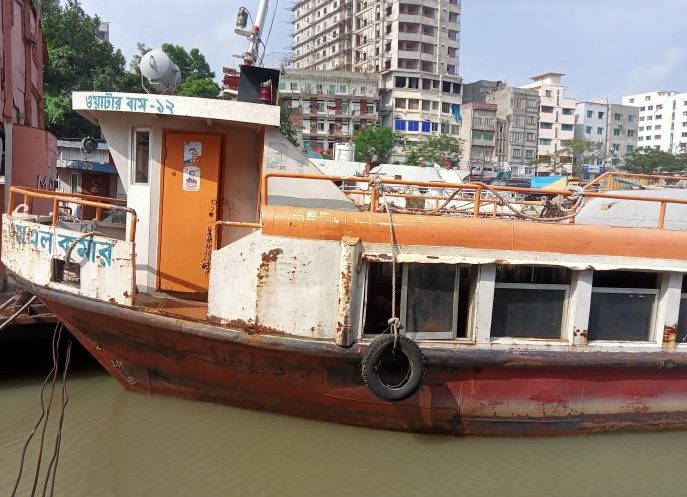
Around Tk122 crore was spent to develop a circular waterway around Dhaka, but the project generated only Tk2.52 crore in revenue, leaving behind abandoned infrastructure and idle vessels. Now, the government is planning to revive the long-defunct service.
Once envisioned as a cost-effective and congestion-free transport system, the circular waterway used rivers including the Turag, Buriganga, Shitalakkhya, and Balu, covering about 110 kilometres around the capital. Water buses once carried passengers from Ashulia to Sadarghat, offering a smoother alternative to road travel.
A recent visit to several landing stations, however, paints a bleak picture. Facilities stand deserted, pontoons are overrun with water hyacinths, and no vessels have docked there for years. The service was effectively shut down around 2016.
The project began in 2000, with its first phase completed in 2005 at a cost of Tk36 crore. This included dredging nearly 30 kilometres of waterways and building landing stations and terminals.
The second phase, completed between 2007 and 2010, cost about Tk47.5 crore and extended the route further. An additional Tk38 crore was spent on purchasing and operating water buses.
Despite the heavy investment, the full route never became operational. Low-clearance bridges—around 20 of the 25 road bridges and three rail bridges along the route—prevented continuous navigation, making large-scale service impractical without major structural changes.
Operational challenges also plagued the service. Passengers cited delays, poor management, and unpleasant odours from polluted rivers as key reasons for its failure. Even when boats were full, departures were often delayed due to absent crew, leading to frustration among commuters.
Out of 12 water buses introduced over time, nine are now set to be sold as scrap by the Bangladesh Inland Water Transport Corporation (BIWTC). The remaining vessels are either inactive or operating on limited routes. Many are now in a dilapidated condition, with broken windows and missing seats.
Landing stations built under the project have also fallen into disuse, some repurposed informally or left to decay.
Despite past failures, the government has renewed interest in the project. At a high-level meeting on August 2, Prime Minister Tarique Rahman directed authorities to reactivate the circular waterway and address related issues such as river pollution, drainage, and navigability.
This time, authorities plan to involve private operators in running the service, with the Bangladesh Inland Water Transport Authority (BIWTA) overseeing coordination. Initial plans focus on restarting services between Gabtoli and Sadarghat.
Experts caution against rushing the revival. Urban planners stress the need for a long-term master plan spanning 15 to 20 years, warning that fragmented or short-term efforts could lead to further financial losses.
They argue that with proper planning, cleaner rivers, and efficient management, Dhaka’s waterways could still become a viable transport alternative—much like the popular water taxi service at Hatirjheel, which continues to attract thousands of passengers daily despite environmental challenges.