


 Play store

The winners of the third edition of the international photography competition **Wiki Loves Bengal 2026** have been announced, with Bangladeshi photographers securing several of the top honours.
Held under the theme **“Festivals of Bengal”**, the competition invited photographers to document the region’s diverse celebrations, rituals and cultural traditions. The initiative has also added thousands of freely usable photographs to Wikimedia Commons, helping build a growing visual archive of Bengali heritage.
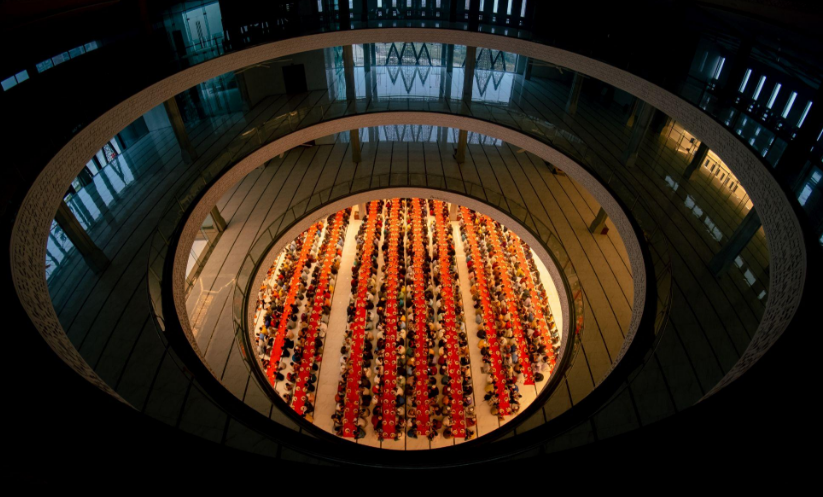
Bangladeshi photographer **Rakibul Alam Khan** won the first prize for a striking image of devotees taking part in a congregational Iftar during Ramadan 2025 at Dhaka’s Masjid Al Mustafa.
Photographed from a high angle, the image captures orderly rows of worshippers seated within the mosque’s circular architectural setting. The interplay of illuminated figures, geometric patterns and surrounding shadows created a distinctive visual rhythm that impressed the international jury.
Juror Biswarup Ganguly praised the alignment between the mosque’s architecture and the orderly rows of worshippers, while fellow juror Abdul Momin highlighted the effective use of the structure as a natural frame.
The second prize went to **Azim Khan Roni of Bangladesh** for his dramatic photograph of *Rakher Upabash* at the Baba Lokenath Brahmachari Ashram in Narayanganj.
The image captures devotees lighting oil lamps amid thick plumes of smoke, with a praying figure at its centre. The combination of flames, smoke and worshippers created a powerful atmosphere, according to juror Timothy A. Gonsalves.
Indian photographer **Shubhayu Dasgupta** secured third place for a layered image showing a child playing in front of a decorated Durga idol.
Using an unusual perspective, the photograph frames the deity in the background through the circular structure of a wheel being rolled by the child in the foreground. The composition brings together the festive setting and an everyday moment while adding depth to the image.
The fourth and fifth places went to **Shibasish Saha of India** and **Mohammad Rubel of Bangladesh**, respectively.
Saha’s photograph depicts devotees carrying a Durga idol through fields of white Kash flowers during autumn, while Rubel captured newly ordained Buddhist monks lighting lamps during the Probarona Purnima festival.
The remaining places in the top ten featured photographs documenting a range of cultural traditions across Bangladesh and India. These included South Asia’s largest Eid congregation in Dinajpur, photographed by Azim Khan Roni; the Karam festival in Purulia by Atanu Das; the Gajan festival in West Bengal by Arpan Basu Chowdhury; the traditional Polo Bawa fishing festival in Pabna by Md Bipul Mandal; and the Moichara festival in Bangladesh by Monojit Dutta.
The competition is organised by **Bangla WikiMaitri**, a joint platform of Wikimedia Bangladesh and the West Bengal Wikimedians User Group. Since its launch in 2024, the initiative has contributed a total of **6,656 freely licensed photographs** to Wikimedia Commons.
This year’s competition recorded significant growth, with **364 photographers submitting 2,903 photographs**. The number of participants increased by **90.6 per cent**, while submissions rose by **61.3 per cent** compared with the previous year.
More than 70 per cent of this year’s participants, or 258 photographers, took part in the competition for the first time.
Project Lead **Moheen Reeyad** said the initiative aims to build a permanent visual archive of Bengal’s cultural heritage.
“A photograph can capture a festival, custom, or everyday story that might otherwise be lost to time,” he said, adding that the open-license model would help make the region’s cultural heritage accessible to researchers, educators and the wider public around the world.
The top three winners will receive cash prizes of **$400, $300 and $200**, respectively. The remaining photographers in the top ten will receive crests and certificates.