


 Play store

Despite notable progress over the past year, access to finance remains the single biggest obstacle to doing business in Bangladesh, according to policymakers, bankers and business leaders, who on Monday called for sweeping reforms to build a more diversified and resilient financial system capable of supporting private sector-led growth.
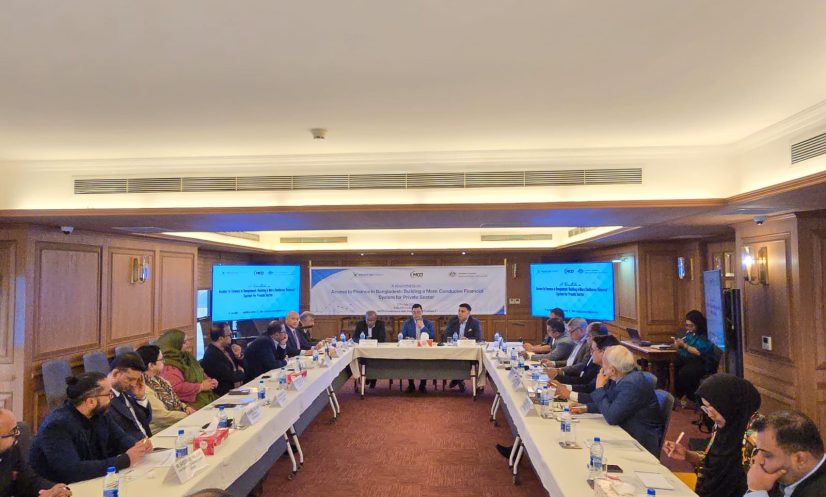
The concerns were raised at a roundtable titled “Access to Finance in Bangladesh: Building a More Conducive Financial System for the Private Sector,” jointly organised by Policy Exchange Bangladesh and the Metropolitan Chamber of Commerce and Industry (MCCI), Dhaka, with support from the Australian Government’s Department of Foreign Affairs and Trade.
The discussion centred on findings of the Bangladesh Business Index (BBX) 2024-25, which showed that access to finance remains the weakest among the 11 pillars measuring the country’s business environment.
Although the score for access to finance improved by 12 points from the previous year, it reached only 40.07 out of 100, highlighting that businesses, particularly small and medium enterprises (SMEs), continue to face significant challenges in obtaining affordable and timely financing.
Delivering the keynote presentation, PricewaterhouseCoopers (PwC) Bangladesh Country Managing Partner Shams Zaman said restoring confidence in the financial sector requires credible mechanisms to resolve distressed assets and non-performing loans while creating alternative sources of long-term finance beyond conventional bank lending.
He noted that Bangladesh’s financial system remains heavily dependent on banks, limiting financing options for businesses and increasing systemic risks.
“Bangladesh needs long-term capital that does not rely solely on banks,” he said, proposing that the country’s existing credit guarantee mechanism be transformed into an autonomous, professionally managed institution capable of supporting a broader range of financing instruments.
A panel discussion moderated by Policy Exchange Bangladesh Chairman and Chief Executive Officer Dr M Masrur Reaz brought together leading representatives from the banking and business sectors to examine structural weaknesses in the country’s financial ecosystem.
Among the panellists were Shasha Denims Ltd Managing Director Shams Mahmud, American Chamber of Commerce in Bangladesh (AmCham) President Syed Mohammad Kamal, BRAC Bank Additional Managing Director and Head of SME Banking Syed Abdul Momen, and HSBC Bangladesh Head of Multinational Wholesale Banking Andalib Mirza.
Shams Mahmud said Bangladesh’s manufacturing sector continues to struggle with the lingering effects of the COVID-19 pandemic and subsequent political uncertainties, while rising energy costs have further intensified financing and cash-flow pressures.
He said higher gas prices and persistent liquidity constraints are making it increasingly difficult for industries to expand production and remain competitive.
Kamal highlighted the financing difficulties faced by small and medium enterprises, noting that large corporations generally enjoy easier access to financial institutions while smaller businesses often struggle to secure loans.
He stressed the need for a coordinated reform agenda involving Bangladesh Bank, the judiciary, financial institutions and policymakers to improve credit accessibility for SMEs.
Syed Abdul Momen underscored the importance of digital transformation in expanding financial inclusion.
He said the country’s SME lending model remains largely manual, making loan processing slower, more expensive and less efficient than it should be.
A stronger digital ecosystem, he argued, would help banks assess borrowers more effectively while expanding access to formal finance.
HSBC’s Andalib Mirza pointed to limited digital financial records and weak verification systems as major barriers to lending, particularly for businesses outside the ready-made garment sector that lack established export histories.
Participants also noted that financing constraints extend beyond banking policies.
Representatives from banks, non-bank financial institutions (NBFIs) and development partners said uncertainty over energy supplies remains a major deterrent to investment, arguing that financial institutions are reluctant to fund new industrial projects without reliable access to gas and electricity.
They emphasised the need to accelerate investment in gas supply and LNG infrastructure to support industrial expansion.
At the same time, participants observed that lending to microenterprises continues to expand through various financing channels and has generally maintained relatively low levels of non-performing loans, demonstrating the sector’s resilience.
Speaking as the distinguished guest, Bangladesh Krishi Bank Chairman Mohammed Nurul Amin said Bangladesh’s financial challenges are shaped by multiple forms of inequality, including regional, gender-based, financial and psychological disparities.
He argued that policymakers should adopt differentiated lending policies tailored to the specific circumstances of different borrower groups rather than relying on a one-size-fits-all approach.
The session was chaired by MCCI President Kamran T Rahman, who stressed the importance of strengthening collaboration between Bangladesh Bank, commercial banks, financial institutions, policymakers and the private sector to improve credit availability and deepen financial inclusion.
Participants agreed that a more diversified financial system, supported by stronger institutions, digital innovation and broader capital market development, will be essential to sustaining investment, boosting private sector growth and improving Bangladesh’s overall business climate.
The recommendations from the roundtable are expected to contribute to future policy reforms aimed at building a more inclusive, efficient and growth-oriented financial system.