


 Play store

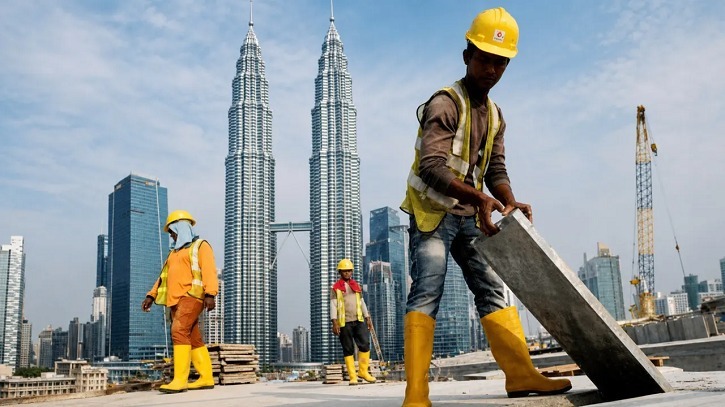
Ahmadul Kobir, Malaysia: Malaysia is considering a further increase in the minimum wage for low-paid workers, with discussions now entering the final stage ahead of the tabling of Budget 2027. The government is considering raising the current minimum wage of RM1,700 to RM2,000, while workers’ organisations are demanding a much higher rate.
The current monthly minimum wage in Malaysia is RM1,700, equivalent to around Tk50,000. The government is discussing a possible increase to RM2,000, but no final decision has yet been made on the new rate or when it would take effect.
Economy Minister Akmal Nasrullah Mohd Nasir said the decision on whether to raise the minimum wage to RM2,000 would be announced by Prime Minister Anwar Ibrahim when he tables Budget 2027. However, the government also needs to consider the impact of any wage increase on small businesses and micro, small and medium-sized enterprises (MSMEs).
Speaking to reporters on Monday, Nasir said the government was seeking to strike a balance between protecting workers’ interests and ensuring the survival of employers, particularly small businesses and MSMEs.
Earlier, on September 26, Prime Minister Anwar Ibrahim indicated that a minimum-wage increase was being considered. Speaking at an event for former students of Universiti Teknologi MARA, he said it was not sustainable for companies to make billions of ringgit in profits while workers continued to earn only RM1,700.
He said workers should also benefit from higher wages as productivity and company revenues increase. He added that the government would announce initiatives on the issue in the upcoming budget.
Malaysia introduced its minimum-wage policy in 2013, when the monthly minimum wage was set at RM900. It was subsequently increased to RM1,000 in 2016, RM1,100 in 2019, RM1,200 in 2020, RM1,500 in 2022 and RM1,700 in 2025.
This represents an increase of around 88.9 per cent between 2013 and 2025.
The current RM1,700 minimum wage took effect on February 1, 2025, for specified categories of employers. From August 1, 2025, it was extended nationwide regardless of the number of employees. Domestic workers are excluded from the minimum-wage policy.
Malaysia’s minimum-wage rules also apply to foreign workers. As a result, eligible workers from Bangladesh, Nepal, Indonesia and other countries are entitled to the statutory minimum basic wage.
Under the current rules, foreign workers are also entitled to a minimum basic wage of RM1,700. If the new rate is set at RM2,000, eligible foreign workers would likewise be entitled to the new statutory minimum.
Around 400,000 Nepali workers are employed in Malaysia, and they would directly benefit from any increase in the minimum wage.
Talking to several Bangladeshi and Nepali workers employed in Malaysia, they said rising living costs have made it increasingly difficult to save money.
They said that after covering their daily expenses, particularly the rising cost of food, they are able to send the remaining money home. However, without overtime work, saving money has become increasingly difficult.
While the government is discussing a possible increase in the minimum wage to RM2,000, the Malaysian Trades Union Congress (MTUC) has called for the minimum wage to be raised to RM3,100. That would be more than 82 per cent higher than the current RM1,700.
Some government-linked companies and government-linked investment institutions have already adopted RM3,100 per month as a benchmark for a “living wage”. However, the government has not formally proposed RM3,100 as the new statutory minimum wage.
A direct increase from RM1,700 to RM3,100 would significantly raise labour costs for businesses. Business groups have expressed concerns that smaller companies operating on thin margins could face additional financial pressure. They have also warned that higher labour costs could affect product prices and hiring.
Economy Minister Akmal Nasir has said sustainable long-term wage growth will require improvements in workers’ productivity, skills and the use of technology. He has stressed that wage increases should be accompanied by productivity gains.
Malaysian law requires the minimum wage to be reviewed at least once every two years. During the review process, the National Wages Consultative Council is required to assess the impact of the minimum wage on social and economic development.
The government’s pre-Budget 2027 statement also places emphasis on its “Decent Wage Agenda”. It notes that the national minimum wage currently stands at RM1,700, while government-linked investment companies and government-linked companies have adopted RM3,100 per month as a living-wage benchmark.
The 13th Malaysia Plan also aims to move the economy towards higher income and productivity by 2030.
Meanwhile, there has been another change in the employment costs of foreign workers. Since October 2025, both employers and foreign workers have been required to contribute 2 per cent each of wages to Malaysia’s Employees Provident Fund (EPF).