


 Play store

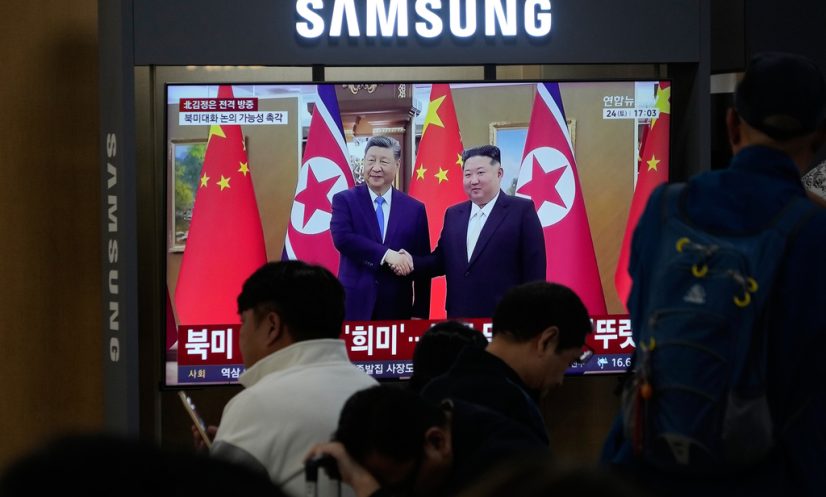
North Korean leader Kim Jong Un is in China for his first visit to the country in a year, South Korea’s government said on Saturday, as Pyongyang seeks to strengthen ties with Beijing amid growing geopolitical tensions with the United States.
Kim appears to have arrived in the Chinese border city of Dandong on Saturday after crossing a newly opened bridge linking the two countries, according to South Korea’s Unification Ministry, which handles inter-Korean affairs.
The ministry did not immediately provide further details. North Korean state media had yet to report on the visit, while China’s Foreign Ministry press office did not respond to a request for confirmation.
Kim’s visit marks another step in his increasingly assertive foreign policy as he seeks to align North Korea more closely with China and Russia in what Pyongyang portrays as a united front against the United States under a “new Cold War” framework.
The visit comes amid efforts by North Korea to reinforce relations with China, its traditional main ally and economic lifeline, after Pyongyang spent recent years prioritising ties with Moscow.
Experts say the opening of the New Yalu River Bridge this month carries particular significance for bilateral relations. The bridge is expected to accommodate round-the-clock two-way traffic, including container shipments and heavy cargo trucks, potentially expanding trade between the neighbouring countries.
Citing anonymous diplomatic sources, Japan’s Kyodo News agency reported earlier on Saturday that Chinese authorities had imposed strict traffic restrictions in parts of Dandong, with all hotel rooms in the affected areas unavailable for reservation.
Kim’s latest visit is his sixth to China since he took power in late 2011 following the death of his father, Kim Jong Il.
The trip also appears timed to highlight the strength of North Korea’s relationship with Beijing ahead of the October 25 anniversary of China’s first major victory in the Korean War, which came days after Chinese troops crossed the Yalu River into North Korea in October 1950.
The Korean War began in June 1950 when North Korea launched a surprise attack on South Korea, prompting a US-led United Nations coalition to intervene and push back the northern offensive.
China subsequently deployed forces to support North Korea, while the Soviet Union provided assistance, including air support. Fighting ended with an armistice in 1953, but no peace treaty was signed, leaving the Korean Peninsula technically at war.
North Korea’s official Korean Central News Agency reported on Friday that a delegation from China’s Ministry of Veterans Affairs had arrived in Pyongyang the previous day. It did not say whether the delegation’s visit was connected to preparations for the war anniversary.
Chinese President Xi Jinping visited Pyongyang in June for a meeting with Kim. During their summit, Xi expressed Beijing’s willingness to expand cooperation in trade, agriculture, construction and technology, while Kim described relations with China as a top strategic priority.
Kim last visited Beijing in September 2025, when he met Xi and attended a military parade alongside Russian President Vladimir Putin and other foreign leaders.
Meanwhile, North Korea has continued to maintain a hard line towards South Korea and has so far rejected a proposal by US President Donald Trump to revive diplomatic engagement.
Talks between Trump and Kim collapsed in 2019 during the US president’s first term, largely over disagreements about sanctions relief and the scope of North Korea’s denuclearisation.
Pyongyang has since demanded that Washington abandon what it calls its “hostile policy” and drop denuclearisation demands as a precondition for renewed negotiations.
South Korea’s National Intelligence Service told lawmakers last month that it saw a 50 per cent possibility of a meeting between Trump and Kim on the sidelines of next month’s Asia-Pacific Economic Cooperation (APEC) summit in Shenzhen, China.
Any such meeting would represent a potential opening for renewed diplomacy, although North Korea’s continued insistence on changes to Washington’s policy remains a major obstacle.
Kim’s latest visit to China is therefore expected to draw close international attention as Beijing and Pyongyang seek to strengthen their strategic relationship amid shifting regional alliances and persistent tensions over North Korea’s nuclear programme.