


 Play store

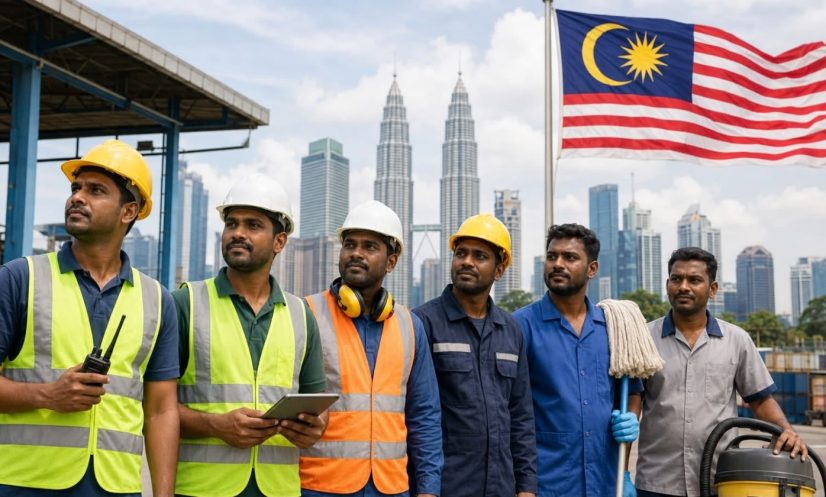
Ahmadul Kobir, Malaysia: Recruitment of Bangladeshi workers for Malaysia is gaining momentum as the Bangladesh High Commission in Kuala Lumpur accelerates the verification and attestation of employers’ demand letters and powers of attorney, key steps in the overseas recruitment process.
The High Commission has so far received 254 applications for more than 8,600 workers. Of these, 130 applications covering 4,570 workers have already been attested, while applications from two companies seeking to recruit 40 workers were rejected for failing to meet the required standards.
Malaysian employers have been submitting applications through the High Commission’s e-Embassy system since September 22. In addition to online applications, employers must submit hard copies of the required documents to the High Commission in accordance with a prescribed checklist. The documents must also be attested by Malaysia’s Ministry of Foreign Affairs.
After receiving an application and obtaining the High Commissioner’s approval, officials from the Labour Welfare Wing conduct on-site inspections of the companies concerned.
The inspections examine employers’ financial and infrastructural capacity, workplace conditions, workers’ accommodation facilities and previous records. If the requirements are met, the demand letter and power of attorney are attested online with the approval of the High Commissioner.
Once the attestation is completed, the information is forwarded to the Secretary of Bangladesh’s Ministry of Expatriates’ Welfare and Overseas Employment, the Director General of the Bureau of Manpower, Employment and Training (BMET), the concerned Bangladeshi recruiting agency and the Malaysian employer.
The High Commission has made it clear that applications will not be approved unless employers meet the required standards.
At least two companies have had their applications rejected after inspections found that their workplaces and workers’ accommodation facilities did not meet the prescribed requirements.
Officials said the companies could apply again after improving their workplace conditions, worker management systems and accommodation facilities.
According to data provided by the High Commission, 161 companies have submitted the required hard-copy documents for recruiting 6,475 workers.
Of these applications, 132 have been processed, while 28 others are undergoing review and on-site verification. Inspections are continuing, with officials saying decisions will be made promptly after the verification process is completed.
As new applications continue to arrive, the overall attestation process remains ongoing.
At a meeting with representatives of recruiting agencies on November 5, Bangladesh’s Expatriates’ Welfare Minister said the government would consider sending temporary staff from Bangladesh, if necessary, to help speed up the attestation process.
The assurance has brought some relief to recruiting agencies concerned about possible delays.
An owner of one of the 25 principal Bangladeshi recruiting agencies listed under the Foreign Worker Centralised Management System (FWCMS), speaking on condition of anonymity, said the agencies wanted to ensure that workers recruited through them found legitimate jobs and could live safely in Malaysia.
“We do not want to see workers stranded without jobs, returning home penniless or becoming undocumented and ending up in detention centres,” he said.
He recalled that during previous recruitment cycles, many Bangladeshi workers arrived in Malaysia only to find themselves without jobs, forcing some to live in extremely difficult conditions. Others eventually became undocumented and ended up in detention centres.
According to him, such incidents damaged the reputation of Bangladeshi recruiting agencies and also affected Malaysian companies.
“If employers suffer losses, it will become increasingly difficult for them to recruit new workers in the future. Therefore, we seek the full cooperation of the ministry and the High Commission to protect workers’ interests. Approvals should only be granted after proper verification,” he said.
At the same time, he urged the High Commission to avoid unnecessary delays.
“We want the High Commission to conduct on-site inspections promptly rather than leaving applications pending for long periods. Once all requirements are fulfilled, the applications should be attested without delay. We are prepared to follow the ministry’s instructions and guidelines in full,” he added.
The current system has revived the High Commission’s direct role in assessing the capacity of Malaysian employers before approving recruitment.
During the 2017-18 recruitment cycle, the Bangladesh High Commission conducted on-site inspections of employers before attesting demand letters. Those familiar with the process said the system produced comparatively better employment outcomes for Bangladeshi workers.
However, during the 2022-24 recruitment cycle, Malaysian authorities assessed employers’ capabilities, limiting the Bangladesh High Commission’s direct role in inspecting workplaces and accommodation facilities.
This time, the High Commission has again taken responsibility for physically inspecting each employer before granting attestation.
The move is expected to strengthen protection for Bangladeshi workers and reduce the risk of workers arriving in Malaysia without proper jobs or adequate accommodation.
However, concerns remain over whether the verification process can be completed within a reasonable timeframe as the number of applications continues to grow.
Stakeholders say restoring Bangladesh’s reputation in Malaysia’s labour market and ensuring safe migration will require both rigorous screening and prompt service delivery.
They believe a transparent and well-organised recruitment system, backed by proper assessment of employers, accountability among recruiting agencies and integrity among officials, could help prevent the irregularities and hardships experienced by Bangladeshi workers in previous recruitment cycles.