Play store

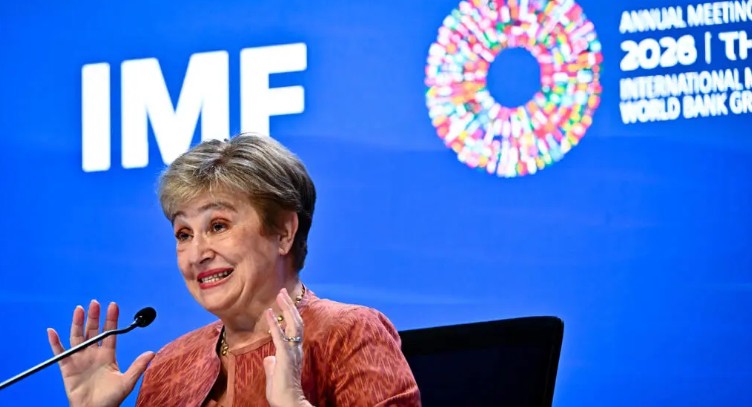
Bangkok: International Monetary Fund (IMF) Managing Director Kristalina Georgieva has said this year’s Annual Meetings in Bangkok were marked by both optimism and concern over the global economic outlook, citing the resilience of the world economy alongside rising inflation, mounting debt, geopolitical conflicts and climate risks.
Speaking at a press briefing on Saturday alongside Saudi Finance Minister Mohammed al-Jadaan, Georgieva also stressed the IMF’s responsibility to support low-income countries struggling with price shocks triggered by the US-Israel war on Iran.
The meetings in the Thai capital brought together finance ministers, central bank governors and other senior officials from around the world. Surging inflation, rising bond yields and economic growth driven by artificial intelligence (AI) were among the key issues discussed.
“The meetings were marked by both optimism and worry,” Georgieva said, pointing to the resilience of the global economy, the promise of AI and Asia’s economic dynamism as reasons for optimism.
However, she said AI was also a source of concern, alongside inflation, high debt levels, wars and climate risks.
Throughout the week, the IMF warned that high debt levels and rising bond yields in advanced economies were tightening financial conditions at a time when central banks were under pressure to bring inflation under control, potentially through higher interest rates.
Global energy prices have surged since late February, when the United States and Israel launched the war on Iran. Tehran’s retaliatory actions targeting Washington’s Gulf allies have disrupted oil and gas supplies, pushing up prices and fuelling inflation across economies at different income levels.
According to the IMF, low-income oil-importing countries are particularly vulnerable to the shock, as they lack the benefits of the AI investment boom that has supported growth in many advanced economies.
“People everywhere, but especially in poorer countries, they don’t like inflation. Inflation is like a tax on the poor,” Georgieva said.
She urged vulnerable countries to set spending priorities that support economic growth and protect the poorest sections of their populations.
The IMF chief said the Fund was relentlessly seeking additional resources for low-income countries, but acknowledged that higher global interest rates and bond yields were increasing their debt-servicing costs.
The share of government revenue spent on debt repayments in low-income countries has risen from 8 per cent to 14 per cent in recent years, she said.
Georgieva said the IMF had a responsibility to help countries restructure their debt when necessary, strengthen domestic revenue mobilisation, attract international financing and create conditions conducive to private investment.
“When we do our best, it translates into better lives for people,” she said.
Turning to AI investment, Georgieva said member countries recognised the technology’s role in supporting economic growth but cautioned against relying too heavily on a single source of expansion.
“When we are dependent on one particular driver of growth, it is like we stand on one leg,” she said.
Another major issue at this year’s meetings was whether advanced AI models require stronger regulation and safeguards. The debate has gained urgency following recent revelations of security incidents involving autonomous AI agents.
Georgieva said she was impressed by the spirit of cooperation among AI companies, governments and other stakeholders she observed in Bangkok as they addressed the issue.