Play store


The ultimate test of leadership lies in whether a ruler is willing to sacrifice political allies to safeguard the nation. The recent decision by Prime Minister Tarique Rahman to force the immediate resignation of BNP reserved-seat female lawmaker Ferdousi Ahmed Mishti sends precisely this message. This welcome flash of accountability serves as a rare example in a political landscape long dimmed by impunity.
Ordered to step down following her alleged involvement in the attempted grabbing, demolition, and looting of a reputed private medical facility in Dhaka, Mishti’s swift removal has drawn widespread public acclaim. Although this decisive action has temporarily boosted the Prime Minister’s approval ratings—which have otherwise suffered under the weight of unfulfilled promises—it also lays bare a deeper, more uncomfortable truth: a singular, piecemeal approach will not cure a systemic disease. If the Prime Minister truly intends to build a prosperous new Bangladesh, he must prove that the rule of law applies to everyone, demonstrating unequivocally that the nation stands far above the partisan interests of the Bangladesh Nationalist Party (BNP).
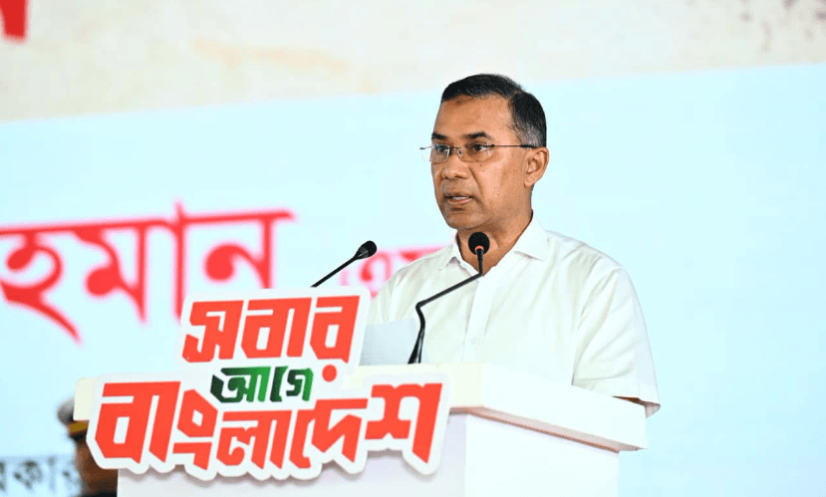
When Prime Minister Rahman assumed office under the twin banners of “I have a plan” and “Bangladesh First,” expectations were monumental. Following the transformative general elections on February 12, 2026, the electorate handed his administration an overwhelming mandate, desperate for structural reform and a departure from the historical cycles of political exploitation. However, the initial euphoria of that mandate has rapidly collided with a grim ground reality. In the months following the election, the much-vaunted plan has struggled to contain a surge in unbridled corruption, systemic financial bribery, illegal land grabbing, vandalism, and devastating extrajudicial crimes. Alarmingly, much of this lawlessness has been perpetrated by men operating under the banner of the ruling party itself, leading many to fear that a mere changing of the guard has nothing to do with the vicious cycle of corruption and evil governance.
This ambient frustration was recently given voice at the highest level of state. Immediately before assuming the presidency, the former Secretary General of the BNP, Mirza Fakhrul Islam Alamgir, delivered a hard-hitting, remarkably candid critique of the persistent bribery plaguing the country, flatly observing that “nothing has changed.” For a figure of such political magnitude to express such profound frustration on a public stage underscores the depth of the crisis. It was a rare, clear-eyed acknowledgment from within the ruling apparatus that the virus of corruption remains deeply embedded. It is no coincidence that the Prime Minister’s forceful action against Lawmaker Mishti came in the immediate wake of the President’s sobering assessment. The administration faced an acute crisis of credibility, and the forced resignation was the necessary price to arrest a freefall in public confidence.
Reflecting the sentiments of civil society, Dr. Iftekharuzzaman, the Executive Director of Transparency International Bangladesh (TIB), hailed the Prime Minister’s intervention as both “timely” and the “most appropriate response” to an immense embarrassment. However, the TIB chief added a crucial, prophetic caveat: this resignation cannot be treated as an isolated, ad-hoc public relations exercise. If it remains a singular event designed merely to quieten public outrage, it will be remembered as nothing more than political theatre. Instead, this moment must serve as the catalyst for a comprehensive, self-purifying process that extends across the ruling party and ripples through all political factions in Bangladesh.
The historical context of this struggle reveals why the public remains fiercely skeptical. Since its very inception in 1971, Bangladesh has seen its socio-economic potential repeatedly torpedoed by institutionalized corruption. It is a tragedy that has eroded the lives and livelihoods of millions, siphoning away resources meant for healthcare, education, and infrastructure. Every successive administration over the last five decades has launched high-profile anti-corruption campaigns, and every single one has ultimately failed. The reason for this historical failure is simple: the virus has always lived inside the antidote. Anti-corruption agencies and judicial mechanisms have routinely been weaponized to target political opponents, while the financial crimes, extortions, and violent excesses of ruling party loyalists were quietly swept under the rug. Past BNP governments were categorically no exception to this rule, frequently allowing partisan shielding to undermine the integrity of the state.
If Prime Minister Tarique Rahman truly means business—if he genuinely desires to break this vicious cycle and carve out a lasting, historic legacy—he must wage a genuine, blind war on corruption. A real war cannot be selective. It cannot look at party affiliations, family lineages, or political contributions. Land grabbing, extortion, and the terrorizing of private businesses do not become more acceptable simply because the perpetrators carry the ruling party’s identity cards. When party men believe they are insulated from the law, the state itself becomes an accomplice to their crimes. By holding Lawmaker Mishti accountable, the Prime Minister has set a vital precedent; he has effectively signalled that party loyalty is no longer an absolute shield against criminal misconduct. The challenge now is to transform this single precedent into an institutional norm.
To move beyond piecemeal governance, the administration must urgently empower independent institutional watchdogs. The Anti-Corruption Commission (ACC), the judiciary, and law enforcement agencies must be given the total operational autonomy required to investigate and prosecute financial and social crimes without needing explicit clearance from the executive branch. True reform is not achieved when a Prime Minister has to personally intervene to remove a corrupt official; true reform is achieved when institutional systems catch and punish that official automatically, regardless of their status.
The overwhelming mandate of February 12, 2026, was not a blank check for partisan dominance. It was a profound, collective demand from the people of Bangladesh for an equitable society governed by the rule of law. The citizens did not vote to replace one system of oligarchic entitlement with another. They voted for a “prosperous new Bangladesh” where merit triumphs over political patronage and where public safety is absolute.
Prime Minister Rahman stands at a critical historical crossroads. He can choose the well-trodden path of his predecessors, protecting his rank-and-file to maintain party cohesion while allowing the country’s moral and economic fabric to erode. Or, he can choose the courageous path of a true statesman. By aggressively pursuing corrupt actors within his own ranks, he will undoubtedly face internal friction, but he will earn the permanent trust and protection of the Bangladeshi people. The dismissal of Ferdousi Ahmed Mishti must not be the end of a brief political cleanup; it must be the opening salvo of a relentless, systemic purge. The mandate has been given, the warning from the presidency has been sounded, and the public is watching. It is time for the Prime Minister to definitively prove to the world that Bangladesh is, and always will be, far bigger than the BNP.