


 Play store

Armed conflicts are destroying forests, disrupting wildlife habitats and threatening livelihoods, while funding for ecosystem recovery remains largely absent from global biodiversity negotiations, experts say.
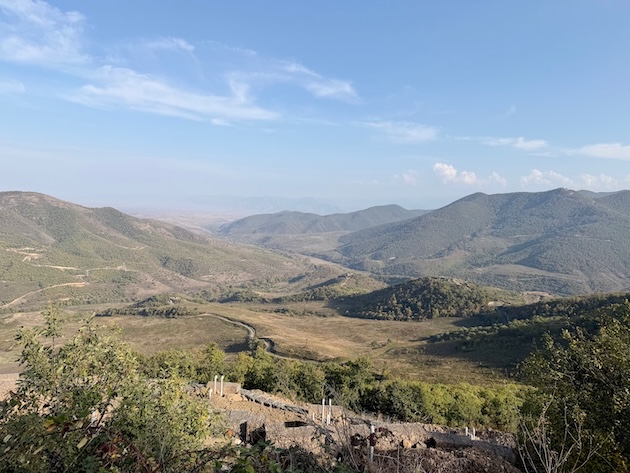
The environmental consequences are visible in Armenia’s Shikahogh State Reserve, a biodiversity hotspot near the Azerbaijan border, where forest loss, military infrastructure and restricted access are raising concerns about the future of wildlife and local communities.
During a visit to the reserve on October 22, large patches of hillside appeared stripped of vegetation, interrupting forest cover in an area rich in biodiversity. Military positions on both sides of the border underscored the growing pressure on the landscape.
Located in Armenia’s Syunik Province, the reserve was established in 1958 and covers almost 30,000 acres, about 94 per cent of which is forested. It is home to rare species, including the Caucasian leopard, Bezoar ibex, brown bear and Armenian viper. The reserve also contains around 1,100 plant species, 70 of which are listed in the IUCN Red Data Book.
Local officials say environmental changes have become more visible since fighting in 2022 affected parts of southern Armenia.
Marat Harutyunyan, deputy mayor of Kapan, the municipality closest to the reserve and the Azerbaijan border, alleged that Azerbaijani forces had cleared sections of forest for military positions and access roads. The extent of the alleged clearance has not been independently verified.
Signs of tree cutting and earthworks were also visible on the Armenian side near military installations, although officials declined to discuss their purpose or scale.
Amin Mammadov, co-founder of the Environmental Protection First Coalition and chairman of the Public Council under Azerbaijan’s Ministry of Ecology and Natural Resources, accused Armenia of selectively highlighting environmental problems.
He argued that Armenia had largely overlooked pollution of transboundary rivers linked to mining activities within its territory. The coalition has called for measurable action to protect shared rivers, improve mining management, strengthen environmental monitoring and ensure public access to environmental information.
Another coalition member, Mugabil Bayramov, chairman of the Azerbaijani Cartographers Public Union, said the group had prepared a geographic information system-based digital map in 2024 identifying mineral deposits, mining enterprises and rivers allegedly affected by industrial pollutants.
The competing allegations illustrate how environmental concerns have become entangled with political tensions in the South Caucasus. Restricted access, security concerns and the absence of comprehensive cross-border monitoring have made independent verification difficult.
Beyond forest loss, the conflict is changing how people use the land.
Harutyunyan said Azerbaijani forces occupied several heights overlooking parts of the reserve and nearby communities, leaving residents afraid to visit certain areas because of the risk of landmines.
Vladik Agatelyan, a 60-year-old farmer, said a mine explosion killed two of his cows, forcing him to reconsider raising livestock.
“The risks are too many, so I have stopped raising cattle,” he said.
Some neighbours continue to keep livestock but no longer graze animals near the forest. As farming income declines, families are turning to other sources of earnings. Agatelyan said his wife had taken a teaching job at a village school, earning about $100 a month.
Manvel Arzumanyan, a retired veterinarian in his seventies, recalled a time when bears, wild goats and other animals moved freely through the surrounding forests and mountains. The area once served as an important ecological corridor linking habitats across Armenia, Azerbaijan and Iran, he said.
Wildlife sightings have become less frequent, according to Arzumanyan.
Harut Marzynyan, a zoologist responsible for wildlife monitoring at Shikahogh State Reserve, said the conflict had made fieldwork increasingly difficult, limiting researchers’ ability to monitor animal movements and conduct regular surveys.
Roads, military infrastructure and fragmented landscapes can disrupt wildlife corridors and isolate animal populations, he said. Security restrictions have prevented the reserve from carrying out comprehensive studies to determine the extent of the damage.
Similar concerns have emerged in other conflict zones.
George Mitri, professor of environmental sciences at the University of Balamand in Lebanon, said the environmental impact of the Israel-Hezbollah conflict extended well beyond areas directly affected by fighting. More than 11,000 hectares had been affected by conflict-related fires, while thousands more hectares had suffered damage from explosions, military activity and vegetation loss.
“The ecological impact of war on biodiversity is much broader than the area directly affected by bombing,” Mitri told Inter Press Service.
Jen Maman, senior policy and campaign strategist at Greenpeace, said at least 65,000 olive trees had been burned during recent hostilities in southern Lebanon, citing Greenpeace assessments and partner research.
She said the damage extended to agricultural land, water resources and soil quality. The use of white phosphorus had also raised concerns because it can ignite vegetation and potentially leave pollutants in soil and water.
Maman cited investigations that found elevated concentrations of phosphorus and heavy metals in some affected areas of Lebanon, raising concerns about long-term environmental damage.
The consequences extend beyond wildlife and forests to agriculture, fisheries, livestock production and food security, potentially turning ecological destruction into a wider economic and humanitarian crisis.
Mitri said recovery efforts should begin with systematic documentation using satellite imagery, photographs, field surveys and scientific assessments. Such evidence would help establish the scale of destruction and support future accountability and restoration.
He said restoration plans should involve ecologists, biodiversity experts, hydrologists, soil scientists and toxicologists to assess habitat loss, contamination and ecosystem disruption.
Local communities should also be included in recovery efforts, as displaced residents often possess detailed knowledge of environmental changes that may not be captured by scientific data.
“The community has to be re-established where they were,” Mitri said, arguing that environmental recovery and community recovery were inseparable.
However, restoring ecosystems damaged by war can be expensive, requiring mine clearance, soil remediation, reforestation, habitat restoration, biodiversity monitoring and assistance for affected communities.
Mitri said environmental assessments should be linked to compensation mechanisms, recovery planning and international financial support.
Despite growing evidence of environmental destruction in Lebanon, Gaza, Ukraine and the South Caucasus, dedicated funding for restoring ecosystems damaged by armed conflict remains largely absent from global biodiversity finance discussions.
At the 17th Conference of the Parties to the Convention on Biological Diversity (COP17), governments are debating how to mobilise billions of dollars to implement the Kunming-Montreal Global Biodiversity Framework. Yet the question of how to finance the recovery of ecosystems damaged by war has received little attention amid the conference’s packed agenda.
Astrid Schomaker, executive secretary of the Convention on Biological Diversity, declined to comment directly on the environmental dispute between Armenia and Azerbaijan. However, she warned at the conference’s opening ceremony that biodiversity loss threatened all countries and economies.
“No nation, no economy, no society is immune from the impacts of biodiversity loss,” she told delegates.
She also stressed the importance of implementation, monitoring and risk management, warning that even the best decisions would be meaningless without the capacity to put them into practice.
As COP17 negotiations continue, it remains unclear whether the environmental consequences of armed conflict and the need to restore damaged ecosystems will receive greater attention.
In Shikahogh, the consequences are already visible. Forest cover has been lost in parts of the landscape, access to land has become more restricted, and residents face growing difficulties sustaining their livelihoods.
The experiences of communities in Armenia and Lebanon highlight a broader challenge for global conservation efforts: protecting biodiversity requires addressing not only habitat loss and pollution but also the environmental damage caused by war and ensuring that resources are available to restore ecosystems once fighting ends. Source: IPS News