Play store

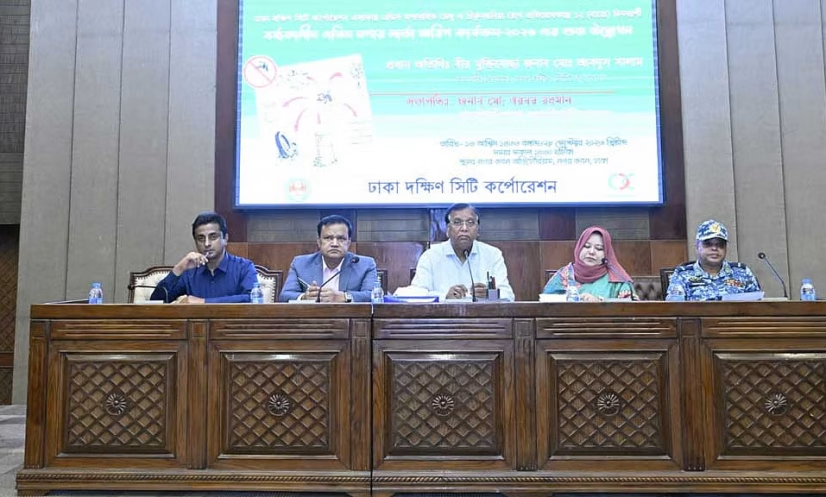
The Dhaka South City Corporation (DSCC) has launched a 12-day survey to identify Aedes mosquito breeding sites and areas at risk of dengue.
DSCC Administrator Abdus Salam inaugurated the survey at Nagar Bhaban on Monday. The survey will continue across all 75 wards until October 8.
According to a DSCC press release, the initiative aims to identify breeding grounds and high-risk areas and support data-driven mosquito-control measures.
Under the survey, 30 households will be randomly selected from each ward, with data collected scientifically from a total of 2,250 households.
The DSCC said the survey would help identify mosquito prevalence and major sources of Aedes larvae across the corporation’s 10 regions.
Speaking at the inauguration, Abdus Salam said scientific identification of breeding sites and high-risk areas was essential to controlling dengue.
“The survey will provide an accurate picture of the current situation, based on which we will take effective measures,” he said.
He urged residents to cooperate, noting that stagnant water in homes and yards had been identified as a major breeding ground for Aedes mosquitoes during a pre-monsoon survey.
He called on residents to keep rooftops, balconies, construction sites and surrounding areas free of stagnant water.
A total of 72 field workers from the DSCC and the Directorate General of Health Services’ Communicable Disease Control unit will collect data. The KoboToolbox application is being used to ensure transparency and accuracy.
After the survey, the data will be analysed to determine the Breteau Index (BI), House Index (HI), Container Index (CI) and Pupa Index (PI).
The DSCC said areas with a BI of 20 or above would be classified as high-risk, those with a BI of 10–19 as moderate-risk, and those below 10 as low-risk.
Based on the findings, the DSCC plans to intensify mosquito-control activities in identified hotspots, including cleanliness drives, larvicide application and special crash programmes.