


 Play store

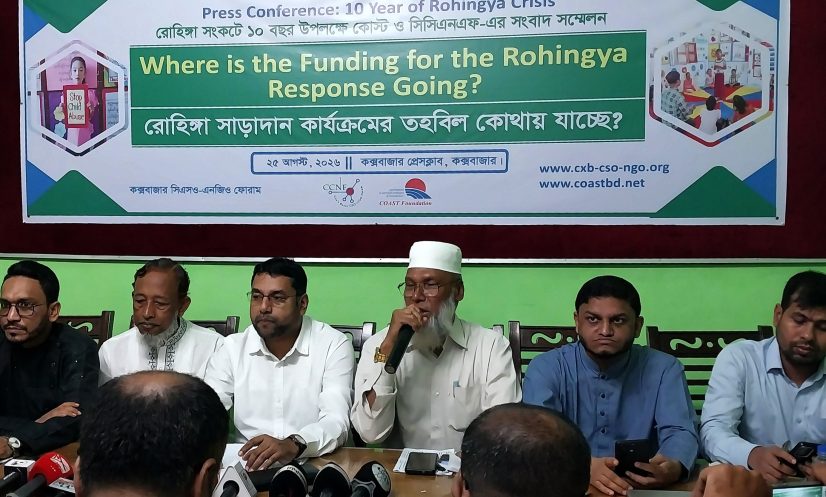
Nearly 88 percent of funding under Bangladesh’s 2026 Joint Response Plan for the Rohingya humanitarian operation is held by UN agencies, while local NGOs receive just 2.5 percent of funding allocated for activities inside the refugee camps, according to research presented at a press conference here on Tuesday.
The findings have renewed calls for a fundamental shift in the way humanitarian assistance is financed and delivered, with local civil society organisations arguing that those closest to the crisis should have a greater role in deciding how aid is used and implementing programmes.
The research was presented at a press conference titled “Where Is the Funding for the Rohingya Response Going?”, organised by the Cox’s Bazar CSO-NGO Forum (CCNF) and COAST Foundation at the Cox’s Bazar Press Club.
Md Shahinur Islam of COAST Foundation said the 2026 Joint Response Plan seeks US$710.5 million to provide assistance to around 1.56 million people, including Rohingya refugees and members of the host communities.
According to the research, 87.96 percent of the funding is held by UN agencies, while international NGOs account for 7.78 percent and national NGOs for 4.26 percent.
Local NGOs have no funding allocation as appealing partners under the JRP, the presentation said.
The disparity becomes even more pronounced when funding specifically allocated to the Rohingya camps is considered. International NGOs receive 63.6 percent of such funding, national NGOs 33.9 percent and local NGOs only 2.5 percent.
The figures have intensified a long-running debate over localisation of humanitarian assistance in Bangladesh, where local organisations have argued that they possess stronger knowledge of the camps, host communities and local operating environment but remain largely dependent on international agencies for access to humanitarian resources.
The research also examined a US$150 million funding allocation from the United States, one of the largest individual contributors to the Rohingya response.
Of that amount, 92 percent went to UN agencies and the remaining 8 percent to international NGOs, according to the presentation.
Speakers questioned whether the existing funding architecture delivers sufficient value to refugees and host communities when substantial portions of humanitarian resources are channelled through multiple layers of international organisations.
They also raised concerns about operational and administrative costs associated with international humanitarian operations.
The issue is particularly sensitive as Bangladesh enters the 10th year of the Rohingya crisis. More than one million Rohingya refugees are now living in densely populated settlements in Cox’s Bazar, while the humanitarian operation remains heavily dependent on international donor support.
The crisis began after a massive influx of Rohingya from Myanmar in 2017 following a military crackdown in Rakhine State. Bangladesh has since hosted the refugees on the understanding that their stay would be temporary and that they would eventually return to Myanmar in safety and dignity.
But years of diplomatic efforts have failed to produce large-scale repatriation.
Anjuman Ara Begum of Rokeya Foundation called for meaningful participation of local NGOs in humanitarian programmes and demanded that at least 25 percent of humanitarian funding be provided directly to local organisations.
She argued that local groups should not remain limited to implementing projects designed and financed by larger international agencies.
Helal Uddin, executive director of local NGO Agrajatra, said local organisations currently have either no access or only very limited access to funding under the JRP and the Pooled Fund mechanism.
He demanded that local organisations be recognised as appealing partners under the JRP so they can directly compete for and access humanitarian funding.
The demand reflects a broader international push for the localisation of aid, under which humanitarian financing is increasingly expected to reach national and community-based organisations directly rather than being concentrated among international agencies.
The principle was reinforced globally through the 2016 World Humanitarian Summit and the Grand Bargain, which called for greater funding and decision-making power for local and national humanitarian actors.
However, humanitarian financing in major refugee crises remains dominated by UN agencies and international organisations because donors often prefer established systems for financial management, monitoring and accountability.
Local organisations argue that such arrangements can unintentionally keep decision-making and resources away from communities most directly affected by the crisis.
Nurul Islam Helali, president of the Journalist Association Cox’s Bazar, said providing funding to local NGOs should not be viewed as charity but as a matter of recognising the role and rights of local organisations.
The discussion also highlighted the growing pressure on communities living around the refugee settlements.
Nurul Kabir, a member of Rajapalong Union Parishad, said many local residents living in areas surrounding the camps receive little or no assistance, even as humanitarian programmes provide various forms of support to Rohingya refugees.
The concern reflects a longstanding challenge for the international response. While humanitarian assistance is essential for refugees who have lost access to livelihoods and basic services in Myanmar, host communities in Ukhiya and Teknaf have also faced increased pressure on land, natural resources, roads, public services and employment.
The influx has transformed the local economy and environment, while the presence of large refugee settlements has increased demand for water, fuel and other natural resources.
Robiul Alam, president of the Ukhiya Rights Implementation Committee, called for greater attention to environmental protection, preservation of surface water and restoration of agricultural land.
Helal Uddin said waste generated in the refugee camps was damaging nearby farmland and called for a permanent solution to waste management.
The environmental dimension of the crisis has become increasingly important as the camps have expanded across a densely populated and ecologically sensitive area.
Deforestation, soil erosion, pressure on groundwater, waste disposal and loss of agricultural land have all emerged as concerns for both refugees and host communities.
Nasir Uddin said the absence of meaningful progress on repatriation was increasing frustration and uncertainty among people in the host communities.
He also pointed to the impact of the prolonged crisis on education in Cox’s Bazar and called for greater long-term investment in education and skills development for local residents.
The prolonged presence of the refugee population has created additional pressure on local schools and public services, while young people in host communities face limited employment opportunities.
Speakers argued that humanitarian assistance should therefore address the needs of both refugees and the communities that have hosted them for nearly a decade.
The issue is becoming more urgent as the humanitarian response faces growing funding shortages.
The 2026 JRP requires hundreds of millions of dollars to maintain food assistance, shelter, healthcare, education, water and sanitation, protection and other essential services. At the same time, donor fatigue and competing global crises have made it increasingly difficult to secure the resources required for a prolonged refugee emergency.
The funding gap has already forced humanitarian agencies to prioritise essential services and reduce or restructure some programmes in previous years.
Despite the focus on aid financing, speakers stressed that humanitarian assistance cannot provide a permanent solution to the Rohingya crisis.
Nasir Uddin said there had been no meaningful progress in repatriation, while CCNF Member Secretary Zahangir Alam said peaceful coexistence would remain difficult without a sustainable resolution to the crisis.
Bangladesh has consistently maintained that the ultimate solution is the safe, voluntary, dignified and sustainable return of the Rohingya to Myanmar.
But conditions in Myanmar’s Rakhine State remain deeply uncertain, particularly amid continuing conflict between the Myanmar military and the Arakan Army.
The security situation has complicated efforts to establish conditions for return, while the Rohingya continue to face restrictions on citizenship, movement and access to basic rights in Myanmar.
Jafor Alam, general secretary of the Ukhiya Imam Somity, called for greater involvement of ASEAN, China and other regional and international organisations in efforts to resolve the crisis.
He said the responsibility for finding a durable solution should not fall on Bangladesh alone.
Momtaz Uddin Bahari, general secretary of the Cox’s Bazar Press Club, also stressed the need for an effective and sustainable solution.
The discussion ultimately returned to the question of who controls the resources intended to address the crisis.
For local organisations, the issue is not simply about receiving a larger share of money. They want a greater role in setting priorities, making decisions and implementing programmes.
The organisers argued that organisations rooted in Cox’s Bazar understand the needs of both refugees and host communities and should therefore be treated as partners rather than subcontractors.
The figures presented at Tuesday’s event highlight the scale of the imbalance: nearly nine out of every ten dollars in the 2026 JRP is held by UN agencies, while local NGOs receive only a small fraction of camp-based funding.
As the Rohingya crisis enters its second decade, the debate over aid localisation is likely to become increasingly important.
The humanitarian response may continue to depend on international financing, but speakers at the event argued that its success should also be measured by whether resources, responsibility and decision-making reach the people and organisations closest to the crisis.
For Bangladesh, which has hosted the Rohingya for nearly a decade, the challenge is now twofold: keeping essential humanitarian assistance flowing while ensuring that the burden on host communities does not continue to grow without adequate support.
And above all, humanitarian financing cannot substitute for the political solution that would allow the refugees to return home safely and with dignity.