Play store

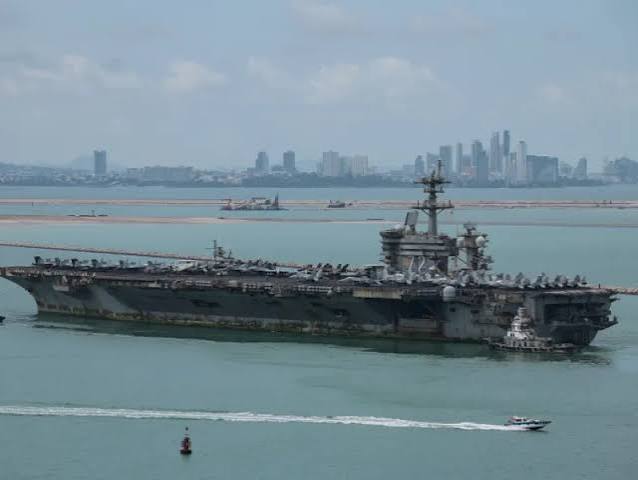
The U.S. aircraft carrier USS Abraham Lincoln has docked at a port in Thailand, where observers were struck by the extensive rust covering much of the ship’s exterior.
The massive warship, which is nearly 1,100 feet long, arrived at Laem Chabang port in the Gulf of Thailand on Wednesday. Photographs showed rust extending across large sections of the vessel, from the bow to the stern.
Experts say the condition is not necessarily unusual for a warship that has spent such a long period at sea. According to U.S. Navy information, the Lincoln left its base in San Diego last November and has spent 286 consecutive days at sea. During that period, the carrier took part in months of military operations and a naval blockade against Iran in the Middle East.
Carl Schuster, a former U.S. Navy captain who served three tours aboard Nimitz-class aircraft carriers such as the Abraham Lincoln, said rust along the waterline is common when a ship remains actively deployed at sea for 60 days or more.
Speaking to CNN, Schuster explained that rust cannot easily be removed while a ship is operating at sea, particularly during wartime. Crew members must access the waterline, remove the corrosion manually, and then apply two coats of anti-corrosion material followed by two coats of the Navy’s specialized gray paint.
Based on the condition visible on the ship, Schuster estimated that completely removing the rust could require at least 30 days of maintenance. However, some critical work could be carried out during the carrier’s stop in Thailand.
The Lincoln is expected to remain at Laem Chabang for several days, giving its crew a chance to rest following the demanding deployment. The carrier is also expected to undergo essential maintenance during its roughly week-long port visit.
Schuster said priority would likely be given to the bow, the curved front section of the ship, because these areas are particularly exposed to seawater and the forces generated as the vessel moves through rough seas.
Some rust on the upper portions of the ship can be treated while the vessel is underway. However, repairs around the waterline require the ship to remain stationary in relatively calm conditions.
Schuster stressed that corrosion cannot simply be ignored. Rust can spread and gradually weaken steel structures from within, making early treatment essential. Critical areas such as decks, walkways and safety rails must be protected before corrosion causes serious structural damage.
The Lincoln’s lengthy deployment has reportedly brought other challenges as well, including concerns over supplies and crew morale. At least one sailor was also reported to have fallen overboard. U.S. President Donald Trump, however, has dismissed concerns about the length of the carrier’s deployment, saying that it was “not that long.”
Trump has not publicly commented on the Lincoln’s condition since its arrival in Thailand. In the past, however, he has repeatedly urged the Navy to keep its warships clean and well maintained. During his second term, U.S. aircraft carriers have been spending longer periods at sea. Former Navy Secretary John Phelan said last year that Trump would sometimes call late at night to discuss rust problems aboard naval vessels.
Schuster added that sailors generally dislike rust-removal work. He said scrubbing rust off a ship is among the two jobs Navy personnel dislike most, with cleaning pipes and sewage systems being the other.
For sailors, it may be an unpleasant chore—but for a ship that spends months at sea, keeping corrosion under control is an essential part of maintaining its fighting capability. Source CNN.