


 Play store

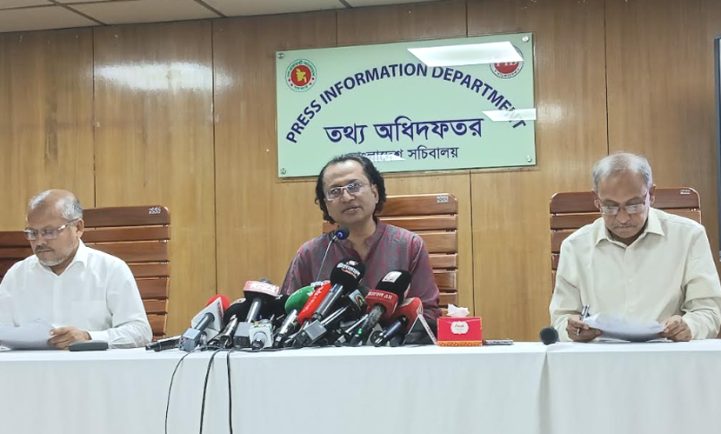
DHAKA: Prime Minister’s Information Adviser Dr Zahedur Rahman has described former prime minister Sheikh Hasina as a “serious criminal”, saying Bangladesh wants her extradited from India.
Speaking to reporters at a press briefing on Tuesday (September 29), Rahman said the extradition issue was a bilateral matter between Bangladesh and India and that discussions between the two countries were continuing. Chief Information Officer Syed Abdal Ahmed was also present.
“We have a convicted serious accused in India. We want her back. This is a bilateral matter, and we are continuing discussions on it,” he said.
Responding to a question about Hasina, Rahman said, “She did not commit murder—what she did is called a crime against humanity. It is a different level of crime. Crimes against humanity can be tried at the international court.”
Saying that Hasina was currently in India, he added, “We want her, and India will have to hand her over.”
The adviser said Bangladesh had continued discussions with India on the matter and had also raised the issue during meetings with the Indian high commissioner to Bangladesh.
“Whenever I meet [Indian officials], I convey Bangladesh’s discomfort to India. I hope they will take action on this matter,” he said.
Creating narratives with misinformation is a crime: On allegations of creating narratives against the government through false information and misinformation, Rahman said there should be full scope for criticism of the government in a democratic system, but such criticism should be based on facts and reasonable grounds.
“I have no objection to making the government controversial. We are a democratically elected government and want to remain democratic. Anyone in the government, even the prime minister, can be criticised if you speak on genuine grounds,” he said.
Criticism of ministers and other government officials is part of democracy, he added, saying fact-based criticism by the media can help the government correct its course.
“Creating a narrative with false information or misinformation is actually a crime,” he said.
Rahman said the prime minister also follows reports published in the media and on social media and gives instructions to relevant officials based on those reports.
He said he had received several phone calls from the prime minister regarding news reports and had been given instructions on different issues. Similar calls, he added, had been made to other officials.
Citing an analysis of misinformation, Rahman said 464 pieces of content were examined during the first month, of which 157 focused on the prime minister.
He said the government did not want to resort to legal action over such content unless necessary. However, if legal measures became necessary, the government would be able to help explain the situation to the public and present evidence showing which claims were false.
PID card cancellation of Channel One journalist
Asked about the cancellation of a PID accreditation card belonging to a Channel One journalist, Rahman said he had previously promised to look into the matter but had not followed up.
“I said I would get the information, but I did not actually follow up later,” he said.
He said he did not believe the journalist’s card had been cancelled for asking a difficult question.
“I don’t think anyone’s card is cancelled because they asked a question, even a tough question. Still, I repeat that I will look into the matter and inform you in the future,” he said.
He added that journalists had the opportunity to ask tough questions of the government.
Government to act on extortion allegations
Asked about allegations of extortion against BNP leaders and activists, the adviser said the government’s responsibility was not merely to create narratives but also to take action over allegations.
“The government’s job is not just to create narratives. What you are talking about is taking action against the allegations,” he said.
He said the government was expected to have information about who was involved in extortion and their links with others, adding that action would be taken if necessary.
No impact on Rooppur from nuclear agreement with US
Asked whether Bangladesh’s peaceful nuclear cooperation agreement with the United States could have any negative impact on the Rooppur Nuclear Power Plant, Rahman said he did not anticipate such an impact.
He said Bangladesh had entered a new era of nuclear power and energy and needed to keep various options open for its future energy security.
“Bangladesh will engage with whoever it needs to, wherever necessary, in its own interests,” he said.
Referring to tensions between the United States and Russia, he said Bangladesh’s foreign minister had nevertheless held talks with his Russian counterpart. Bangladesh would maintain relations and communication with countries including India, Russia and Türkiye as necessary, he added.
Pakistan’s restriction on uranium transport
Journalists also asked whether the United States had played any role in Pakistan preventing an aircraft carrying uranium from Russia for the Rooppur nuclear power plant from using its airspace.
In response, Rahman said Bangladesh would maintain necessary communication and engagement with different countries based on its national interests. He said Bangladesh would continue communicating with relevant countries as necessary in conducting its international relations.