


 Play store

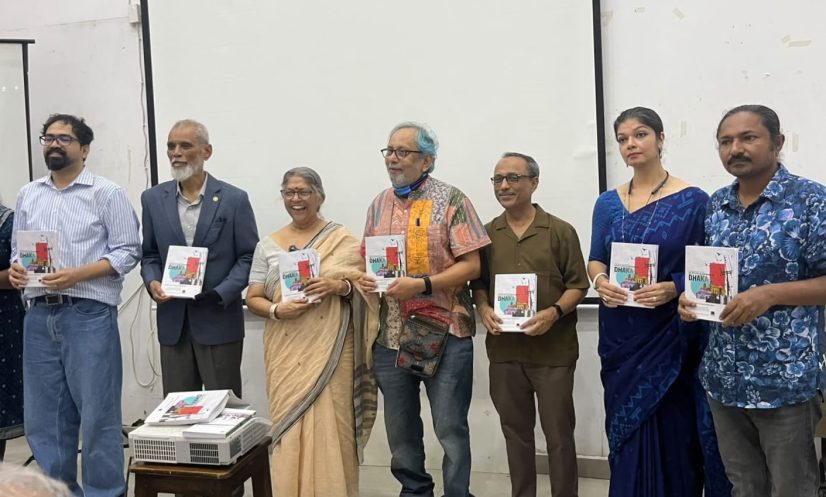
A special publication exploring the complex evolution of Dhaka as a city shaped by history, politics, culture and everyday life was formally launched at the Bangladesh University of Engineering and Technology (BUET), bringing together academics, architects, researchers and urban thinkers.
The publication ceremony for Between Chaos and Cohesion: An Explosive Re-emergence of Dhaka was held on July 6 at Vrooman Hall of the Department of Architecture, BUET. The volume has been released to mark the 20th anniversary of the journal South Asian Cultural Studies.
Edited by Prof Dr Tasleem Shakur and Architect Imamur Hossain, the book has been published by South Asian Cultural Studies in collaboration with Academic Press and Publishers Library.
The volume presents Dhaka as a dynamic and evolving city shaped by political transformation, social change, migration, memory and everyday urban experiences, moving beyond conventional narratives focused solely on planning and infrastructure.
In a note published on the book’s back cover, economist Dr Hossain Zillur Rahman, Executive Chairman of the Power and Participation Research Centre (PPRC), writes that Dhaka cannot be understood only through policy and planning. Instead, he argues, the city should be viewed as a living entity shaped by the memories of its original inhabitants, successive waves of migration and multiple historical layers.
He notes that while discussions on urbanism often revolve around problems and solutions, the book portrays Dhaka as a space of cultural and political contestation, competing claims and continuous transformation.
The publication is the outcome of several years of collaborative research, discussions and editorial work. It originated from an international workshop titled Political Transformations, Changing Heritage and Negotiating Identities: Planning, Designs and the Evolving Cultures of Dhaka, held on January 25, 2025. The workshop was jointly organised by the International Center for Development and Environmental Studies of Sonargaon University and several international research institutions.
The publication ceremony was attended by academics, researchers, architects, writers, students and professionals from diverse fields.
Delivering the keynote remarks as chief guest, Shireen Pervin Huq, Chairperson of the Board of Trustees of Gonoshasthaya Kendra, said Dhaka should be understood not merely through its physical infrastructure or rapid urbanisation, but also through the lives, memories, struggles and participation of its people.
The editors said the book deliberately avoids presenting Dhaka as a city with a single identity. Instead, it examines its multidimensional character through themes such as political transformation, social movements, displacement, informal settlements, housing, religious rituals, food culture, public spaces and everyday urban life.
Several contributors, including Prof Dr Tasleem Shakur, Architect Imamur Hossain and Prof Mohd Aminul Karim, discussed their research and reflected on the changing political and social realities of the capital. Contributions from authors based overseas were also acknowledged during the event.
The publication includes chapters by Nubras Samayeen, Professor Mohammed Mahbubur Rahman, Md Rashed Bhuyan, Parisa Shakur, Sanjida Ahmed Sinthia, Sayeda Jafrina Nancy, Fariba Samia Omi, Fojit Sheikh Babu, Md Iftekhar Rashid, Adil Mohammed, Matluba Khan, Thomas Aneurin Smith, Nova Amin Khan, Daisy Ortega Roman, Tanvir Khan, Suneela Ahmed, Susheel Ghosh and Samiha Nawshin.
The chapters explore issues including Dhaka’s political instability, contested memories, student movements, eviction and rehabilitation, informal urbanisation, public space, Muharram in Geneva Camp, street food, housing transformation, child- and youth-friendly cities, and the built environment of South Asia.
The event was moderated by Dr Nabanita Islam. Speakers observed that Dhaka cannot be defined solely by traffic congestion, population density or infrastructure challenges. They said the city’s resilience also lies in its social relationships, community networks, cultural practices and citizens’ ability to adapt to constant change.
The organisers thanked the Department of Architecture at BUET for hosting the event, particularly its Head, Prof Dr S M Najmul Imam, along with the chief guest, contributors, researchers, students and invited guests.
They said the publication not only marks two decades of South Asian Cultural Studies but also aims to stimulate further research and discussion on the past, present and future of Dhaka.