


 Play store

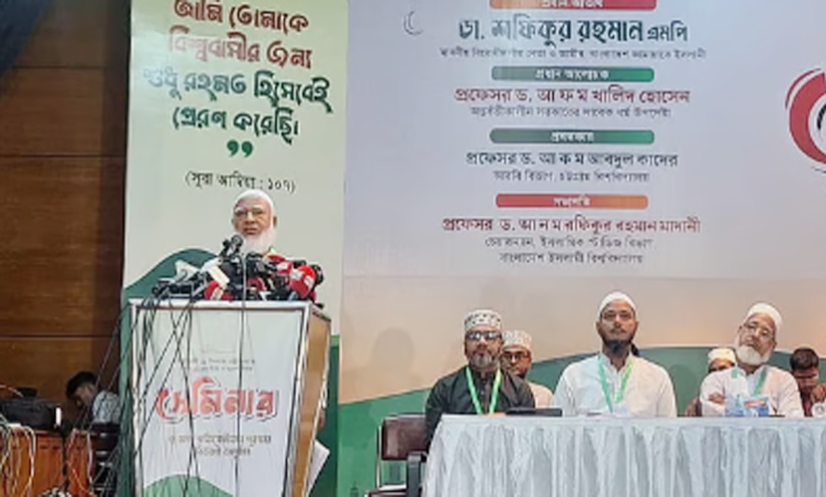
Bangladesh Jamaat-e-Islami Ameer and Leader of the Opposition Shafiqur Rahman has said the Awami League cannot return to power after fleeing the country following what he described as years of wrongdoing.
“History shows that those who flee after committing misdeeds cannot return,” he said.
Shafiqur made the remarks on Sunday at a seminar marking Seerat-un-Nabi at the Muktijoddha Hall of the Institution of Diploma Engineers, Bangladesh (IDEB) in Kakrail, Dhaka.
He accused the previous Awami League government of committing “so many misdeeds” that it could not remain in the country and was forced to flee.
He also alleged that the current government had begun following the same path as the “fascist government” of the previous 15 years.
“This is the path that created Aynaghar, carried out killings without trial and launched attacks on ulema at Shapla Chattar,” he said, urging the government to move away from what he described as the path of fascism.
Referring to the 2024 mass uprising, the Jamaat chief said those who took to the streets had not disappeared or gone to sleep.
“The people who rose up in 2024 have not all died. They have not fallen asleep. They are watching everything with vigilant eyes,” he said.
Shafiqur warned against assuming that the 2024 uprising was the final confrontation.
“Before the main battle, an army is formed, trained and given rehearsals. They should not consider 2024 the final battle. It was a rehearsal for the final battle,” he said.
He said there had been expectations after the 2024 mass uprising that the “debris of fascism” accumulated over decades would be cleared. Instead, he claimed, the debris had increased.
“Fascism does not belong to any particular party. It is a contagious disease. Whoever is infected by this virus becomes fascist,” he said.
The Jamaat leader also criticised what he described as changes to exhibits at the July Mass Uprising Memorial Museum after the elected government came to power.
He urged people to visit the museum, saying its replica of Aynaghar, a secret detention facility, only offered a glimpse of the suffering endured by detainees.
“An inhuman Aynaghar was created in this country. What you will see at the July Memorial Museum is only a dummy version. The reality was much worse,” he said.
According to Shafiqur, several photographs and memorabilia of victims that had been displayed at the museum during the interim government had subsequently been removed.
He alleged that material had been removed to appease a particular country and said such actions were not a positive sign.
He also criticised successive governments for allegedly distorting history.
“Whenever they come to power, everyone says history has been distorted. But the history of Bangladesh so far is that everyone has been responsible for distorting history. No one has been able to come out of this wrongdoing,” he said.
Former adviser to the interim government A F M Khalid Hossain, who addressed the seminar as the keynote speaker, stressed the need for unity.
He warned that a lack of unity could allow adversaries to exploit divisions.
“Ulema are abusing one another. There may be a third force behind this. We have to remain alert,” he said.
Khalid also called for preparations to establish a state system modelled on the principles of Medina.
The seminar, titled “The Prophet’s Principles and Ideals”, was organised by the National Seerat Celebration Committee. A writing competition was also held as part of the programme.
The committee’s member-secretary Abdul Mannan delivered the welcome address, while Professor A K M Abdul Quader of Chittagong University presented the keynote paper. Professor A N M Rafiquar Rahman Madani, convener of the committee, chaired the event.
Jamaat parliamentary whip Rafiqul Islam Khan, Dhaka South city unit Ameer Nurul Islam Bulbul, Secretary Shafiqul Islam Masud, former vice-chancellor of Islamic Arabic University Professor Shamsul Alam, Principal Khalilur Rahman Madani of Tamirul Millat Kamil Madrasa’s Jatrabari branch, and Sherpur-1 MP Rashedul Islam also spoke at the seminar.