Play store

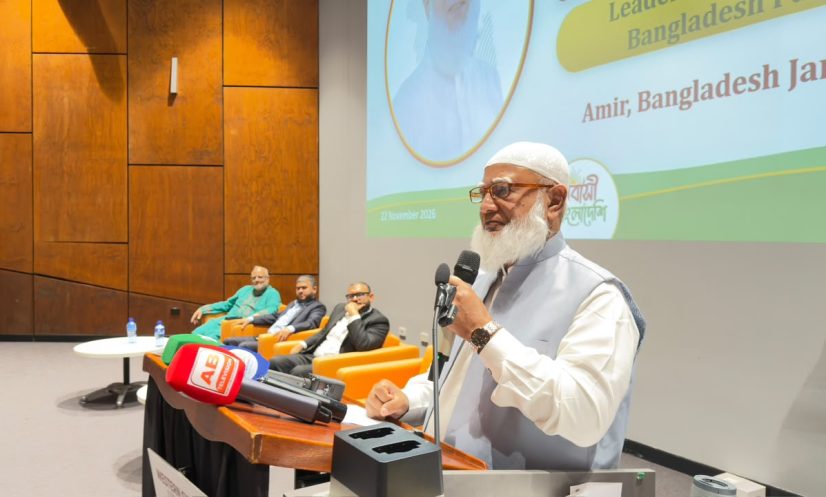
Bangladesh Jamaat-e-Islami Ameer and Leader of the Opposition in Parliament Dr Shafiqur Rahman has stressed the need to utilise the knowledge, expertise, experience and research achievements of expatriate Bangladeshis, rather than relying solely on their financial remittances, to accelerate the country’s development.
He said they wanted to create an environment in which talented Bangladeshis living abroad could return to their homeland and contribute to its progress.
“We want to utilise not only financial remittances but also the intellect, knowledge, experience and research-based achievements of expatriates for the country’s development. We have come to advocate intellectual remittances. If Allah gives us the opportunity, we will treat them not as guests but as our brothers, children and fathers,” he said.
Dr Shafiqur Rahman made the remarks as the chief guest at a programme titled ‘July Uprising and Beyond: Voices from Australia’, organised by expatriate Bangladeshis at Campbelltown in New South Wales, Australia, at 4pm local time on Sunday.
A large number of expatriate Bangladeshis attended the event, where he was accorded a reception with flowers.
Speaking about the contributions of expatriates, the Jamaat chief said their role in the July uprising would never be forgotten.
He said that when the country’s media could not adequately portray the incidents of repression and persecution, Bangladeshis living abroad used social media and various other platforms to bring the reality to the attention of the international community.
Despite restrictions on rallies and public gatherings in different countries, expatriates took to the streets to demand the rights of the people of Bangladesh. Many were arrested, imprisoned and faced punishment for their participation, he said.
“Even now, 54 expatriate Bangladeshis remain in prison, which is deeply painful and shameful for us,” he added.
Calling for dignity and proper treatment of expatriates, the Leader of the Opposition said they were one of the key driving forces of the country’s economy. Yet, many faced mistreatment at airports and other places upon returning home, with some even subjected to physical abuse.
“This is completely unacceptable. Those whom we call remittance warriors must be ensured proper respect and dignity,” he said.
On expatriates’ voting rights, he said they had long been vocal in demanding the right to vote. If expatriate Bangladeshis were denied voting rights in the upcoming local government elections, they would protest against the decision.
Recounting the sacrifices made during the July uprising, Dr Shafiqur Rahman said the fighters of July were still alive, although many had lost their hands, legs or eyesight. Despite their physical disabilities, they had not lost their determination.
He said he had asked injured fighters whether they would be ready to fight again for the country if the nation needed them. In response, some said they had lost one leg but still had the other and would continue fighting for the country even with the support of crutches.
Those who had lost their eyesight also expressed their determination to stand up for the country with the help of others, he added.
He also recalled the courage of a mother who took to the streets carrying her 10-month-old child. She had said she joined the movement considering every child on the streets of Bangladesh as her own.
“These mothers and fighters are our strength. I believe they will rise again whenever the nation needs them,” he said.
Highlighting the core aspirations of the July uprising, the opposition leader said the movement aimed to establish a Bangladesh free from discrimination, founded on humanity and justice.
The slogan of the July movement was ‘We Want Justice’, he said, adding that there was no single mastermind behind the uprising.
Rather, its real heroes were ordinary people, including the mother who joined the streets with her 10-month-old child, Mugdho, who was killed while distributing water, Abu Sayed, who stood unarmed before bullets, and countless students and members of the public who made sacrifices.
“The martyrs do not belong to any particular political party. They are the assets of the entire nation,” he said.
Referring to the post-July political situation, Dr Shafiqur Rahman said the people’s verdict in the referendum must be implemented.
He said they had also raised their voices in Parliament for the implementation of the July Charter and the referendum verdict. Politics in Bangladesh could not continue by disregarding the people’s mandate, he added.
He called for the necessary state reforms to be completed in accordance with public aspirations, asserting that they would not abandon their principles and commitments under any pressure or inducement.
Emphasising the importance of young people’s leadership, he said they wanted to hand over the country’s future to the younger generation.
“Young people will sit in the cockpit of the aircraft named Bangladesh, while we will take the passenger seats and support them,” he said.
Mentioning that 62 per cent of their candidates in the latest election were below the age of 45, he said the Bangladesh of tomorrow would be built under the leadership of young people.
He also called for equal opportunities for women and men to participate in national development, noting that women had played a crucial and courageous role in the July movement.
On the relationship between the government and the opposition, he said they would support the government whenever it took positive steps in the national interest and would protest whenever it made mistakes.
The responsibility of the opposition was to speak up for the rights and interests of the people, he added.
Urging the government to respect the people’s mandate, he said the country should be governed by competent and honest individuals who would remain above corruption.
He also called for effective measures to address terrorism, disorder, corruption and the deteriorating law and order situation.
“No political party or individual is our enemy. If any party or individual commits wrongdoing against the country, that wrongdoing itself is our opponent,” he said.
He expressed his desire to see a united, peaceful and prosperous Bangladesh, adding that the country would change one day and its people would lead that transformation.
Campbelltown City Council member Masud Khalil, representing the expatriate Bangladeshis, also spoke at the programme.
The event was moderated by academic, researcher and political analyst Shibli Sohail, executive director of the South Asian Policy Initiative and Global Voice for Humanity. Professor Dr Abu Yusuf of Western Sydney University and cultural personality Asif Iqbal also shared the responsibility of conducting the programme.
Among others present were MP Dr Mosleh Uddin Farid; Barrister Mir Ahmed Bin Quasem Arman MP, foreign affairs adviser to the Leader of the Opposition; Dr SM Khaliduzzaman, central vice-president of the National Doctors Forum (NDF); and Muhammad Nazrul Islam, assistant private secretary to the Leader of the Opposition.