


 Play store

Dhaka: National Revolutionary Council demands ban on Awami League, threatens indefinite Shahbagh blockade
The National Revolutionary Council staged a protest at Dhaka University on Friday, demanding a ban on the Awami League, which it described as a fascist political party.
After the rally, the organisation staged a symbolic one-hour blockade at Shahbagh intersection in the capital, where protesters set fire to portraits of Indian Prime Minister Narendra Modi and ousted former prime minister Sheikh Hasina, as well as an Indian national flag.
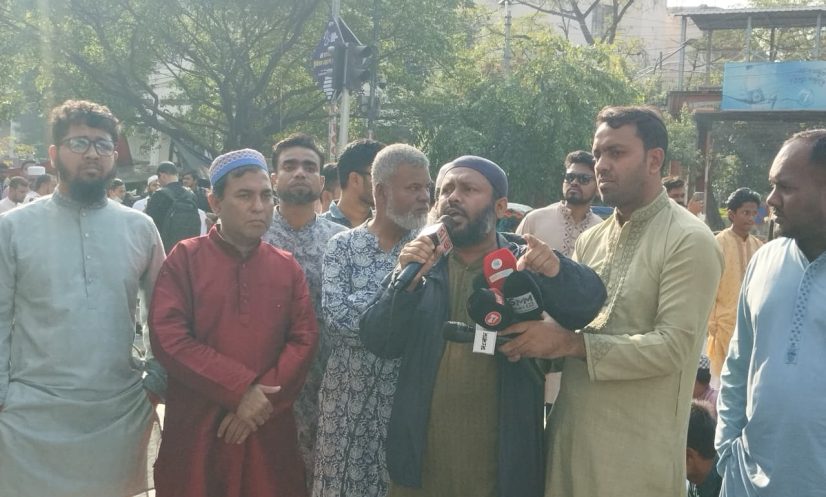
The protest was led by the organisation’s convener, Khomeni Ehsan, who warned that an indefinite blockade of Shahbagh would be launched soon unless the Awami League was permanently banned and what he termed Indian hegemony over Bangladesh was brought to an end.
After Friday prayers, more than 100 leaders and activists of the National Revolutionary Council and its student wing, the Revolutionary Students Council, brought out a procession from the Dhaka University Central Mosque, demanding a ban on the Awami League.
The procession chanted various slogans, including “Nara-e-Takbir, Allahu Akbar”, “Ban the fascist Awami League”, “Execute Hasina immediately”, “Break Modi’s black hand”, “People, resist Indian aggression”, “There is no place for Hasina in Felani’s Bangladesh” and “Delhi or Dhaka? Dhaka, Dhaka”.
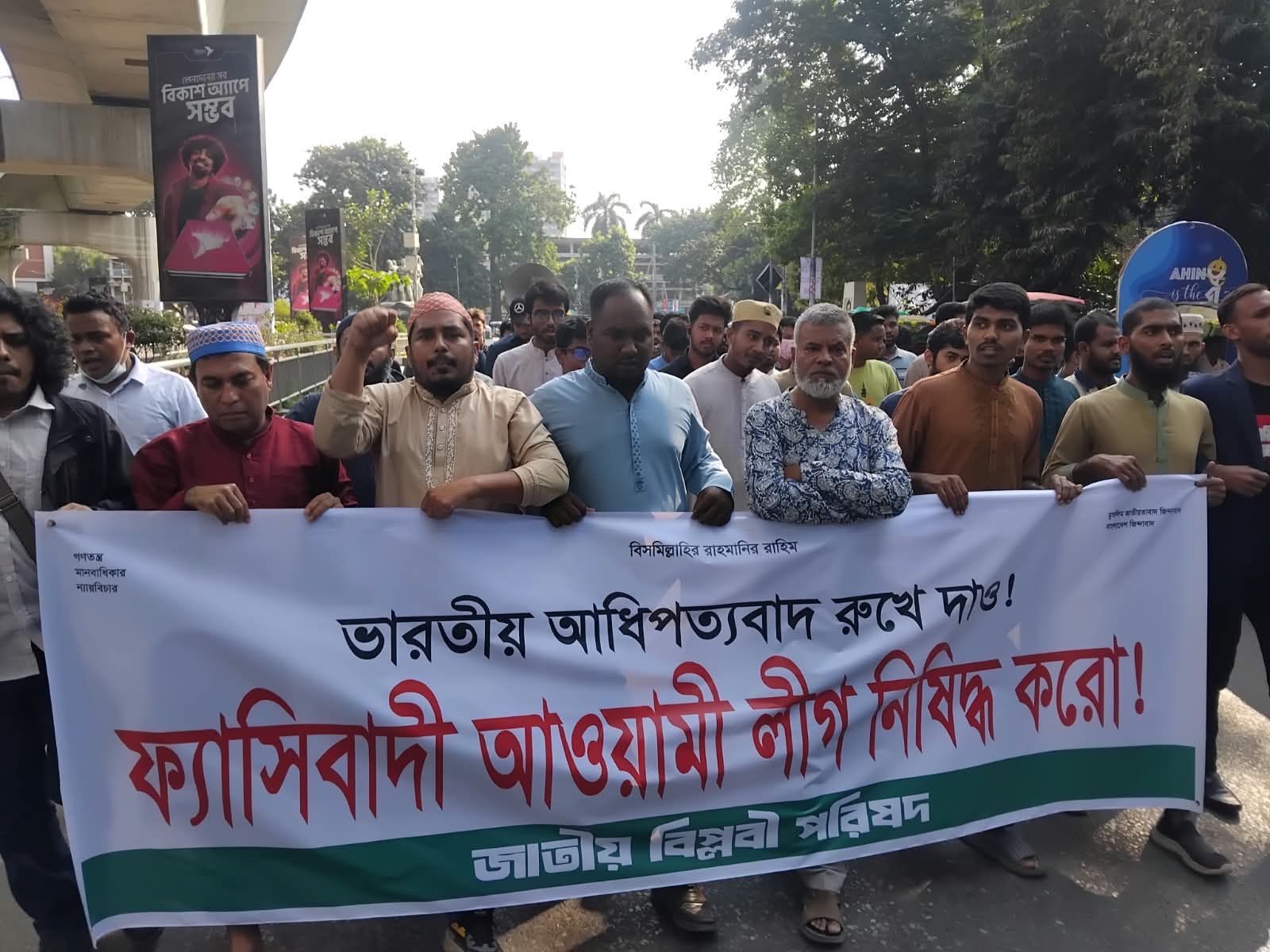
The procession paraded through the Teacher-Student Centre (TSC) area of Dhaka University before reaching Shahbagh intersection, where the demonstrators took position in the middle of the four-way crossing.
Khomeni Ehsan, Manjur Hossain Isa, an organiser of Mayer Daak, an organisation representing families of victims of enforced disappearances, nationalist writer Engineer AKM Rezaul Karim, Syed Qutb, Revolutionary Students Council Convener Abdul Wahed and poet Jihadi Ehsan addressed the gathering.
In his speech, Khomeni Ehsan said the BNP had opposed banning the Awami League after the July Revolution. He alleged that the party was now being rehabilitated through various tactics after Tarique Rahman assumed office as prime minister.
He said attempts were still being made to create opportunities for the Awami League to reorganise itself despite concerns over its alleged violence in Gopalganj.
Criticising Law Minister Asaduzzaman for suggesting that the party could be banned through proceedings at the tribunal, he alleged that such an approach would give the Awami League an opportunity to regroup.
“Our position is clear: the Awami League must be banned through an executive order, and a law banning fascism must be passed in Parliament and incorporated into the Constitution,” he said.
Announcing a tougher movement to press home the demand, he described Friday’s symbolic blockade as a “demo” or preliminary rehearsal.
“If the Awami League is not permanently banned soon, we will blockade Shahbagh intersection and continue an indefinite sit-in,” he warned.
Khomeni alleged that the Awami League had acted as an agent of India since Bangladesh’s independence and repeatedly deprived people of their voting rights to establish authoritarian rule.
He said the party could not be restrained through half-hearted opposition after re-emerging following the July Revolution.
Drawing comparisons with the suppression of fascism and Nazism in Italy, Germany and Austria, he called for permanent constitutional legislation against fascism.
Outlining his proposed framework, he demanded the confiscation of all Awami League offices and assets and a permanent ban on politics for its identified leaders whom he accused of criminal activities.
He also called for barring members of the Sheikh Mujibur Rahman and Sheikh Hasina families, as well as anyone involved in what he described as the July massacre, from engaging in politics.
He further demanded seven years of rigorous imprisonment for anyone chanting the Awami League’s “Joy Bangla” slogan or speaking in support of the party on television talk shows.
Khomeni also sharply criticised the BNP over its historical role in the rehabilitation of the Awami League.
He said BNP founder Ziaur Rahman had revived the party after it was dissolved and brought Sheikh Hasina back from Delhi, allowing her to return to politics.
He recalled that Ziaur Rahman was assassinated on May 30, 1981, just 13 days after Hasina returned to Bangladesh on May 17.
He alleged that the BNP had failed to learn from Ziaur Rahman’s fate and believed that rehabilitating the Awami League would allow the two major parties to dominate politics while other political opponents would be marginalised.
History, he argued, showed that once rehabilitated, the Awami League would target the BNP first.
He also alleged that Ziaur Rahman was assassinated before the party targeted senior Jamaat-e-Islami leaders and that the Awami League later imprisoned former prime minister Khaleda Zia through what he described as false cases.
“If given another opportunity, the Awami League will target Tarique Rahman first,” he said, referring to attacks on lawmakers’ homes in Gopalganj as evidence of what he described as the party’s wider political targets.
Khomeni also accused India of attempting to reassert its influence over Bangladesh.
He said he had expected a change in India’s approach following Hasina’s fall on August 5, 2024, including her extradition, an end to border killings, the cancellation of unequal agreements and a fair share of water from common rivers.
Instead, he alleged, India was using the Awami League to push Bangladesh towards civil conflict.
Announcing another political programme, he said the organisation would launch an “India Out” movement from December 16. He threatened a campaign to prevent the sale of Indian products anywhere in Bangladesh and stop vehicles from entering the country from India.
Addressing the gathering, Manjur Hossain Isa said they had taken to the streets to demand a ban on the Awami League and would continue their struggle to permanently eliminate fascism.
Urging the government to identify suspected individuals around it, he warned against accepting benefits from them.
Referring to the cases of enforced disappearance of Ilias Ali, Chowdhury Alam and Sajidul Islam Sumon, he said there should be no concessions or compromise with the Awami League.
“We will continue our struggle against misrule, taking an oath in the name of martyred Osman Hadi,” he said.
Engineer AKM Rezaul Karim said there was no scope for leniency in confronting what he described as Awami fascism.
Expressing concern that the police might become demoralised, he proposed recruiting volunteer police personnel from among patriotic citizens, following what he described as the British model. He also suggested recruiting such volunteers from different student organisations, including Jatiyatabadi Chhatra Dal and Islami Chhatra Shibir.
Syed Qutb said Bangladesh had achieved independence through bloodshed and that its sovereignty was not a gift from anyone.
He said no threats concerning the country’s borders or sovereignty would be tolerated.
Poet Jihadi Ehsan criticised those questioning the liberation war credentials of Speaker Major (retd) Hafiz Uddin Ahmed following his visit to Pakistan.
He alleged that those who did not support the Awami League or appease India were labelled collaborators by a particular group.
Among others present at the programme were National Revolutionary Council Assistant Member Secretary Abdus Salam, central members Sakib Samin, Saidul Islam and Zainul Abedin, and Hafez Bayezid Bostami.