


 Play store

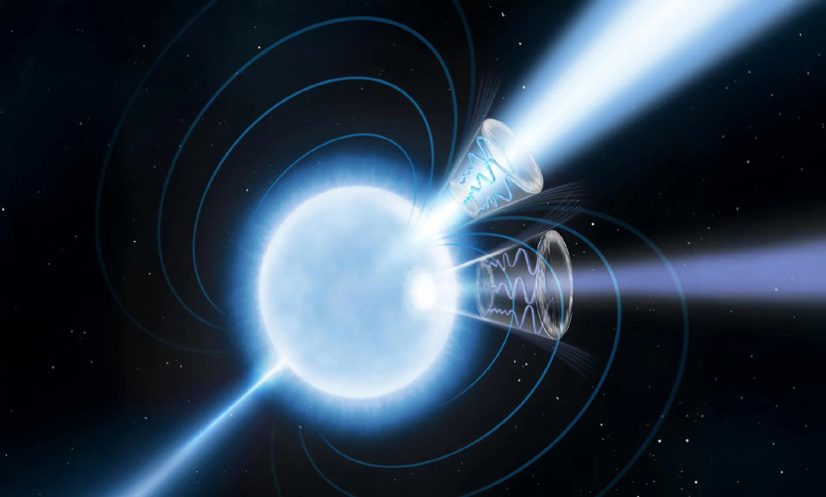
Astronomers may have found some of the strongest evidence yet that empty space can affect how light travels, offering a possible glimpse into one of quantum mechanics’ strangest predictions.
The phenomenon, known as vacuum birefringence, was predicted nearly 90 years ago by physicist Werner Heisenberg. The theory suggests that a vacuum is not completely empty but contains fleeting “virtual particles” that can influence light under extreme conditions.
An international research team, including Dr Marcus Lower of Swinburne University of Technology, searched for evidence of the phenomenon by studying a magnetar, a type of neutron star with the strongest magnetic fields known in the universe.
The researchers observed magnetar 1E 1547.0-5408, or 1E1547, using NASA’s Imaging X-ray Polarimetry Explorer (IXPE). They also used the NICER X-ray telescope aboard the International Space Station and Murriyang, CSIRO’s Parkes radio telescope.
Their findings suggest that the magnetar’s extreme magnetic field may have produced vacuum birefringence. If confirmed, the result could provide a new way to study quantum physics in extreme environments. The findings were published in Nature.
According to quantum theory, extremely strong magnetic fields can affect the virtual particles associated with empty space. These particles can alter the way light travels, producing vacuum birefringence.
Magnetars offer an ideal environment for testing the prediction because their magnetic fields are vastly stronger than anything scientists can produce on Earth.
“Detecting vacuum birefringence requires a magnetic field that is over 100 million times stronger than any we’ve ever made on Earth,” Lower said.
“Thankfully, nature has provided us with magnetars, which are the perfect cosmic laboratories to go looking for this effect.”
The researchers tracked changes in the polarization of radio waves from 1E1547 as the magnetar rotated. Their observations showed that the star’s magnetic and rotational axes are almost aligned, while the magnetar is viewed from nearly directly above one of its poles.
This geometry provided an unusually favorable opportunity to search for vacuum birefringence.
The team then identified two key clues. X-rays detected by IXPE showed extremely high polarization. The direction of the polarization also remained linked to the magnetar’s magnetic field in a pattern consistent with the radio observations.
“Because of the magnetic field’s strength, Heisenberg’s virtual particles become aligned with the direction the field is pointing,” Lower said.
By comparing the polarization of radio waves and X-rays as the magnetar rotated, the researchers found evidence consistent with the long-predicted quantum effect.
However, the team’s observations still require further confirmation before vacuum birefringence can be considered definitively detected.