


 Play store

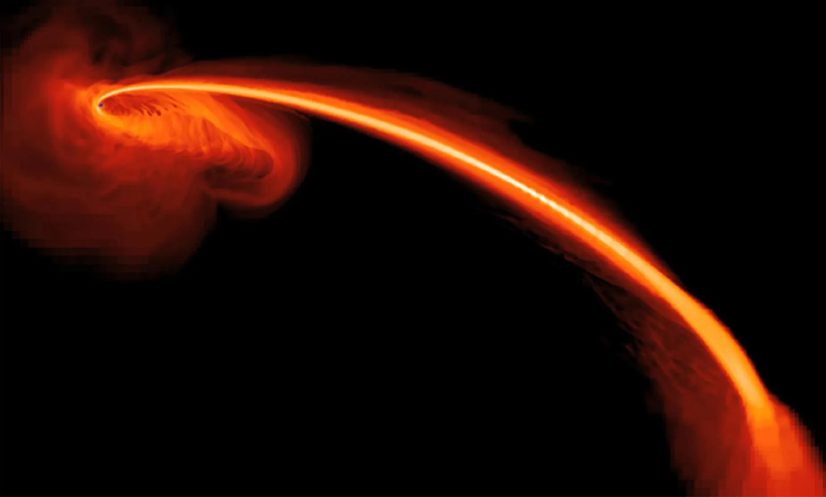
A star’s rotation speed before it encounters a black hole could explain why some recurring cosmic flares gradually become weaker, according to new research by astrophysicists at Syracuse University.
When a star passes dangerously close to a black hole, it is not necessarily destroyed immediately. In some cases, the star survives the encounter and returns for repeated close approaches, losing part of its mass each time and producing a new burst of light.
These events, known as repeating partial tidal disruption events (rpTDEs), give astronomers a rare opportunity to observe the same star interacting with the same black hole multiple times.
Wide-field time-domain surveys have made it possible to identify such systems by repeatedly scanning large areas of the sky and tracking objects whose brightness changes over time.
However, astronomers have faced a puzzle. Rather than producing flares of similar brightness during each encounter, some repeating systems become progressively fainter. Existing theoretical models have struggled to explain the phenomenon.
The new study suggests that the star’s spin before its first close encounter with the black hole could be a key factor.
Published in The Astrophysical Journal, the research was led by doctoral student Ananya Bandopadhyay of Syracuse University, along with postdoctoral researcher Benjamin Amend and associate professor Eric Coughlin of the Department of Physics. Researchers from other institutions also contributed to the study.
In a conventional tidal disruption event, the gravitational pull of a black hole differs significantly across a nearby star. The intense tidal forces can eventually tear the star apart.
The resulting stellar debris begins falling toward the black hole, or accreting onto it. As the material loses energy, it releases intense radiation that can remain visible for days or months.
Although black holes themselves do not emit light, the material produced during a tidal disruption event can illuminate their surroundings, allowing astronomers to study otherwise invisible black holes.
In a partial tidal disruption event, however, the star avoids complete destruction. Its surviving core remains in orbit around the black hole and returns for another close encounter, shedding additional material each time. Such encounters can occur months or even several years apart.
The amount of material stripped from the star depends partly on its internal structure.
According to the researchers, a low-mass star can be compared to a fluffy meringue, making it increasingly vulnerable to the black hole’s tidal forces. A more massive star, by contrast, has a denser, layered structure similar to an onion. Its outer layers can be stripped away while its dense core remains relatively intact.
These differences can influence how much material a star loses during successive encounters.
Astronomers have identified roughly 10 repeating partial tidal disruption systems so far, and four have displayed progressively weaker flares.
At first glance, the explanation might appear straightforward: if less material is stripped away, the resulting flare should become weaker. However, earlier hydrodynamical simulations produced a surprising result. Even when the amount of material lost declined during successive encounters, the simulations predicted flares with roughly the same peak brightness.
The new research points to the star’s pre-existing rotation as a possible missing piece in explaining why some repeating tidal disruption events gradually fade.
If confirmed, the finding could provide astronomers with a new way to understand the internal properties and evolution of stars undergoing repeated encounters with black holes.