


 Play store

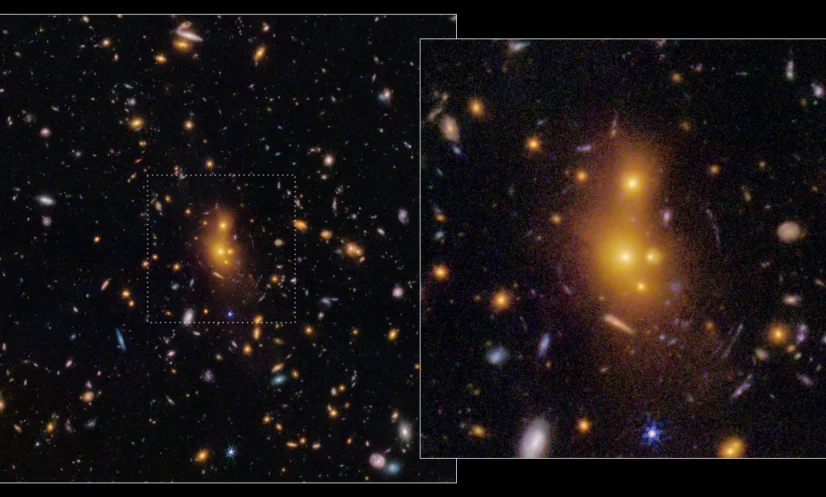
Astronomers using the James Webb Space Telescope (JWST) have identified the most distant known galaxy cluster exhibiting strong gravitational lensing, offering new insights into dark matter and the formation of massive cosmic structures in the early universe.
The galaxy cluster, known as XLSSC 122, is located about 10.4 billion light-years from Earth. Three recent studies led by researchers at IPAC, Caltech’s science and data centre for astrophysics and planetary science, have revealed its unusual structure and provided new ways to investigate its mass distribution.
The findings were presented at a press conference on June 17, 2026, during the 248th meeting of the American Astronomical Society.
Strong gravitational lensing occurs when the gravity of a massive object bends and distorts light from galaxies located behind it. The effect allows scientists to estimate the mass of the foreground object, including its invisible dark matter.
JWST observations revealed distinctive curved arcs of light around the centre of XLSSC 122, providing clear evidence of strong lensing.
“When we got those first images back from JWST, we said, ‘wow, look at this, there’s strong lensing coming from this cluster!’” said Kyle Finner, a staff scientist at IPAC and lead author of the first study.
The cluster is particularly intriguing because it appears remarkably mature for its age. It existed during a period roughly 10 billion years ago known as “cosmic noon”, when star formation across the universe was at its peak and galaxies were producing stars at rates far higher than those seen today.
Despite forming when galaxy clusters were still assembling, XLSSC 122 already displayed a well-organised structure. The latest measurements also indicate that an unusually large proportion of its mass is concentrated near its centre, challenging predictions from standard cosmological models.
“XLSSC 122 is one of the first clusters we know of that formed in the universe, and it has a mass concentration that doesn’t agree with our cosmological model predictions,” Finner said.
Researchers originally detected the cluster in 2014 through an X-ray survey conducted by the European Space Agency’s XMM-Newton spacecraft. Subsequent observations with the Hubble Space Telescope established its distance and indicated that it was unusually developed for its age, but did not reveal clear evidence of strong gravitational lensing.
The more powerful observations from JWST have now enabled scientists to study its mass distribution in greater detail.
Dark matter, which cannot be observed directly through light, accounts for most of the gravitational effect responsible for the lensing. Scientists estimate that it is about five times as abundant as ordinary matter and plays a crucial role in holding galaxies together and shaping the large-scale structure of the universe.
“Strong lensing is a way to measure the dark matter without actually seeing the dark matter,” Finner said, describing the phenomenon as a sensitive tool for testing cosmological models.
In a second study, researchers used weak gravitational lensing, which involves subtle changes in the apparent shapes of distant galaxies, to investigate the cluster’s outer regions.
Combining the results with X-ray and radio observations from other telescopes, the team found that XLSSC 122 is still undergoing a merger, with its constituent galaxies continuing to come together.
A third study identified faint, diffuse light from stars no longer gravitationally bound to individual galaxies. Known as intracluster light, this glow comes from stars scattered throughout the spaces between galaxies.
The observations represent the earliest known detection of intracluster light, providing another tool for investigating how galaxy clusters developed in the distant universe.
Together, the three studies offer new evidence about the evolution of massive structures and the distribution of dark matter during an early period of cosmic history, potentially helping scientists refine their understanding of how the universe evolved after the Big Bang about 13.8 billion years ago.