


 Play store

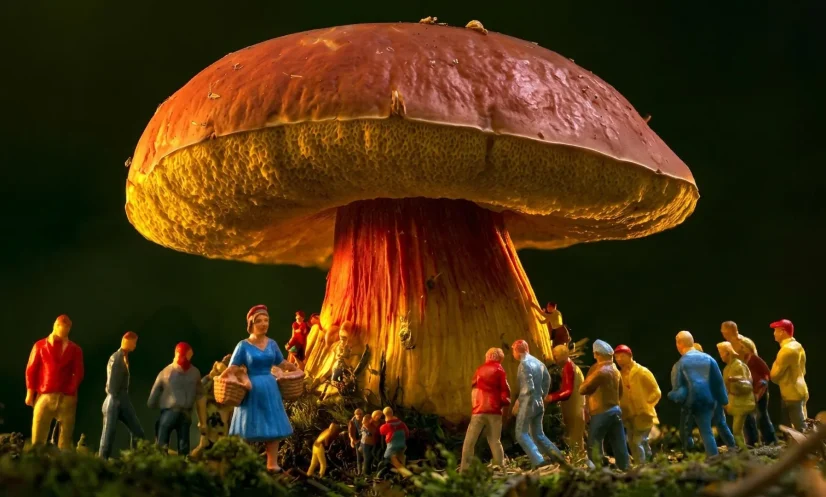
Scientists have identified a mushroom linked to bizarre hallucinations in which people see miniature human figures, solving part of a mystery that has puzzled researchers for nearly a century.
Researchers at the University of Utah used DNA sequencing to identify Lanmaoa asiatica as the mushroom responsible for the unusual visions reported in southwestern China and the northern Philippines.
Known as Lilliputian hallucinations, the phenomenon is named after the tiny inhabitants of Gulliver’s Travels. Surprisingly, researchers found no evidence of known psychoactive compounds, including psilocybin, in the mushroom, suggesting it may contain a previously unidentified hallucinogenic substance.
The findings could help scientists better understand unusual visual experiences, neurological disorders and how the brain constructs our perception of reality.
The study, led by University of Utah doctoral student Colin Domnauer and mycologist Bryn Dentinger, who is affiliated with the university and the Natural History Museum of Utah, was published in the journal Mycologia.
The mystery dates back to 1934, when Western researchers learned that people in Papua New Guinea experienced vivid visions of miniature humans after eating wild mushrooms. The phenomenon became known as “mushroom madness”.
Investigations during the 1950s and 1960s pointed to several possible species belonging to the Boletaceae family. However, chemical analyses failed to identify any substance that could explain the hallucinations.
Even Albert Hofmann, the scientist who first isolated psilocybin and discovered LSD’s hallucinogenic effects, was unable to identify an active ingredient in the mushroom samples he examined.
The lack of a chemical explanation led some researchers to question whether the mushrooms caused the visions at all. Some suggested that cultural beliefs and traditional expectations might account for the experiences, and scientific investigations largely ceased by the end of the 1960s.
Interest revived in the 1990s, when people in Yunnan province in southwestern China reported similar hallucinations after eating bolete mushrooms. Researchers suspected that Lanmaoa asiatica might be responsible, although the species had not been conclusively established.
A further breakthrough came in 2024, when Domnauer learned of similar experiences among an Indigenous community in the remote Northern Cordillera region of the Philippines.
Residents described a wild edible mushroom called “Sedesdem” that could cause people to see miniature human figures. Similar mushrooms are known as “Nonda” in Papua New Guinea and “Jian shou qing” in Yunnan.
Although the mushrooms are part of local food traditions, eating them without thorough cooking can trigger the unusual hallucinations.
Domnauer travelled to China and the Philippines, interviewed residents and collected mushroom specimens for analysis. The fieldwork also included the first scientific survey of fungi in the northern Philippines.
DNA analysis confirmed that the mushrooms known as Jian shou qing in China and Sedesdem in the Philippines were both Lanmaoa asiatica. The discovery was unexpected because the species had previously been thought to occur only in China.
Dentinger also travelled to Papua New Guinea to collect specimens from the region where the mystery was first documented. However, unusually dry weather prevented him from obtaining samples for genetic comparison.
Despite identifying the mushroom associated with the visions, researchers have yet to determine which substance causes the hallucinations.
Finding the responsible chemical could open a new avenue of research into how the brain processes visual information and produces perceptions that do not correspond to the external world.