


 Play store

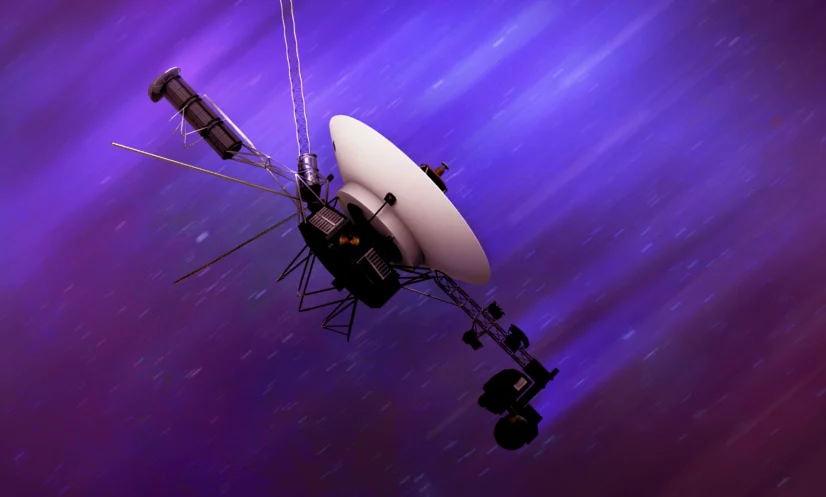
NASA’s Voyager 1 is set to achieve another historic milestone later this year when it becomes the first human-made object to reach a distance of one light-day from Earth.
According to NASA’s trajectory calculations, at 2:16:07 a.m. PST on November 18, 2026, Voyager 1 will be 16,094,799,096 miles (about 25.9 billion kilometres) from Earth—the distance that light travels in 24 hours.
The milestone means that any radio command sent from Earth will take an entire day to reach the spacecraft, while a response transmitted immediately would require another day to return, making a full round-trip communication take about two days.
Unlike previous milestones, such as crossing the heliopause in 2012—the boundary between the Sun’s influence and interstellar space—the one-light-day mark is not a physical location. Instead, it represents a communications milestone defined by the finite speed of light.
The achievement underscores the extraordinary longevity of Voyager 1, which was launched on September 5, 1977, aboard a Titan IIIE-Centaur rocket from Cape Canaveral. Originally designed to conduct flybys of Jupiter and Saturn, the spacecraft has far exceeded its planned mission and continues to operate nearly five decades later in interstellar space.
At such an immense distance, spacecraft operations have become significantly more challenging. Engineers must wait two days to receive confirmation that a command has been successfully executed, even when all systems function normally.
Voyager 1 remains the most distant spacecraft ever built by humanity and continues to send back valuable scientific data from beyond the heliosphere, offering insights into the environment between the stars.