


 Play store

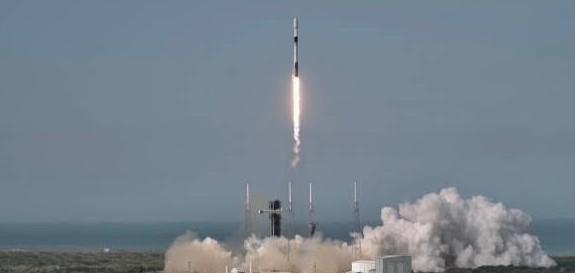
A private space mission to extend the operational life of ageing communication satellites blasted off on Tuesday, marking another milestone in the growing effort to service spacecraft in orbit instead of replacing them.
Launched aboard a SpaceX rocket, Northrop Grumman’s Mission Robotic Vehicle (MRV) will spend the next year travelling to geosynchronous orbit, about 36,000 kilometres above Earth, where it will attach propulsion units, or “jetpacks”, to satellites running out of fuel.
The mission is designed to help satellite operators prolong the life of expensive communications satellites by several years, reducing replacement costs and contributing to more sustainable use of space.
The minivan-sized robotic spacecraft is equipped with two robotic arms capable of capturing and installing propulsion units on ageing satellites. For its maiden mission, the MRV is carrying three electric-propelled jetpacks, each roughly the size of a household washing machine.
The jetpacks separated from the spacecraft shortly after launch and will independently travel to the designated orbit using xenon-powered electric thrusters. Once there, they will await installation by the robotic vehicle.
Northrop Grumman expects the first servicing operation to take place by mid-2027. The robotic spacecraft will attach a jetpack to an ageing communications satellite before moving on to service two additional spacecraft.
Each propulsion unit will provide enough thrust to maintain a satellite’s orbital position for several more years after its original fuel supply is exhausted, potentially saving satellite operators millions of dollars in replacement costs.
The initial customers for the mission are Luxembourg-based satellite operator SES and Australia’s Optus, both of which operate communications satellites in geosynchronous orbit.
The latest mission builds on Northrop Grumman’s earlier satellite-servicing achievements. In 2019 and 2020, the company successfully launched two Mission Extension Vehicles that docked with ageing communications satellites and assumed propulsion duties, allowing them to remain operational beyond their planned lifespans.
The new robotic servicing system represents a more advanced approach. Beyond extending satellite life, future versions are expected to perform repairs, relocate operational satellites and even remove defunct spacecraft from increasingly congested orbital zones.
Northrop Grumman is developing the technology in collaboration with the US Naval Research Laboratory and the Defense Advanced Research Projects Agency (DARPA), reflecting growing interest in on-orbit servicing for both commercial and government space missions.
The launch comes just weeks after another private satellite-servicing mission entered orbit. On July 3, Katalyst Space Technologies launched its three-armed Link spacecraft, which is expected to raise NASA’s ageing Swift Observatory into a higher orbit to prevent its premature re-entry.
NASA’s Swift space telescope, launched in 2004 to study powerful gamma-ray bursts, has been losing altitude faster than expected because of increased solar activity. NASA has awarded Katalyst a $30 million contract to boost the observatory back to its original orbit, potentially extending its scientific mission for several more years.
Together, the missions highlight the rapid emergence of in-orbit satellite servicing as a cost-effective and sustainable solution for managing the growing number of spacecraft operating around Earth.