Play store

By Mohiuddin Suman
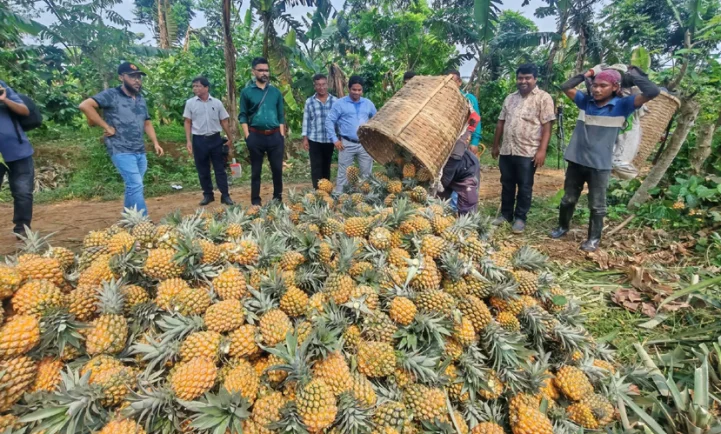
Farmers in Tangail’s Madhupur, home to Bangladesh’s Geographical Indication (GI)-recognised pineapple, are increasingly turning to organic cultivation to restore the fruit’s famed aroma and flavour, which have been undermined by the excessive use of chemicals in recent years.
Known as the country’s pineapple capital, Madhupur has witnessed a steady rise in commercial cultivation to meet growing nationwide demand. However, in pursuit of higher profits, some growers have resorted to applying excessive hormones and chemical mixtures to induce flowering, accelerate ripening and improve the fruit’s appearance.
Agriculture experts warn that these practices produce pineapples with bright yellow colour and larger size but diminish their natural sweetness, aroma and nutritional value. The chemically treated fruit may also pose health risks.
With consumers becoming more conscious about food safety and increasingly avoiding chemically ripened fruit, many farmers are now embracing organic methods that produce safe, chemical-free pineapples while fetching better prices.
One such farmer is Sohel Rana of Hagura Kuri village in Fulbag Chala Union of Madhupur upazila. He began organic pineapple cultivation in 2025 after receiving training and financial support from the Palli Karma-Sahayak Foundation (PKSF) through local development organisation SSS.
Using a Tk 60,000 grant along with his own investment, Rana cultivated 24,000 Honey Queen pineapple plants on four bighas (120 decimals) of land using only organic fertiliser.
From planting to harvesting over an 18-month period, around 50 workers were employed on the project. His total production cost, including labour and other expenses, stood at Tk 235,000.
Rana has already sold pineapples worth Tk 528,000 and expects to earn another Tk 70,000 from the remaining harvest.
“While chemically ripened large pineapples sell at Tk 25-30 each in the wholesale market, my organically grown pineapples are selling for Tk 40-45 apiece,” he said.
According to Rana, Madhupur’s pineapple is renowned for its unique taste and fragrance, but indiscriminate use of chemicals by some growers has tarnished its reputation.
Inspired by his success, several local farmers, including Mizanur Rahman Sabuj, Rony Mia and Kalyan Matthew, have also adopted organic pineapple cultivation. Around 100 farmers across the Madhupur hill region are now engaged in producing safe pineapples.
Rana markets his produce directly to buyers from Dhaka and northern districts, including Nilphamari, Rangpur, Bogura and Sirajganj. He also receives orders through his Facebook page, “SR Blog BD”, and delivers the fruit nationwide via courier services.
He explained that naturally ripened pineapples can be identified by their yellow base and green upper portion, along with their strong fragrance and sweet taste. In contrast, hormone-ripened fruit turns uniformly yellow but lacks both aroma and sweetness.
Santosh Chandra Pal, acting executive director of SSS, said the organisation has long been supporting farmers in the Madhupur hill region through small-scale financing, training and technical assistance.
Under the Sustainable Micro Enterprise and Resilient Transformation (SMART) project, around 1,800 members are currently receiving financial and technical support to adopt safe farming practices and improve their livelihoods, he said.
Deputy Director of the Department of Agricultural Extension in Tangail, Md Ashik Parvez, said three pineapple varieties—Giant Kew, Honey Queen and the imported MD-2—are cultivated in the Madhupur region.
He warned that excessive use of hormones for higher profits could lead to serious long-term health hazards, including liver and kidney damage and even cancer.
“Our department is continuously encouraging and training farmers to produce chemical-free pineapples to preserve the GI recognition, unique flavour and heritage of Madhupur pineapples,” he said.
Parvez also highlighted the export potential of safe pineapples, noting that global demand remains strong. He said value-added pineapple products, including juices and processed foods, could significantly boost Bangladesh’s export earnings if supported by modern food-processing technologies.
According to him, several domestic beverage companies are already exporting pineapple juice, and proposals have been submitted to the government to expand the sector through new development projects.