Play store

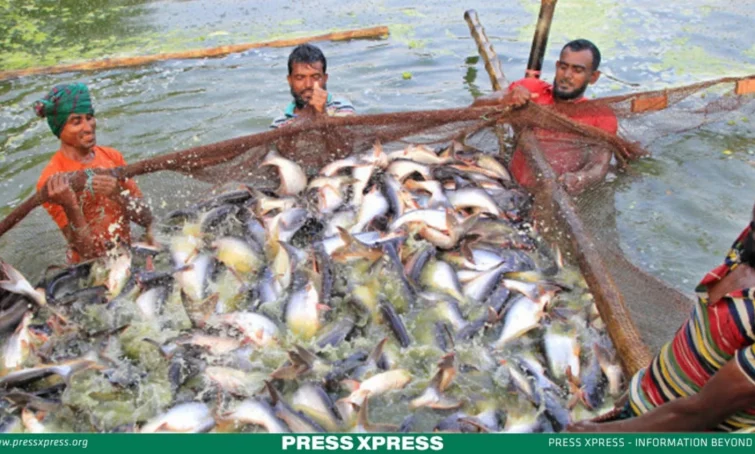
Bangladesh produced a record 5.11 million metric tonnes of fish in the 2024-25 fiscal year, underscoring the growing importance of the fisheries sector to food security, nutrition, employment and the rural economy.
The information was disclosed recently ahead of National Fisheries Week 2026, which began on Sunday and will continue until August 30.
This year’s fisheries week is being observed under the theme, “Bangladesh first, a self-sufficient nation in fish.”
Daily per capita fish availability has increased to 67.80 grams, exceeding the nationally determined nutritional requirement of 60 grams, according to the Ministry of Fisheries and Livestock.
Prime Minister Tarique Rahman inaugurated the national programme at the George Institute Mini Stadium ground in Achmita Union of Katiadi upazila in Kishoreganj on Sunday.
As part of efforts to increase fish production and conserve aquatic resources, the prime minister also released fish fry into the Old Brahmaputra River at Mirzapur Chairman Bari Ghat in Pakundia, Kishoreganj.
He travelled to Pakundia by road from Dhaka and reached the venue at around 11:30am.
During the opening ceremony, the prime minister distributed National Fisheries Awards to 14 individuals and organisations in 13 categories for their contributions to the fisheries sector.
The fisheries sector has become a major pillar of Bangladesh’s agricultural economy. It contributes 2.58 percent to the country’s gross domestic product and 22.03 percent to agricultural GDP, according to ministry data.
Around 20.6 million people are directly or indirectly involved in fisheries-related activities, making the sector a major source of employment and income, particularly in rural and coastal communities.
Bangladesh has also strengthened its position in global fisheries production. Citing the Food and Agriculture Organization’s 2026 report, Fisheries and Livestock Minister Aminur Rashid said Bangladesh ranks second globally in fish capture from inland open-water sources and fifth in aquaculture production from closed-water bodies.
The country also ranks first in the world in hilsa production. Hilsa is one of Bangladesh’s most commercially and culturally important fish species and provides livelihoods for a large number of fishing communities.
Support for fishermen
The government is placing greater emphasis on protecting fish stocks while supporting fishermen during seasonal fishing bans and other conservation measures.
During the 2025-26 fiscal year, substantial quantities of Vulnerable Group Feeding rice were distributed among registered fishermen during different fishing restrictions to help compensate for income losses caused by temporary fishing bans.
The government has also taken steps to provide rice support to more than 1.8 million registered fishermen and create alternative employment opportunities for them during periods when fishing is prohibited.
Financial assistance has also been provided to families affected by fishing-related accidents. During the same fiscal year, the families of 26 fishermen who died and 13 who went missing while fishing received Tk50,000 each.
The government is also working to reform the management of water bodies by abolishing the leasing system for water bodies, coastal canals and haors and opening them up to local fishermen and poor communities.
The initiative is being pursued under the principle that “the net belongs to the fisher, so does the water”, the minister said.
Focus on shrimp exports
Alongside boosting domestic fish production, the government is seeking to expand Bangladesh’s presence in international seafood markets.
An integrated plan is being prepared to establish shrimp as a global brand and increase shrimp exports, Aminur Rashid said.
The initiative is aimed at improving the competitiveness of Bangladesh’s shrimp industry and expanding its access to international markets.
With more than 20 million people directly or indirectly dependent on fisheries, the sector has become increasingly important to Bangladesh’s food and nutrition security as well as rural livelihoods.
The government is therefore focusing on expanding sustainable aquaculture, protecting aquatic ecosystems, supporting fishermen during conservation periods and increasing the value of fisheries products for export.
National Fisheries Week is being observed across the country with programmes aimed at raising awareness about fish conservation, sustainable production and the protection of aquatic resources.
The government expects the campaign to encourage wider public participation in conserving fisheries while advancing its goal of making Bangladesh more self-sufficient in fish production.