Play store

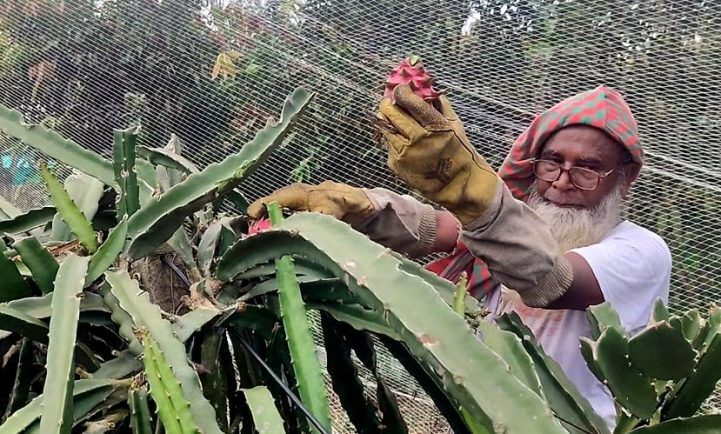
Farmers in Sirajganj are enjoying a bumper harvest of dragon fruit this season, while favourable market prices have further encouraged them to expand cultivation of the profitable crop.
Dragon fruit farming is spreading rapidly across Ullapara, Kamarkhanda, Kazipur and Sadar upazilas, with new orchards also emerging in several char areas. Farmers are increasingly bringing fallow and previously unused land under cultivation as the crop offers good returns with comparatively less labour.
According to the agriculture department, a target was set to cultivate dragon fruit on around 18 hectares of land across the district’s nine upazilas this season. However, the actual area under cultivation has exceeded the target, officials said.
High, well-drained, loamy and sandy soils are considered suitable for dragon fruit cultivation. Although BAU-1, BAU-2 and BAU-3 varieties are grown in Sirajganj, BAU-3 is the most widely cultivated variety.
Farmers generally begin by installing concrete poles at specific intervals and building a support structure with GI wire. Dragon fruit saplings are then planted around the structure. The plants usually begin flowering about six months after planting, with the flowers developing into fruit. A single support structure can continue producing fruit for six to seven years.
S M Idris Ali, a farmer and entrepreneur from Brahmkhola village near the Daibhanga River in Sirajganj Sadar, has achieved success by cultivating dragon fruit on around 2.5 bighas of land.
Idris told Sarabangla that he had been cultivating high-yielding fruit varieties since 1999 but started growing dragon fruit for the first time in 2023.
“I faced some difficulties initially, but gradually learned the techniques through training and advice from the agriculture department. I am now earning a good income from the orchard,” he said.
He produced around five tonnes of dragon fruit last year and expects production to reach nearly six tonnes this season.
Last year, he sold the fruit to local traders for an average of Tk150-160 per kg. The price has now risen to Tk180-200 per kg, allowing him to earn a profit of up to Tk200,000 per bigha, he said.
The success of farmers like Idris has encouraged small and marginal farmers in the area to take up dragon fruit cultivation. Many are establishing new orchards after seeking advice from agricultural officials.
Agriculture officials said dragon fruit farming has already improved the financial condition of many farmers while bringing fallow and unused land into production.
A K M Manzure Mawla, deputy director of the Department of Agricultural Extension in Sirajganj, said dragon fruit was a promising and profitable crop and that interest in its cultivation was increasing among farmers.
“The agriculture department is providing farmers with necessary advice and technical support. Expanding dragon fruit cultivation could increase farmers’ incomes while bringing more unused land under production,” he told Sarabangla.
Farmers, however, said more effective market management was needed to ensure fair prices for their produce, particularly as production costs and market conditions could affect profitability.
With bumper yields, strong market prices and attractive returns driving its expansion, dragon fruit cultivation is emerging as a promising new agricultural enterprise in Sirajganj. Stakeholders believe that continued training, technical assistance and better market management could further unlock its potential in the district.