


 Play store

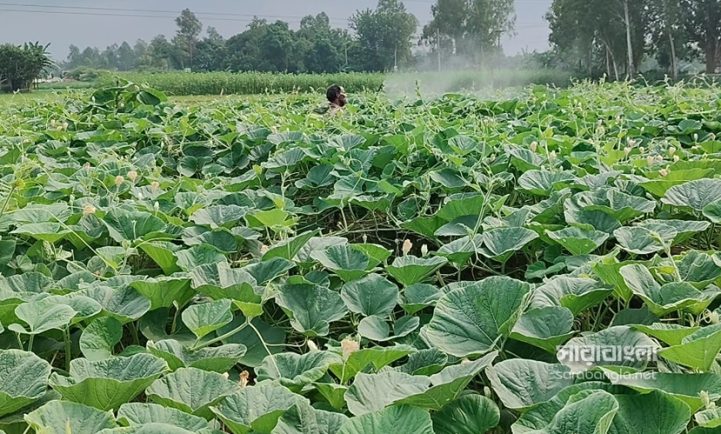
A bumper harvest of bottle gourds has brought relief and renewed optimism to farmers in Sirajganj this season, as the absence of major flooding and favourable weather have helped boost vegetable production across the district.
Sirajganj, an agriculture-dependent district formed by the alluvial plains of the Jamuna River, regularly suffers crop losses during the monsoon when rising river water inundates large areas of farmland. But farmers have so far avoided major flooding this year, allowing them to properly tend their crops and harvest vegetables on time.
Bottle gourd cultivation has expanded across large areas of Sirajganj Sadar, Kamarkhand, Ullapara and Shahjadpur upazilas. Rows of gourds hang from bamboo trellises, while farmers spend much of the day harvesting, sorting and taking the produce to local markets.
Local markets are receiving a steady supply of gourds collected directly from farms. Traders and wholesalers are transporting the vegetables to markets within the district as well as neighbouring areas, giving farmers faster access to buyers.
Farmers said bottle gourd is relatively less risky than many other vegetables because it can be harvested within a short period and remains in demand throughout the year. With favourable weather producing a good harvest and prices remaining satisfactory, growers expect to make a reasonable profit after recovering production costs.
According to the Department of Agricultural Extension (DAE) in Sirajganj, bottle gourd has been cultivated on 118 hectares of land in the district this season. The agriculture department is encouraging farmers to grow the vegetable as a high-yielding and profitable crop.
The department has also provided agricultural incentives to 8,000 farmers in the district to increase vegetable production.
Nazrul Islam, a farmer from Char Nurnagar in Kamarkhand, cultivated bottle gourd on 60 decimals of land this season.
“The weather was quite favourable this year. As floodwater did not enter the fields, we were able to provide regular care and the plants produced plenty of gourds. Prices are also good, so I expect to make a decent profit after covering my costs,” he said.
He said floods had previously destroyed crops before farmers could harvest them, adding that he planned to expand cultivation next season if good yields and prices continued.
Asadul Islam, a farmer in Sirajganj Sadar, said the absence of flooding had been particularly beneficial because bottle gourd plants are highly vulnerable to waterlogging.
“This year we were able to apply fertiliser, pesticides and water on time, which helped ensure a good harvest. Strong market demand is also giving us satisfactory returns,” he said.
Saiful Islam, a farmer in Ullapara, said bottle gourd had become one of the more profitable vegetables in his area because of its steady demand.
“We can sell the gourds both in local markets and at different weekly markets. The yield is good and prices are fairly satisfactory this year, so we expect to make a profit,” he said, adding that advice from agricultural officials had also helped farmers manage fertiliser use and diseases.
Agriculture officials said bottle gourd can produce returns within a relatively short period. Selecting suitable varieties, using quality seeds, applying fertiliser and irrigation on time, and controlling pests and diseases can further increase yields.
Cultivation on trellises also allows farmers to control the spread of plants and make better use of farmland.
The agriculture department is encouraging farmers to adopt modern technologies, including mulching. The method helps retain soil moisture, control weeds and reduce the spread of diseases, potentially lowering production costs while increasing yields.
AKM Monzure Mawla, deputy director of the DAE in Sirajganj, said bottle gourd cultivation had increased in the district this season and yields were good because of favourable weather.
“Farmers are being advised to cultivate bottle gourd using modern methods. Technologies such as mulching can help increase yields while making it easier to control weeds and diseases,” he said.
Officials said Sirajganj has significant potential for vegetable production because of its fertile alluvial soil, particularly in riverine char areas.
However, floods and river erosion remain major threats to agriculture. Rapid flooding can cause extensive damage to bottle gourd and other vegetable crops.
The absence of major flooding this season has therefore provided considerable relief to farmers along the Jamuna, who normally have to battle floodwaters while cultivating their land.
With favourable weather, timely crop management and encouraging market prices, Sirajganj’s bottle gourd farmers are now seeing new opportunities for higher farm income.