


 Play store

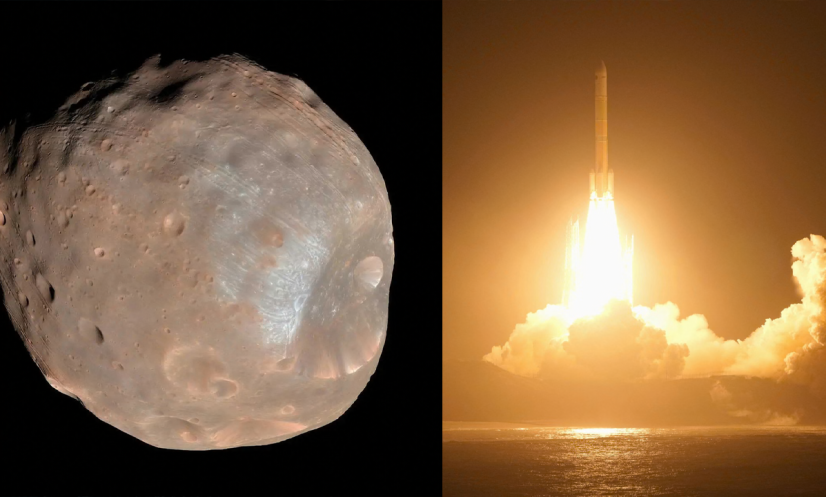
Japan has launched a historic space mission to collect soil and rock samples from Phobos, one of Mars’s two moons, and bring them back to Earth.
Scientists hope the samples will provide important clues about the formation of the solar system and the origins of life on Earth.
The Japan Aerospace Exploration Agency (JAXA) said the Mars Moons eXploration (MMX) spacecraft was launched aboard an H-3 rocket from Tanegashima Island in southwestern Japan early in the morning.
According to the mission plan, the spacecraft is expected to reach Mars orbit in August next year. It will then attempt to collect at least 10 grammes of soil and rock from the surface of Phobos, one of the planet’s two small, potato-shaped moons. The spacecraft is scheduled to return to Earth with the samples in 2031.
Phobos, which is marked by numerous craters and measures about 22.5 kilometres across, orbits Mars at an altitude of approximately 6,000 kilometres and completes nearly three orbits of the planet each day.
The H-3 rocket lifted off from Tanegashima Space Centre at 4:41am local time, streaking into the dark sky as thousands of people woke up early to watch the launch live. About an hour later, JAXA scientists confirmed the mission’s successful start after the spacecraft separated from the rocket’s upper stage. Celebrations were seen in the mission control room.
Over the past half-century, NASA has landed nine spacecraft on Mars, while China also successfully landed a spacecraft on the planet in 2021. However, attempts to land on either Phobos or Mars’s other moon, Deimos, have not previously been made.
“This is a very exciting and wondrous moment,” said Tom Statler, a NASA astrophysicist involved in the Japan-led project.
Five space agencies are collaborating on the five-year mission. Under the plan, a robotic lander and a rover will be deployed to explore Phobos.
The mission, which costs approximately $578 million, involves a spacecraft weighing five tonnes. After reaching Mars orbit next summer, it will adjust its position to match the orbit of Phobos before releasing a small French-German rover called Idefix. The rover is named after the white terrier in the Asterix comic series.
Because Phobos has only about one-thousandth of Earth’s gravity, the four-wheeled rover is expected to make a series of short hops across the moon’s surface before coming to a stop. It will then examine the surface for around 100 days, helping identify a safe landing site and a suitable location for sample collection.
The main spacecraft’s four-legged lander is expected to remain on Phobos for only about two hours. During that time, it will use drilling and suction-based technology to collect soil and rock samples before launching back into space.
Officials said the spacecraft would also make several flybys of Deimos to observe the second Martian moon before leaving Mars orbit. The departure is planned for November 2030.
“This is a once-in-a-lifetime opportunity. We are part of the first mission to bring samples back from the Martian system,” said Markus Grebenstein, head of rover-related work at the German Aerospace Center.
Scientists hope the samples will help determine how Phobos and Deimos formed and could even provide clues about the origins of life. NASA has said the findings could support future Mars missions, including potential human exploration.
Researchers have two main theories about the origins of the moons. The giant-impact theory suggests that Phobos and Deimos formed from material ejected when a large celestial object struck Mars. The alternative theory proposes that the moons are asteroids captured by Mars’s gravitational pull.
JAXA says determining which theory is correct could improve understanding of how conditions suitable for life developed on rocky planets close to the Sun, including Earth. The four innermost planets are Mercury, Venus, Earth and Mars.
The mission comes amid a broader international effort to bring Martian material back to Earth, with the United States and China also pursuing sample-return projects.
NASA’s Perseverance rover has been exploring Mars and collecting samples since 2021. However, plans to return those samples to Earth were put on hold by the Trump administration following a congressional vote in January this year.
China, meanwhile, plans to launch its Tianwen-3 mission around 2028, with the aim of returning samples from Mars by 2031. If the schedule holds, China’s mission could bring Martian samples back to Earth before Japan’s MMX spacecraft returns from the Martian moons.