Play store

Emergency warning systems in both Russia and Ukraine have come under cyberattacks, raising concerns over the spread of false alerts to civilians amid the ongoing war.
Russia’s Emergency Situations Ministry said its emergency alert mobile app had been targeted in a “major cyberattack” that could have allowed hackers to spread false information.
However, the ministry said the country’s public warning system was functioning normally. It did not immediately identify those responsible for the attack.
The incident came shortly after Ukraine’s air raid alert app was hacked, resulting in the distribution of false warnings.
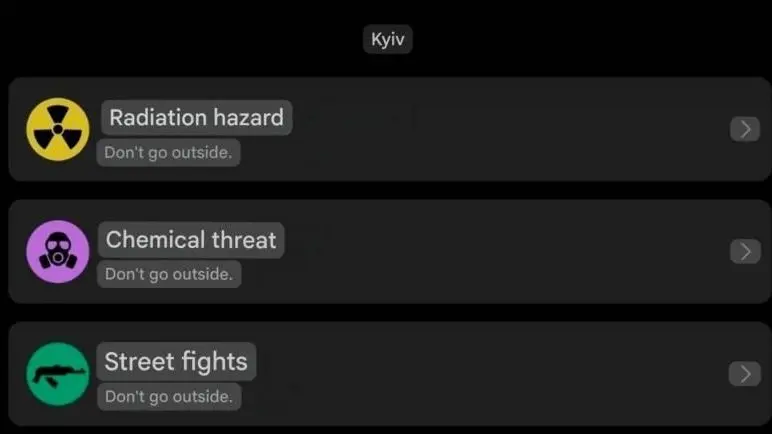
Ukraine’s Centre for Strategic Communications blamed Russia for the hacking in a post on social media platform X, saying one of the fake alerts contained a message in Russian.
Ukraine also shared an image showing several warnings displayed on its air raid alert app and urged citizens to ignore any unusual messages appearing on the application.
Meanwhile, Russia said its mobile app remained out of service, but the broader public warning system was operational.
The Emergency Situations Ministry stressed that citizens continued to receive alerts through multiple channels, including sirens, loudspeakers, text messages, and television and radio broadcasts.
Describing the mobile application as merely an additional information service, the ministry said on Telegram that the hacking had neither affected nor could affect the functioning of the public warning system.
Experts were working to restore the app’s normal operation, while the situation remained under control, it added.
The cyber incidents came shortly after the end of a six-day ceasefire in the Ukrainian frontline town of Oleshky, which has been under Russian control since 2022.
False alerts in Ukraine were reportedly sent just minutes before the ceasefire expired.
The rare six-day truce, brokered through an agreement involving US First Lady Melania Trump and Pope Leo XIV, had allowed hundreds of people to be evacuated from Oleshky. It was the longest ceasefire since Russia launched its full-scale invasion of Ukraine in 2022.
However, renewed fighting is expected in the area, with both sides accusing each other of using the pause to reinforce their frontline forces.
Despite this, the humanitarian operation has raised hopes for further cooperation. Officials in Kyiv said it could lead to a “systematic solution” and pave the way for further steps in the peace process.
Yana Lantratova, Russia’s coordinator for the Oleshky operation, said both countries had agreed to conduct regular humanitarian missions.
However, a Kremlin spokesperson said Moscow viewed such operations as separate from the peace process.
Ukraine’s Air Force urged citizens to remain calm after the alerts were issued. In a Telegram warning, it said the air raid application had possibly been subjected to hostile interference and assured the public that there was no radiation threat.
The country’s intelligence agency also reported a technical malfunction in the application, advising citizens to consult other information sources for updates on potential air threats.
The app, developed under Ukraine’s Ministry of Digital Transformation, provides users with real-time notifications about the beginning and end of air raid alerts.
Meanwhile, both Russia and Ukraine have continued attacks on each other’s energy infrastructure.
Russia reported a nighttime drone attack on an industrial facility in the eastern part of Moscow, which Ukrainian media identified as the Kstovo oil refinery in the Nizhny Novgorod region.
Regional Governor Gleb Nikitin described the overnight and morning drone attacks as major, reporting significant damage to the facility. He also warned of power outages and reduced hot water supplies.
A woman was injured by falling drone debris, he added.
Ukrainian forces have repeatedly targeted Russian oil and gas facilities in retaliation for Russian attacks on Ukraine’s energy infrastructure.
Ukrainian President Volodymyr Zelensky said Russia had attacked energy facilities in four regions on Saturday night, leaving hundreds of thousands of homes without electricity.
According to a Reuters report quoting Zelensky, the attacks were particularly intense. Some electricity connections were restored on Sunday.
Meanwhile, one of the fake alerts circulated through Russia’s emergency app claimed that nuclear warheads fitted to P1-Sans-A (Ukrainian attack drones) had been launched towards all Russian regions.
The warning began by saying that citizens faced a risk of “coming to life” and advised them to urgently stockpile three weeks’ worth of food and take shelter.