Play store

The government is working to establish the country’s first artificial intelligence (AI) infrastructure and data centre within the next 12 months to ensure Bangladesh does not fall behind in the global AI race.
The proposed infrastructure will provide access to graphics processing units (GPUs), high-speed memory, advanced neural processing units (NPUs) and AI models.
However, the government’s objective is not to develop a homegrown AI model like ChatGPT. Instead, it aims to provide powerful computing capacity and access to essential data for local young people, researchers, entrepreneurs and technology companies.
Rehan Asif Asad, adviser to the prime minister on the Ministry of Posts, Telecommunications and Information Technology, said Bangladesh had failed to fully capitalise on the software revolution of the 1990s but would not miss the ongoing AI revolution.
He said the priority was to develop young people not merely as users of AI technology but as innovators capable of developing solutions to real-world problems.
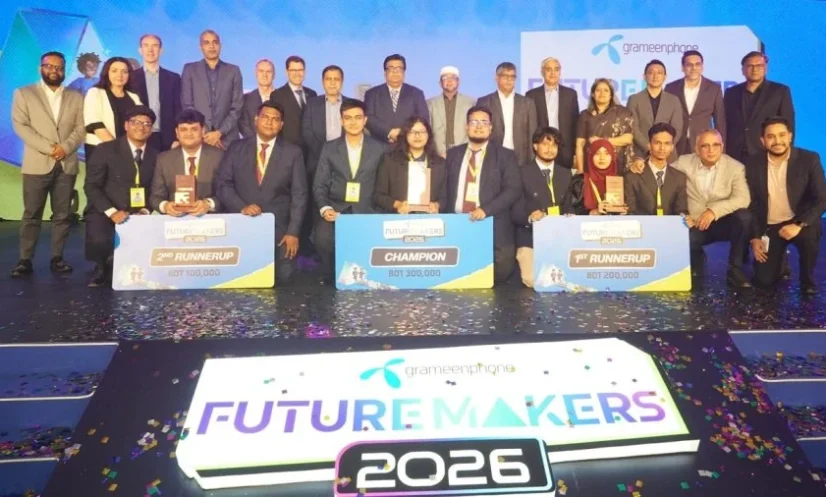
He was speaking at the grand finale of the second edition of ‘Grameenphone FutureMakers 2026’, an AI-based innovation competition addressing social challenges, held at a city hotel on Tuesday.
The competition, themed ‘AI for Social Good’, showcased technology-driven solutions in healthcare, education, the environment, employment and social inclusion.
More than 7,000 students participate
More than 7,000 students from over 70 universities across the country took part in this year’s competition, submitting 1,130 AI-based ideas. Participation increased by around 40 per cent compared with the inaugural edition in 2025.
Students from science, technology, engineering and mathematics (STEM) and other disciplines presented ideas across seven areas, including digital inclusion and education, healthcare and mental well-being, skills development and employment, gender equality and environmental protection.
EchoClip wins top prize
Team LubDub emerged as the champion with its innovation, EchoClip, an AI-powered clip-on device designed to work with conventional stethoscopes and help identify early signs of potential heart disease.
Team River Sentinel secured the first runner-up position with an AI-based river erosion forecasting system designed to identify vulnerable areas and provide early warnings to communities at risk.
Team Jinxed finished second runner-up with Spasto AI, an AI-assisted speech therapy application offering personalised treatment plans, guided home exercises and progress monitoring.
The champion team received Tk3 lakh, while the first and second runners-up received Tk2 lakh and Tk1 lakh respectively.
Members of the winning teams will also have opportunities to join Grameenphone’s Next Business Leader (NBL) talent development programme and Nextern internship programme.
Five priorities for technology development
Addressing the event, Rehan Asif Asad outlined three fundamental layers of AI technology: computing power, including GPUs and next-generation NPUs; high-bandwidth memory (HBM); and language models.
He highlighted the dominance of South Korean companies Samsung and SK Hynix in the high-speed memory market and mentioned OpenAI, Anthropic and Grok among major players in language models.
He said semiconductors and AI had played significant roles in South Korea’s economic and technological development. Global demand for advanced chips was so high that even buyers with sufficient funds might have to wait until 2031 or 2032 for supplies, he added.
The adviser said the government was prioritising five areas to strengthen Bangladesh’s technological capabilities.
These include developing appropriate laws, policies and regulatory guidelines; ensuring secure and reliable connectivity; building digital public infrastructure; strengthening AI and cybersecurity capabilities; and expanding domestic manufacturing of consumer electronics, semiconductors and other technological equipment.
On digital public infrastructure, he outlined a vision of ‘one citizen, one ID, one wallet’, under which citizens would have integrated physical and digital identities linked to essential documents, government services and financial accounts.
He said a team of Estonian experts was assisting the government in developing an integrated e-governance framework. The initiative would draw on Estonia’s X-Road model, which enables secure data exchange among government institutions.
He also warned that while AI would create opportunities for innovation and improved services, criminals could use the technology to launch increasingly sophisticated cyberattacks. Strong digital infrastructure and cybersecurity would therefore be essential.
Referring to domestic manufacturing, he said the government wanted to build on Bangladesh’s success in the ready-made garment industry and achieve similar progress in electronics manufacturing over the next five years.
He said the government was committed to creating an environment in which local entrepreneurs and technology companies could participate in the global technological transformation.