


 Play store

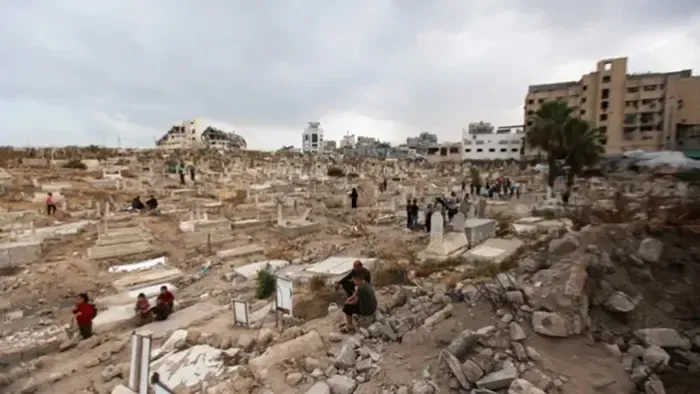
Gaza’s cemeteries are running out of space as the territory struggles to bury thousands killed during the ongoing war, with families increasingly forced to reuse graves or resort to temporary burial sites.
Israel’s military campaign in Gaza, which began in October 2023, has killed more than 73,000 Palestinians and injured more than 150,000, according to the report. Although a ceasefire is officially in place, Israeli attacks have continued almost daily, while millions have been displaced.
For 20-year-old Omar al-Sawhi, the shortage of burial space has become a deeply personal reality. His father, 40-year-old Mohammad, was selling tea and coffee at a small roadside shop in Gaza City’s Zeitoun area when he was shot in the neck near Israel’s designated “Yellow Line” on June 10. He died at the scene.
When Omar took his father’s body to the Zeitoun cemetery, he found that little burial space remained. Cemeteries across Gaza have become severely overcrowded following years of mass casualties.
Many graves have no permanent markers. In some cases, a stone and a piece of paper bearing the deceased’s name are all that identify a burial site. The shortage of land and construction materials has made traditional graves increasingly difficult to prepare.
“I stood in the middle of the cemetery and saw countless graves,” Omar told Al Jazeera. “There were mountains of sand everywhere, and people had been buried beneath that sand.”
Omar said his family could not afford the roughly 500 shekels ($167) needed to prepare a new grave, even if they could find available space.
“There was no place for a new grave. So in the end, we had to bury my father in my grandfather’s grave,” he said.
Gaza’s severely damaged health and civil infrastructure has also made it difficult to identify and properly bury the dead. Thousands of Palestinians have been listed as missing during the war, while others have been temporarily buried in home courtyards, beside tents, inside displacement camps, and in school and hospital grounds.
Following a US-mediated ceasefire announced in October 2025, the intensity of Israeli attacks declined somewhat, allowing families to search for the remains of relatives buried beneath rubble or in makeshift cemeteries.
However, at least 1,200 Palestinians have reportedly been killed in Israeli attacks since the ceasefire, creating further pressure on Gaza’s already overcrowded burial grounds. Gaza authorities said the remains of 529 Palestinians were recovered from seven mass graves located on hospital premises.
The burial crisis is not solely the result of the number of people killed. More than 40 cemeteries have also been destroyed since the war began, according to Gaza’s Ministry of Religious Affairs and Endowments.
Access restrictions imposed on cemeteries in areas under Israeli military control have further reduced families’ options for burying their dead.
Ikrami al-Madalal, a media official at Gaza’s Endowments Ministry, said many of Gaza’s 60 cemeteries were already close to capacity before the war.
For 50-year-old gravedigger Tafesh Abu Hatab, who has worked in the profession for 19 years, the war has been the most difficult period of his career.
The Khan Younis cemetery where he works had around 60 graves when the war began. It now holds roughly 6,000 bodies.
At one point during the conflict, Tafesh said he had to prepare as many as 35 graves a day.