Play store

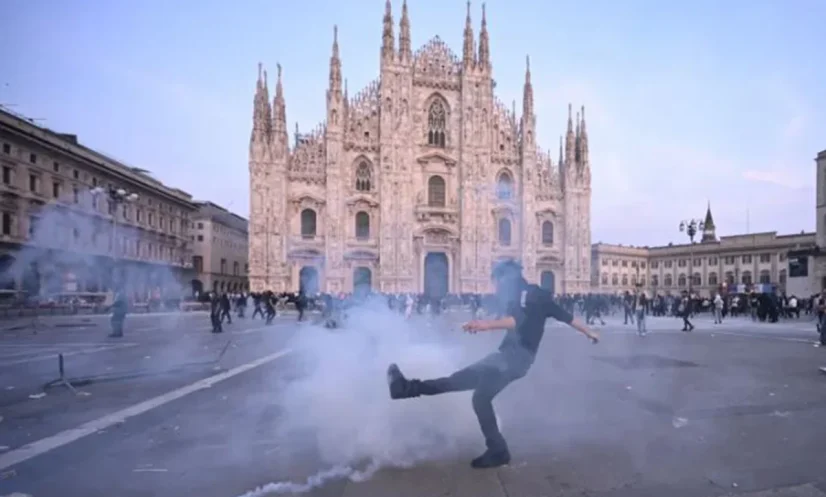
Hundreds of thousands of people took to the streets in France, Belgium, Italy and Portugal on Saturday to protest rising living costs, low wages, housing shortages and problems in the education system, triggering clashes with police in several cities.
The demonstrations, held separately across the four countries, saw incidents of looting, arson and violence. Police used tear gas and water cannon to disperse protesters in some locations.
The unrest has put renewed pressure on governments across the European Union, with analysts warning that public anger over economic uncertainty and the rising cost of living could spread further in the coming days.
France experienced one of its most turbulent days of protests in decades, with more than 550,000 people taking part nationwide, according to the country’s interior ministry. The demonstrations expanded following weeks of student protests.
Violence erupted in several cities as groups of masked and radical protesters attacked public buildings, luxury shopping centres and supermarkets. Police officers and vehicles also came under attack.
French Prime Minister Sébastien Lecornu said 1,200 people had been arrested and 150 police officers injured in the unrest. Visiting officers deployed in central Paris, he said it was a miracle that the number of casualties had not been higher.
According to AFP, shops were looted in Paris, Marseille, Nice, Nantes, Bordeaux, Limoges, Lille, Toulouse and Strasbourg, among other cities.
Paris Mayor Emmanuel Grégoire said entire streets in the capital had been damaged.
In Limoges, a fire set by masked protesters almost completely destroyed the city hall, a building more than 140 years old. Municipal buildings in Marseille and Lille were also attacked and vandalised, while a tourist office was set on fire in Lyon.
President Emmanuel Macron said in a post on X that those responsible would be brought to justice and punished.
In Brussels, students have been protesting for weeks against increases in university registration fees.
During Saturday’s demonstrations, police used tear gas and water cannon to disperse protesters accused of throwing objects at officers and setting fires. Water cannon were also deployed to control protests in Liège, in eastern Belgium.
In Portugal, thousands of people marched through Lisbon to protest rising living costs, low wages and a severe housing shortage in major cities.
House prices in Portugal have more than doubled since 2017, while rents for new tenancy agreements have risen at a similar pace, adding to pressure on households.
Parliamentary Affairs Minister Carlos Abreu Amorim said on Friday that the government could not be forced to change its decisions through street slogans. Protesters, however, argued that the country’s leaders were disconnected from the everyday difficulties faced by ordinary people.
Clashes with police in Italy
In Milan, a demonstration against war and rising living costs began peacefully but later turned violent.
Masked protesters threw stones and chunks of paving at police and set fire to barricades made from tables. Police responded with tear gas and water cannon.
Italian news agency LaPresse reported that at least two police officers were injured and around 50 protesters were detained, many of them minors.
Prime Minister Giorgia Meloni condemned the violence, saying that while protesting was a right, setting cities on fire was not.
Milan’s centre-left mayor, Giuseppe Sala, said the grievances behind the demonstrations were understandable but attacks on police and extensive damage to the city were unacceptable.
Clashes and stone-throwing were also reported alongside peaceful gatherings in Bologna.
Alberto Alemanno, a professor of European Union law and policy at HEC Paris business school, said France had become the focal point of the unrest, but signs of discontent were emerging elsewhere.
Early indications of protests were also visible in Greece, Germany and Austria, where demonstrations could intensify in the coming week, he said.
Alemanno stressed that the protests were not part of a single coordinated movement. Rather, they were separate demonstrations emerging simultaneously in different countries, linked by shared concerns over inadequate education funding, the rising cost of living and uncertain career prospects after graduation.
With important elections scheduled in several European countries, including Spain, France, Italy and Poland, over the next 12 months, analysts believe the growing unrest could significantly influence political debate across the continent.