


 Play store

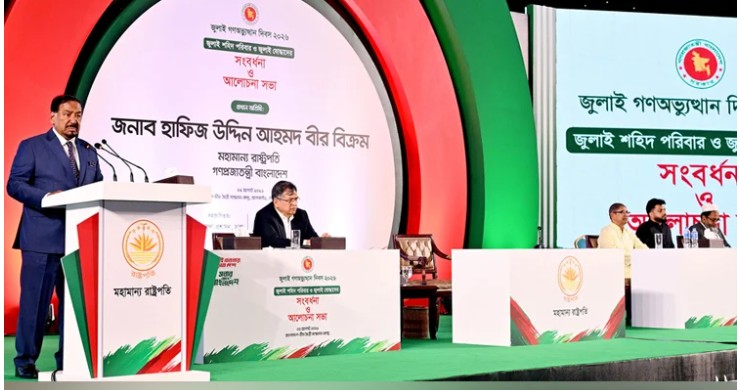
Acting President Hafiz Uddin Ahmad Bir Bikram on Wednesday said ensuring the welfare of the families of those martyred in the July Mass Uprising, along with the treatment and rehabilitation of the injured, is the government’s “most sacred responsibility.”
“The most important task of this government is to look after the families of those who made the supreme sacrifice in the July movement. This is our most sacred responsibility,” he said.
“It is also the government’s sacred duty to restore the health of those who were injured, who lost their eyesight or limbs,” he added.
The Acting President made the remarks while addressing a reception and discussion for the families of the July martyrs and July fighters at the Bangladesh-China Friendship Conference Centre, organised to mark July Mass Uprising Day 2026.
Describing the July Mass Uprising as a defining moment in the nation’s history, he said August 5, 2024, marked the end of prolonged authoritarian rule and the beginning of a new chapter for Bangladesh.
Calling the day one “written in golden letters,” Hafiz Uddin said the uprising reflected the triumph of people who stood for democracy, justice and human dignity.
He paid tribute to those killed during the movement, including Abu Sayeed, Mugdha, Wasim, Yamin, Farhan, Nafiz, Sajal, Rabbi, Meraj, Elem, Taim, Naima, Riya Gope and Ahad, saying their sacrifices would inspire future generations.
The Acting President became emotional while referring to the presence of a mother accompanying her son who lost his eyesight during the movement.
“The young man lost his eyesight in the struggle to restore democracy and establish the rule of law. If such people have to go from minister to minister even for their modest needs, it would be a matter of shame for the nation,” he said.
Addressing the July fighters and the families of the martyrs directly, he assured them that the government would honour its commitments.
“Do not lose heart. You will certainly receive the honour you deserve from this government. We will dedicate everything within our means for your welfare,” he said.
He also pledged that the government would remain accountable to the people.
“If this elected government makes any mistakes, bring them to our attention and we will correct them,” he said.
Referring to the previous Awami League government, the Acting President alleged that it had been responsible for repression, enforced disappearances, killings, corruption and money laundering, claiming those responsible had shown no remorse.
“We are not like the Awami League, and we do not want to become like them,” he said.
Hafiz Uddin, a decorated freedom fighter, recalled joining the Liberation War at the age of 27 and said he remained committed to defending democracy.
“I fought in the Liberation War at the age of 27. Now, at the age of 82, I will fight another one for Bangladesh and its people, to make good governance and democracy permanent,” he said.
He said the July Mass Uprising had created a historic opportunity to rebuild the state and urged all citizens to work together to establish a democratic, corruption-free and discrimination-free Bangladesh where every citizen enjoys equal rights and dignity.
“Today we stand at the beginning of a new journey. Differences of opinion will remain, but on issues of national interest, democratic values, and the country’s independence and sovereignty, we must remain united,” he said.
The Acting President also called on citizens to remain vigilant against division and hatred, urging them to embrace the spirit of the July Mass Uprising through patriotism, honesty and mutual respect.
Earlier, he presented crests to representatives of the families of the July martyrs and July fighters.
The programme was chaired by Liberation War Affairs Minister Ahmed Azam Khan. Home Minister Salahuddin Ahmed and State Minister for Liberation War Affairs Ishraq Hossain attended as special guests. Representatives of Bangladesh Jamaat-e-Islami, the National Citizens Committee, senior government officials and family members of the martyrs also attended the event.
The programme began with the national anthem, recitations from holy scriptures, a one-minute silence in memory of the July martyrs, and the screening of a documentary on the July Mass Uprising.