Play store

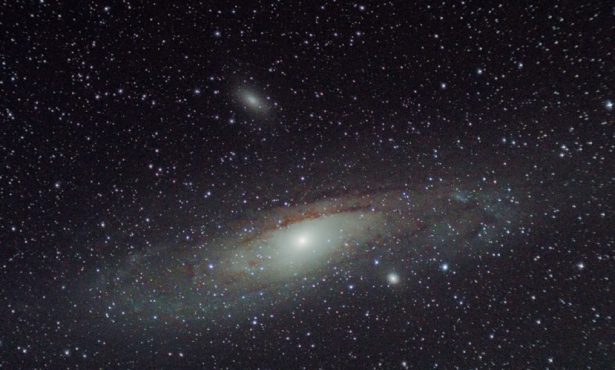
Star formation in the nearby Andromeda Galaxy has been steadily declining over the past 500 million years, with the rate falling even more sharply during the last 40 million years, according to a new study based on observations from the Hubble Space Telescope.
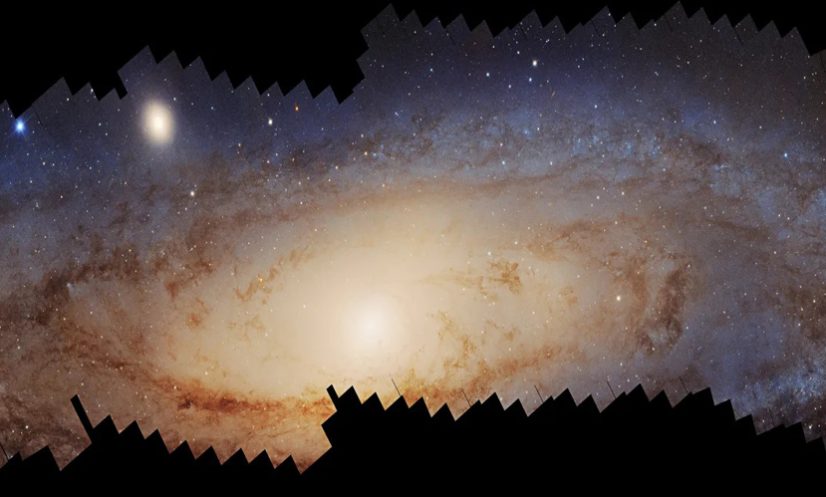
The study, published July 27, 2026, in The Astrophysical Journal, used data from two Hubble surveys to trace the history of star formation across about two-thirds of Andromeda’s disk.
Astronomers already knew that Andromeda, also known as M31, experienced a major burst of star formation about 2 billion years ago. The new research provides a more detailed picture of what happened afterward, showing that the galaxy’s star-making activity gradually weakened over the past half-billion years before declining more rapidly in the most recent 40 million years.
Lead author Tobin Wainer, an astronomer at the University of Washington, said the project brought together decades of research to provide a comprehensive view of Andromeda.
“This project is the combination of multiple decades worth of experience to really get a holistic picture of the Andromeda Galaxy,” Wainer said in a statement released by the Space Telescope Science Institute.
Located about 2.5 million light-years from Earth, Andromeda is roughly comparable in size to the Milky Way. Its relative proximity allows Hubble to resolve individual stars while also giving astronomers a broad view of the galaxy’s entire disk.
That makes Andromeda particularly valuable for studying how galaxies evolve. Scientists cannot obtain the same outside perspective of the Milky Way because Earth and the solar system are located within its disk.
“Andromeda is important because it’s a neighbor that is close enough that we can see it in great detail while also getting a global perspective,” said study co-author Raja GuhaThakurta, an astronomer at the University of California, Santa Cruz.
The study found that about 500 million years ago, Andromeda was producing stars at a rate of roughly one solar mass per year, similar to the Milky Way’s current rate. That was already a substantial decline from its earlier peak, when the galaxy was forming stars at about six solar masses per year.
By around 40 million years ago, Andromeda’s star-formation rate had fallen to approximately half a solar mass per year. Today, it has declined further to about one-fifth of a solar mass per year.
Researchers say much of the slowdown appears to be linked to a large ring of gas and dust surrounding the galaxy about 32,000 light-years from its center. A 2015 study of northern Andromeda found that the ring was responsible for roughly 60 percent of the galaxy’s star formation during the previous 400 million years.
As activity within the gas-and-dust ring weakened, it appears to have driven the broader decline in Andromeda’s ability to produce new stars.
By reconstructing Andromeda’s recent star-formation history, astronomers hope to better understand how the galaxy has evolved and gain clues about the history and future development of galaxies, including the Milky Way.