


 Play store

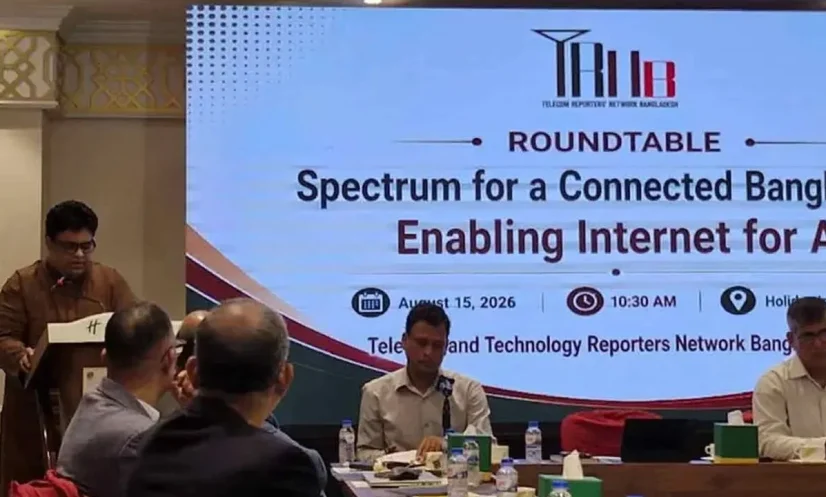
The government plans to bring around 70 million people under mobile internet coverage within the next six to 12 months, Prime Minister’s Adviser on Posts and Telecommunications Rehan Asif Asad has said.
He said nearly half of Bangladesh’s mobile phone users still rely on 2G feature phones, making it impossible to shift them to smartphones overnight. The government is therefore looking at affordable smartphone models and coordinated initiatives involving handset manufacturers and mobile operators.
“As many as 50 percent of the country’s mobile phones are still 2G,” Rehan Asad said while addressing a roundtable titled “Spectrum for a Connected Bangladesh: Enabling Internet for All”, organised by the Telecom and Technology Reporters Network Bangladesh (TRNB) at a hotel in Dhaka on Saturday.
He said Bangladesh has around 140 million mobile phone users, meaning roughly 70 million people are still using 2G phones.
“We cannot bring these 50 percent of users to smartphones overnight,” he said, adding that the transition could be achieved gradually through a coordinated effort involving the government and the telecom industry.
Rehan said discussions on making affordable smartphones began around two weeks before the national budget was announced.
Industry stakeholders and handset manufacturers subsequently worked together to explore whether a smartphone could be produced for around Tk 3,000.
“Manufacturers prepared a bill of materials within seven days and showed that producing such a phone for Tk 3,000 was not possible. However, it could be produced within Tk 5,000 to Tk 6,000,” he said.
The adviser said the government had also reviewed low-cost smartphone models available in international markets.
He cited Reliance in India as an example, saying the company sells a low-cost Android phone for around $39. The device does not use a full touchscreen, with roughly two-thirds of the front dedicated to the touchscreen and the remaining portion using a keypad.
Reducing the screen size and incorporating a keypad helps lower the production cost by around $6, he said.
Bangladeshi manufacturers are considering a similar approach to produce affordable smartphones for domestic consumers, according to Rehan.
He also called on mobile operators to join the initiative by working with manufacturers on co-branded handsets and offering bundled voice and data packages with the devices.
Bangladesh Telecommunication Regulatory Commission (BTRC) Chairman Emdad Ul Bari said the telecommunications sector should not be viewed solely from the perspectives of consumers or operators.
“The people, businesses and government need to be considered together,” he said.
Consumers have long raised concerns over two issues: service quality and prices, he added.
Regarding service quality, call drops remain one of the most frequently raised complaints. Emdad said call drops cannot be eliminated completely because they can result from numerous technical factors, even when a network is operated according to regulatory standards.
He also noted that the International Telecommunication Union (ITU) recognises a certain level of call drops as acceptable under its standards.
Meanwhile, Mobile Operators Association of Bangladesh (AMTOB) President Ziad Satara said mobile operators in Bangladesh spend at least 16 percent of their total revenue on spectrum fees.
He said the figure compares with an average of around 10 percent in the Asia-Pacific region and about 8 percent globally.
The relatively high cost of spectrum, he suggested, remains an important issue for the telecom industry as Bangladesh seeks to expand affordable connectivity.
The roundtable brought together policymakers, regulators, mobile operators and telecom experts to discuss how spectrum policy can be used to expand internet access and improve connectivity across the country.
The event was chaired by TRNB President S M Masuduzzaman Robin and moderated by its General Secretary Faruk Hossain.
Grameenphone CEO Yasir Azman, Banglalink CEO Erik Aas, telecom expert Nurul Kabir and AMTOB Secretary General Lt Col Mohammad Zulfikar also spoke at the event.