


 Play store

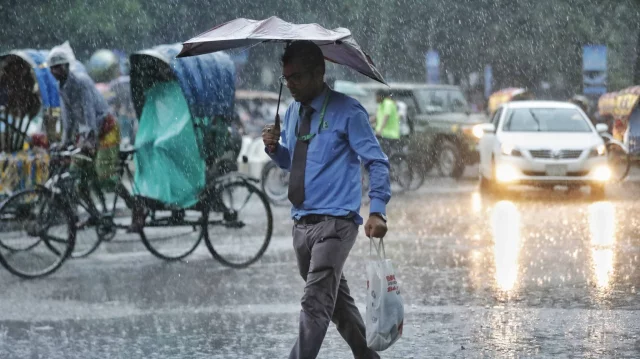
Rainfall brought a noticeable improvement in Dhaka’s air quality on Wednesday morning, with the capital recording a ‘moderate’ Air Quality Index (AQI) rating and ranking 22nd among the world’s most polluted cities.
According to AQI monitoring data, Dhaka recorded a score of 77 at 9:15 am, indicating that the air was generally acceptable for most people, although unusually sensitive individuals could still experience minor health effects.
Kinshasa topped the global pollution ranking with an AQI score of 188, followed by Kuwait City at 156 and Dubai at 134.
Under the AQI scale, a score between 51 and 100 is considered ‘moderate’, while readings of 101-150 are classified as ‘unhealthy for sensitive groups’, 151-200 as ‘unhealthy’, 201-300 as ‘very unhealthy’, and anything above 301 as ‘hazardous’, posing serious health risks to the general population.
The AQI provides a daily assessment of air pollution levels and their potential impact on public health.
In Bangladesh, the index is calculated based on concentrations of five major pollutants: PM2.5, PM10, nitrogen dioxide (NO₂), carbon monoxide (CO), sulphur dioxide (SO₂) and ozone.
Dhaka has long struggled with poor air quality, particularly during the dry winter months when pollution levels typically spike. Air quality generally improves during the monsoon season as rainfall helps wash pollutants from the atmosphere.
According to the World Health Organization (WHO), air pollution is responsible for an estimated seven million premature deaths worldwide each year, contributing to diseases such as stroke, heart disease, chronic obstructive pulmonary disease (COPD), lung cancer and acute respiratory infections.