Play store

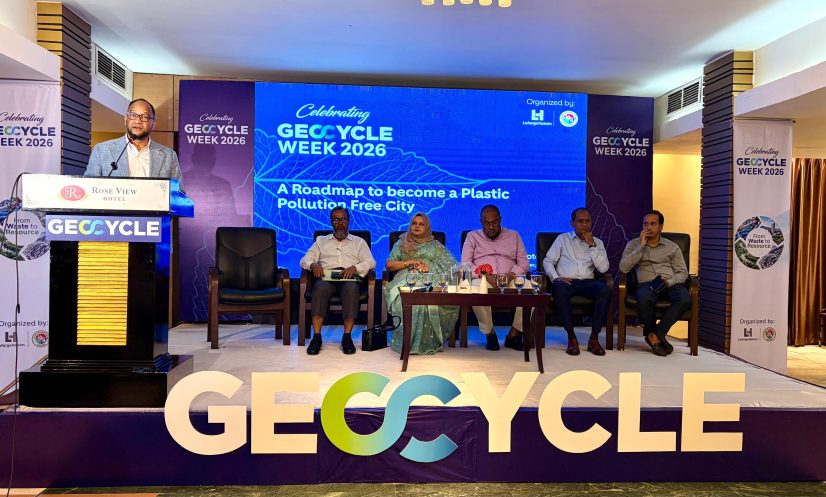
SYLHET: LafargeHolcim Bangladesh PLC (LHB) and Sylhet City Corporation (SCC) have joined hands to develop a roadmap for making Sylhet a plastic pollution-free city through improved waste management, recycling and circular economy practices.
The two organisations organised a seminar titled “A Roadmap to Become a Plastic Pollution-Free City” at the Rose View Hotel in Sylhet on Sunday as part of Geocycle Week 2026.
The seminar brought together government officials, environmentalists, academics, media representatives and youth leaders to discuss an actionable strategy for sustainable urban waste management and reducing plastic pollution in the city.
Abdul Quiyum Choudhury, Administrator of Sylhet City Corporation; Mohammad Iqbal Chowdhury, CEO of LafargeHolcim Bangladesh; Muhammad Razaie Rafin Sarkar, CEO of Sylhet City Corporation; women entrepreneur Shama Haque Chowdhury; Md Abul Kalam Azad, Director of the Department of Environment in Sylhet; and Shipon Chowdhury, DIG of DIFE Sylhet, took part in the discussion.
The seminar began with an audio-visual presentation on Geocycle, the waste-management arm of LafargeHolcim Bangladesh, followed by presentations by Lieutenant Colonel (Retired) Mohammad Eklim Abdeen, Chief Waste Management Officer of SCC, and Latifur Rahman, Head of Geocycle.
A key focus of the discussion was the Material Recovery Facility (MRF) at the Lalmatia Dumping Ground, jointly established by LHB and SCC in 2024.
The facility is described as the country’s first state-of-the-art municipal waste and plastic segregation plant. It currently plays a role in Sylhet’s circular economy strategy by sorting non-biodegradable plastic waste and diverting it from landfills and waterways.
The segregated plastic waste is then sent to Geocycle for co-processing, according to the organisers.
Building on the facility’s operations, LHB and SCC also outlined plans for a bio-drying project. The proposed technology will pre-treat municipal solid waste and reduce its moisture content, which is expected to improve the efficiency of plastic waste segregation and recovery.
Emphasising the city corporation’s commitment to sustainable urban development, Abdul Quiyum Choudhury said local government initiatives must be supported by community engagement and effective regulatory measures.
“To transform Sylhet into a clean and green city, local government initiatives must align with strong community engagement and regulatory frameworks. Our vision is to build a plastic pollution-free city through strategic partnerships, modern infrastructure, and continuous public awareness,” he said.
Mohammad Iqbal Chowdhury, CEO of LafargeHolcim Bangladesh, highlighted the role of the private sector in developing circular economy solutions.
“At LafargeHolcim, we are deeply committed to driving sustainable growth and lowering carbon emissions across Bangladesh through Geocycle, our waste management wing,” he said.
“Partnering with Sylhet City Corporation allows us to deploy safe co-processing capabilities that divert plastic waste from landfills and rivers, contributing directly to a cleaner environment and a better tomorrow,” he added.
Muhammad Razaie Rafin Sarkar, CEO of Sylhet City Corporation, said sustainable and long-term solutions were essential for managing municipal waste as the city continues to grow.
“Effective municipal solid waste management requires sustainable, long-term solutions tailored to our growing urban footprint. By collaborating with industry pioneers and leveraging modern waste management practices, Sylhet City Corporation is taking decisive steps to eliminate plastic waste from our streets and waterways,” he said.
Through Geocycle, LafargeHolcim Bangladesh continues to provide co-processing solutions for waste that can reduce the amount of waste sent to landfills and support circular economy and waste-management initiatives.
The seminar concluded with a joint commitment from the city corporation and LHB to accelerate circular economy practices, strengthen waste segregation and recovery, and work towards reducing plastic pollution across Sylhet.