Play store

Washington says it struck 90 military targets as Tehran retaliates across the Gulf, while shipping through the Strait of Hormuz drops sharply.
The United States and Iran exchanged fresh strikes on Thursday, intensifying their military confrontation as Iran buried its late Supreme Leader Ayatollah Ali Khamenei after six days of funeral ceremonies and observers reported a sharp decline in shipping through the strategic Strait of Hormuz.
The US military said it struck 90 Iranian military targets, including air defence systems and logistics infrastructure along Iran’s southern coastline, in an effort to weaken Tehran’s ability to threaten commercial shipping in the vital waterway.
Iran, meanwhile, said it launched retaliatory attacks on US assets in Kuwait, Bahrain and Qatar. State-linked media later reported additional strikes targeting sites in Kuwait, Jordan and Iraq.
Iranian state media also reported that areas near the Bushehr nuclear power plant were hit, citing the province’s deputy governor, although the United States has not commented on those reports. Iran’s Foreign Ministry condemned the latest US attacks as a “grave war crime” and accused the US administration of acting in an “evil and psychopathic” manner.
According to Iran’s Health Ministry, at least 14 people have been killed and 78 injured across five provinces during the past two days. The Foreign Ministry also said bridges and a railway linking Tehran to Mashhad, where Khamenei was buried, were damaged in the attacks.
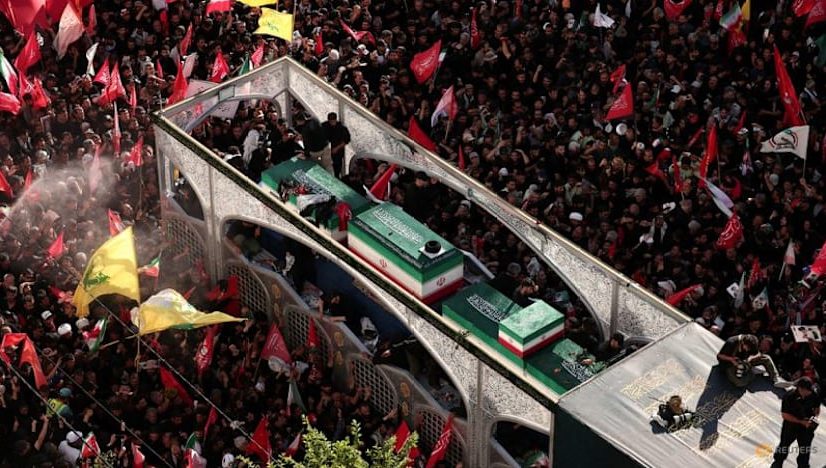
Huge crowds gathered in Mashhad for the funeral of Khamenei, who was killed on 28 February during the opening hours of US and Israeli strikes on Iran. Thousands of mourners carrying Iranian flags filled the streets, while some held placards threatening US President Donald Trump.
Elsewhere in the Gulf, Bahrain reported explosions in the capital, Manama, Kuwait said it intercepted missiles and drones, and Qatar issued a security alert following the Iranian attacks.
Explosions were also reported later on Thursday in the southern Iranian port of Konarak, where a local official said a naval facility had been attacked by an “enemy”. However, a US defence official told the BBC that American forces had not conducted any strikes inside Iran in recent hours.
Iranian Parliament Speaker Mohammad Bagher Ghalibaf warned Washington that further military action would provoke a response.
“If you strike, you’ll get hit,” he wrote on X, adding that the Strait of Hormuz would reopen only under Iranian arrangements rather than “American threats”.
US Central Command (CENTCOM) said the latest operation followed successful strikes carried out the previous night and was intended to further reduce Iran’s capability to attack commercial vessels and civilian mariners using the strategic shipping route.
The renewed fighting has also disrupted maritime traffic through the Strait of Hormuz, one of the world’s busiest oil transit corridors.
Phil Belcher, marine director of the International Association of Independent Tanker Owners (Intertanko), said the number of ships using the southern route near Oman had fallen into “single figures” following the latest escalation.
He said daily vessel traffic through the Strait had dropped to around 30 ships from about 70 a week earlier, far below the normal level of around 130 ships before the conflict intensified.
Belcher said optimism following last month’s memorandum of understanding between Washington and Tehran had quickly faded as the renewed violence rattled the shipping industry and affected seafarers operating in the region.
Iranian media reported power outages in Chabahar and a fire at an Islamic Revolutionary Guard Corps (IRGC) barracks in Bushehr after Wednesday night’s attacks. Verified videos circulating on social media appeared to show significant damage to a marine control tower in Chabahar.
US President Donald Trump said Iran had recently contacted Washington seeking to revive negotiations but questioned whether Tehran could be trusted to honour any future agreement.
“I don’t know if they’re worthy of making a deal,” Trump said. “I don’t know that they’re going to honour the deal.”
Trump later declared that last month’s ceasefire agreement with Iran was “over”, describing further negotiations as “a waste of time”.
Responding on X, Iranian Foreign Minister Abbas Araghchi said Tehran would answer US actions “with action: fearlessly and with great valour.”
The latest escalation marks the most serious exchange of hostilities between the United States and Iran since the two sides signed a memorandum of understanding on 17 June that called for a 60-day ceasefire, the safe passage of vessels through the Strait of Hormuz and continued negotiations over sanctions and regional security.This version follows a conventional international news style with a strong lead, smooth transitions, and no subheadings within the body. Source: BBC News