


 Play store

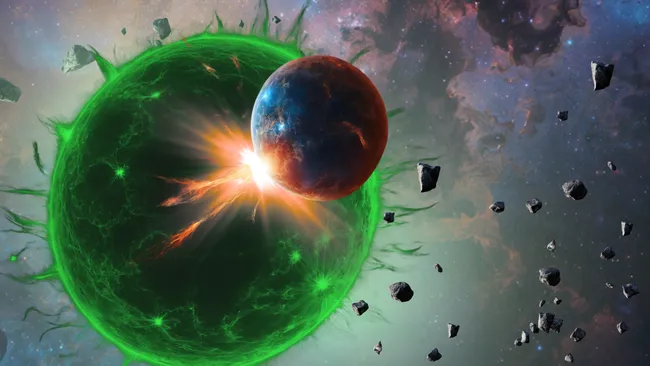
Scientists have identified what may be the first genuinely green star, a dead stellar remnant whose unusual colour is linked to the rocky material it consumes from nearby planetary bodies.
The object, known as WD J1330+6435, is a white dwarf located about 326 light-years from Earth. Researchers say its atmosphere has been enriched with calcium, lithium and sodium from planetary debris, producing a green hue.
The finding challenges the conventional understanding that a star’s colour is determined mainly by its temperature, according to research led by Mark Hollands of the University of Warwick.
White dwarfs are the dense remnants left behind when stars similar in mass to the Sun exhaust their nuclear fuel and collapse. Although they typically appear white or pale blue, the study suggests that their atmospheric composition and extreme density can produce a wider range of colours, including green, pink, purple, yellow and cyan.
“Most stars, including most white dwarfs, behave like ‘perfect radiators,’ so their colour is set almost entirely by temperature,” Hollands said in a statement quoted by Space.com. “But nobody had really looked into what else might be possible for white dwarfs.”
The researchers found that elements behave differently under the extreme conditions in a white dwarf’s atmosphere. Carbon, calcium and sodium can interact with dense helium plasma and absorb light across a broader range of wavelengths, altering the star’s apparent colour.
In WD J1330+6435, traces of sodium absorb part of the orange spectrum, leaving a greenish glow, Hollands explained.
The team also identified WD J1011+2845, a white dwarf about 48 light-years away, as a candidate for an exceptionally red-coloured star. Carbon molecules brought to its surface distort its light, producing a deep salmon-pink appearance.
The researchers estimate that unusual colours remain relatively rare among white dwarfs. Of 151 such objects within roughly 65 light-years of Earth, only five displayed extraordinary colours. Based on their findings, they estimate that about one in 30 white dwarfs across the wider population may have an unusual hue.
Despite the colourful exceptions, white remains the typical colour of these stellar remnants.
The findings offer a new perspective on the final stages of stellar evolution, including how dead stars interact with the remains of planetary systems. In billions of years, the Sun is expected to become a white dwarf, although the study does not establish that it will turn green.
The research suggests that the remnants of dying stars may be far more colourful than astronomers have traditionally assumed.