


 Play store

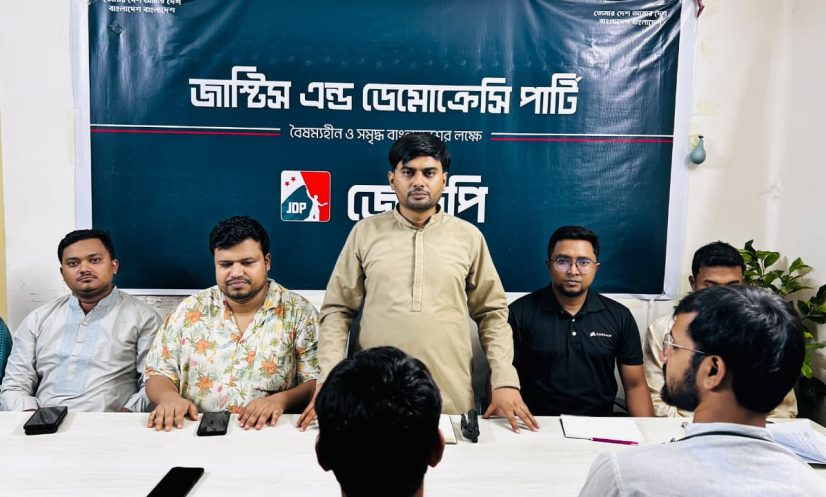
DHAKA: The Justice and Democracy Party (JDP) has criticised the absence of any state or party programme marking the 121st anniversary of the Partition of Bengal, saying the omission reflects a serious disregard for history, heritage and cultural traditions despite the BNP being in power with Bangladeshi nationalism as one of its core political principles.
JDP Convener Naim Ahmad said the 1905 Partition of Bengal was an important chapter in the historical development of Bangladesh’s distinct political identity and Bangladeshi nationalism, describing it as one of the sources of inspiration and an ideological foundation for pro-Bangladesh politics.
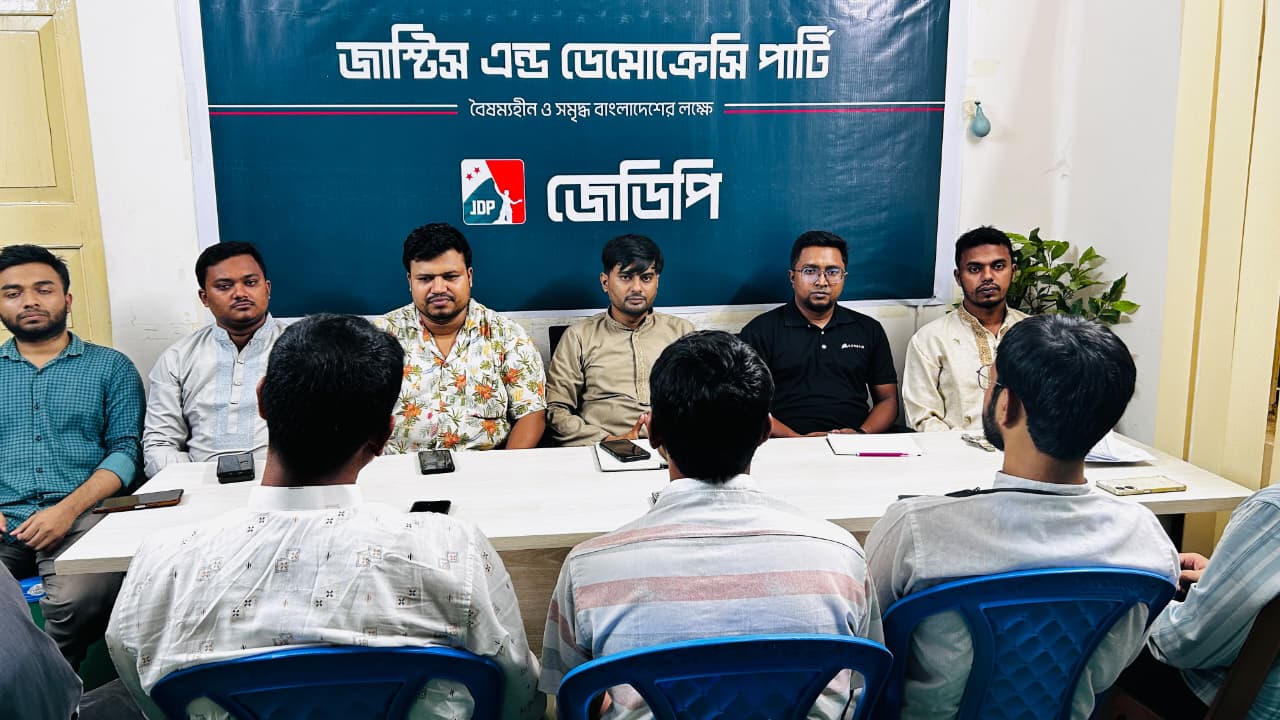
He made the remarks at a discussion organised by the JDP’s Dhaka North city unit at the party’s central office on Friday evening to mark the anniversary.
Naim said the BNP presents Bangladeshi nationalism as a key pillar of its political ideology, yet no state or party programme had been evident to commemorate an event he described as significant to the historical roots of that nationalism. He said the failure to properly remember an important chapter in the country’s national history was disappointing.
The JDP leader said the 1905 Partition of Bengal should not be viewed solely as an administrative reorganisation under British colonial rule or simply as the division of Bengal. It had opened up new possibilities for the political, economic and cultural development of people in eastern Bengal, he said.
Under the partition, a new province of Eastern Bengal and Assam was created, where Muslims formed the majority. Making Dhaka the provincial capital also enhanced the region’s administrative and political importance, he added.
Recalling the historical context of the anti-partition movement, Naim said that when the partition came into effect on October 16, 1905, the Congress and various groups opposing it observed the day through mourning, the tying of rakhi threads, fasting and work stoppages.
He argued that the anti-partition movement later contributed to the rise of Hindutva. However, he said, support for partition among sections of the population in Eastern Bengal and Assam was not based solely on religious identity. Some members of the economically and socially disadvantaged Muslim community and Dalit Hindus had supported it in the hope of improving their circumstances and reducing inequality, he said.
Naim said the annulment of the partition and subsequent communal and political polarisation in the subcontinent influenced Muslim thinking about a separate political future.
Eastern Bengal became part of Pakistan following the 1947 Partition of British India. Political discrimination, movements for autonomy and the struggle for liberation subsequently culminated in the emergence of independent Bangladesh in 1971, he said.
He argued that the 1905 partition should therefore be considered an important episode in the evolution of eastern Bengal’s distinct political identity.
Referring to the Muslim-majority character of Eastern Bengal and Assam under the partition, Naim claimed that an independent, sovereign Bangladesh with a Muslim majority might have emerged as early as the 1940s had the partition not been annulled. He blamed opposition from Hindu nationalist groups for thwarting that possibility.
Presiding over the discussion, JDP Dhaka North Convener Imran Hossain Rahat said Bangladesh’s independence in 1971 came against a backdrop of economic, political and administrative discrimination, as well as cultural domination.
He described the Partition of Bengal as the ideological starting point of the struggle that eventually led to independence.
“The partition created a political realignment in eastern Bengal that later evolved into a distinct political identity associated with Muslim nationalism in the subcontinent and accelerated the process of achieving independence from British rule,” he said.
Although the partition took place 121 years ago, its history continued to inspire struggles for dignity and self-determination, Rahat said, adding that the legacy of those struggles extended to the July mass uprising.
The speakers called for the Partition of Bengal Day to be officially commemorated, discussions on the event to be held in educational institutions, and research into its political, economic and cultural consequences.
The discussion was moderated by JDP Dhaka North Member Secretary Engineer Mahtab Hossain Sabbir.
Among those present were the party’s Chief Organiser Md Ahchhan Ullah, Joint Member Secretaries Mostafa Shahriar and Abdul Hamid, Dhaka North Senior Joint Convener Shafiqul Islam Sumon, Joint Member Secretaries Shihab Uddin and Sohrab Ali, Office Secretary Ivan and Finance Secretary Mohammad Al Amin, among others.