Play store

Japan has successfully conducted the first test flight of its experimental reusable rocket, marking a significant step toward reducing space launch costs and boosting its competitiveness in the global space industry.
The reusable vehicle, named RV-X, was launched on Saturday from the Japan Aerospace Exploration Agency’s (JAXA) Noshiro Testing Center in northeastern Japan.
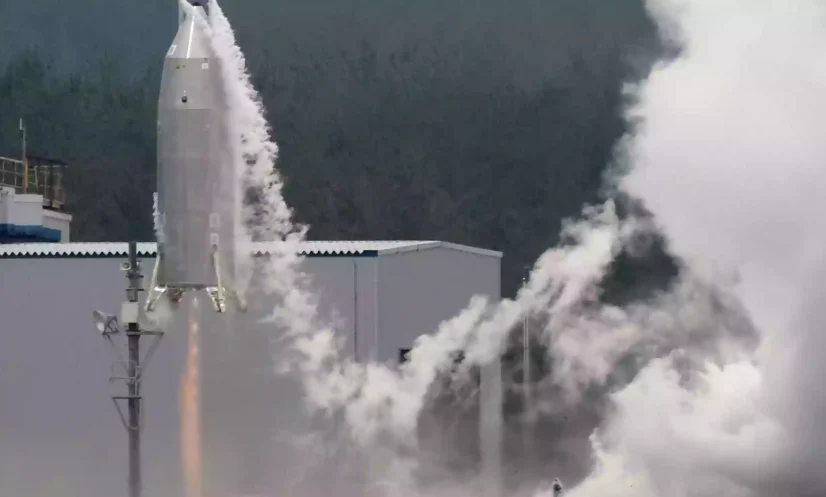
In a brief but crucial test lasting under one minute, the rocket lifted off vertically, hovered mid-air, moved laterally, and landed safely—demonstrating key capabilities required for reusable launch systems.
The launch, livestreamed by a Japanese space enthusiasts’ group, showcased precise control and stability.
According to JAXA’s reusable rocket project manager Takashi Ito, the test proceeded exactly as planned. The rocket reached a height of 11 metres, shifted 16 metres horizontally while maintaining an upright position, and then executed a controlled landing.
The RV-X programme is part of Japan’s broader effort to develop reusable rocket technology, similar to systems pioneered by private space companies, with the goal of significantly lowering launch costs.
JAXA aims to eventually apply this technology to a reusable successor to its current H3 rocket, which is designed for single use.
The successful test comes at a time of intensifying global competition in the space sector.
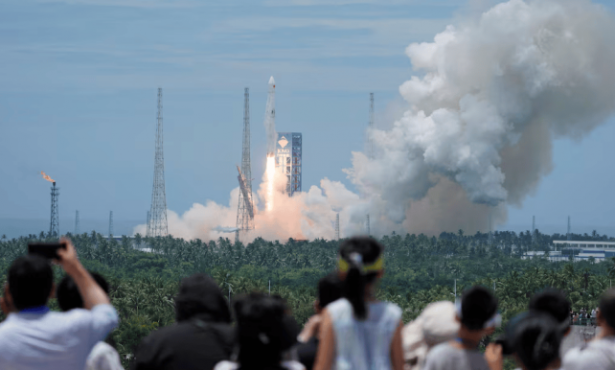
Just a day earlier, Chinese state media reported the recovery of a rocket’s first stage after launch, highlighting parallel advancements in reusable technologies.
Japan introduced the H3 rocket as a more cost-effective replacement for its highly reliable H-2A model.
However, officials acknowledge that further cost reductions are necessary to remain competitive in the rapidly expanding commercial launch market.
The Japanese government views the development of a reliable and economically viable launch system as critical not only for commercial success but also for national security and strategic independence in space.
The RV-X, developed jointly by JAXA and Mitsubishi Heavy Industries, measures 7.3 metres in length and 1.8 metres in diameter.
It is equipped with a durable engine and four shock-absorbing landing legs designed for repeated use. Ito noted that the rocket’s engine has already undergone 165 combustion tests, underscoring its reliability.
JAXA is also collaborating with partners in France and Germany to advance reusable rocket technology.
Future tests of the RV-X are expected to reach altitudes of up to 100 metres as development progresses.
The successful trial signals Japan’s growing ambition to establish a stronger foothold in the global space race through innovation and cost efficiency.