Play store

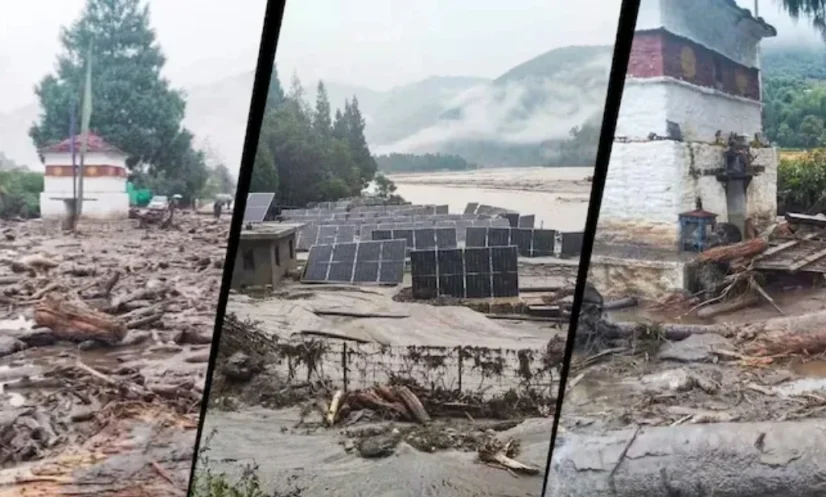
A glacial lake outburst flood (GLOF) in Bhutan has damaged a solar-powered irrigation project, prompting India to issue alerts in five districts of West Bengal and Assam over fears that floodwaters could flow downstream.
The dam of Shintaphu Lake, located beneath Wakila Mountain in Bhutan’s Gasa district, breached on Thursday (October 29) evening, sending water southwards into the Mo Chhu River and triggering flash floods in downstream areas.
India Today reported the development.
Also known as Shintaphu Tso, the lake is situated in the upper reaches of the Mo Chhu River basin. Floodwaters partially damaged a solar-powered irrigation project in the Dochukha-Jomlingthang-Ritsa area of Guma Gewog in Punakha district, rendering it unusable.
The flood also forced the closure of part of the Punakha-Gasa highway due to rocks and debris brought down from the mountains. No casualties have been reported in Bhutan so far, according to local representatives.
An official of Bhutan’s National Centre for Hydrology and Meteorology (NCHM) said Shintaphu Lake is among 17 potentially dangerous glacial lakes in the country. A monitoring station was installed at Taktsimakhang to monitor water levels, but no warning signals were received before the dam breach.
The extent of the breach and the damage to downstream areas remain unclear. Fast-flowing water carrying rocks and debris could damage homes, roads, bridges and agricultural land.
Shintaphu Lake lies in the Punatsangchhu River basin, which enters India and flows as the Sankosh River. This has raised concerns about possible flooding in downstream Indian areas.
India has issued alerts in Alipurduar, Darjeeling, Jalpaiguri and Cooch Behar districts of West Bengal, as well as Dhubri district in Assam, warning of a possible rise in the Sankosh River’s water level.
Teams of the National Disaster Response Force (NDRF) and State Disaster Response Force (SDRF) have been kept ready in Tufanganj and Baksirhat in Cooch Behar to respond to possible flooding.
An Indian government warning said floodwaters could reach the India-Bhutan border within six to eight hours.
The Sankosh River is connected through India to the Brahmaputra river system in Bangladesh, making the downstream flow from Bhutan significant for the country as well.
However, no confirmed information or official warning has so far indicated whether the flooding could pose any risk to Bangladesh.