


 Play store

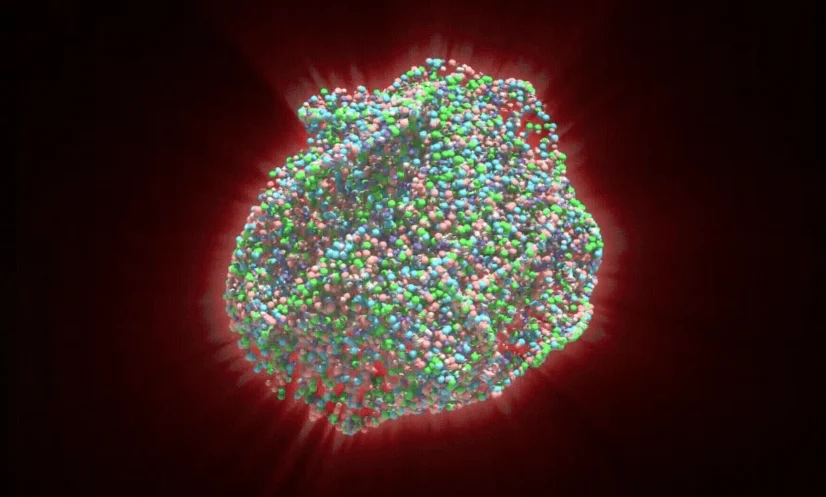
Scientists at CERN’s Large Hadron Collider (LHC) have found further evidence that an exotic form of matter, believed to have filled the universe shortly after the Big Bang, can be created by colliding relatively light atomic nuclei such as oxygen and neon.
The findings, reported by all four major LHC research collaborations — ALICE, ATLAS, CMS and LHCb — challenge the long-held assumption that extremely heavy atomic nuclei are required to produce this primordial matter, known as quark-gluon plasma (QGP).
The results come one year after the first-ever oxygen collisions at the LHC and could provide new insights into the conditions that existed during the earliest moments of the universe.
Quark-gluon plasma is an extremely hot and dense state of matter in which protons and neutrons break apart into their constituent quarks and gluons, the particles that normally bind them together.
Scientists believe the universe existed in this state during the first millionths of a second after the Big Bang, nearly 14 billion years ago.
The plasma can be briefly recreated by smashing atomic nuclei together at extremely high energies inside particle accelerators. Its temperature can exceed 100,000 times that at the centre of the Sun.
For decades, physicists believed that producing QGP required collisions involving very heavy nuclei, particularly lead. However, recent experiments have increasingly indicated that the phenomenon may also occur in collisions involving much lighter particles.
One of the strongest indications comes from the ATLAS collaboration, which detected evidence of energy loss by energetic particles travelling through the material produced in oxygen-oxygen and neon-neon collisions.
Researchers studied pairs of particle jets — concentrated streams of particles generated during collisions — and observed differences in their energy, suggesting that some particles had lost energy while passing through the extremely hot and dense medium.
The effect was particularly pronounced in central, or head-on, collisions, which are expected to produce larger volumes of plasma.
The CMS collaboration also found a suppression in the production of charged particles in oxygen and neon collisions compared with proton-proton collisions. Such a reduction is consistent with energetic particles losing energy while travelling through quark-gluon plasma.
Meanwhile, the LHCb collaboration examined particles containing charm quarks and found stronger suppression in neon collisions than in oxygen collisions.
This pattern is consistent with the expectation that heavier nuclei produce larger volumes of plasma, resulting in greater energy loss by particles moving through the material.
Together, the findings from the four research collaborations provide multiple indications that quark-gluon plasma can emerge from collisions involving relatively light atomic nuclei, opening new avenues for studying the origins and evolution of the universe.