


 Play store

The United States launched a third consecutive night of military strikes against Iran as President Donald Trump insisted a diplomatic deal with Tehran remained possible, even while announcing plans to impose fees on shipping through the strategically vital Strait of Hormuz.
The latest escalation has raised fears of a wider regional conflict, with fresh attacks reported across the Gulf and global energy markets reacting sharply to the renewed hostilities.
US Central Command said American forces struck Iranian air defence systems, coastal radar installations and small military boats late Monday, describing the operation as part of efforts to safeguard international navigation through the Strait of Hormuz.
The strikes came shortly after Trump declared that the United States was reinstating what he called an “Iranian blockade” and vowed to keep the vital shipping lane open.
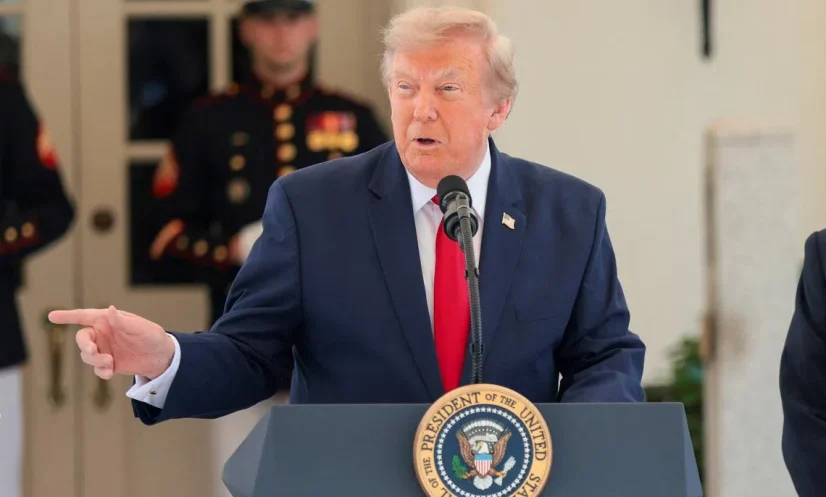
“We’re going to hit them hard tonight, and we’re going to hit them hard tomorrow,” Trump said during a radio interview before the attacks. Later, speaking at the White House, he said US forces were targeting Iranian military capabilities around the strait but maintained that diplomacy remained an option.
“Yeah, I think a deal is possible. Sure, I do,” Trump told reporters, adding that negotiations had faltered after Iran sought more time to continue talks.
Soon after the strikes, the United Arab Emirates said Iranian cruise missiles hit two Emirati oil tankers, Mombasa and Al Bahiyah, while they were sailing through Omani territorial waters in the southern lane of the Strait of Hormuz. One crew member was killed and eight others were injured.
The United Kingdom Maritime Trade Operations (UKMTO) also reported that a tanker had been struck by an unidentified projectile northeast of Oman’s Qalhat, although it was not immediately clear whether it was the same incident reported by the UAE.
Earlier, Trump announced on his Truth Social platform that the United States would ensure the Strait of Hormuz remained open while introducing a 20 percent fee on cargo passing through the waterway.
“The Hormuz Strait is OPEN, and will remain OPEN, with or without Iran,” he wrote. “The USA will be, from this point forward, known as ‘THE GUARDIAN OF THE HORMUZ STRAIT’… and will be reimbursed at the rate of 20 percent on all cargo shipped.”
The proposal drew an immediate response from the United Nations’ shipping agency, which said there was no legal basis under international law for imposing mandatory transit fees on vessels using international straits.
Iran also rejected Trump’s announcement. Iran’s top joint military command said the United States had no authority to determine the future of the Strait of Hormuz and would not be allowed to interfere in the strategic waterway.
Foreign Minister Abbas Araghchi said Iran had always been and would remain the guardian of the strait. Responding to Trump’s proposed shipping fee, he remarked sarcastically that “20 percent is of course too much. We will be fair.”
The US Navy-led Joint Maritime Information Center later announced that the blockade would take effect from 8:00 pm GMT on Tuesday and would apply to all vessel traffic along Iran’s coastline, including ports and oil terminals. It said humanitarian cargo would be permitted after inspection, while transit to and from non-Iranian destinations would continue.
The Strait of Hormuz is one of the world’s most important energy corridors, through which roughly one-fifth of global oil and gas supplies normally pass each day. Any prolonged disruption could have significant consequences for international energy markets.
The conflict spread further across the Gulf as Iran’s Revolutionary Guards claimed responsibility for attacks on US military facilities in Jordan, Bahrain and Kuwait.
Air raid sirens sounded across Bahrain as the country’s military said it intercepted several Iranian missiles and drones. Kuwait’s armed forces also reported intercepting hostile aerial targets, while Jordan said it had shot down four Iranian missiles before they reached their intended targets.
Iran insisted it was targeting only US military assets but warned that any Gulf state assisting Washington would be regarded as participating in the conflict.
Meanwhile, Iranian state media reported at least four explosions near the port city of Bandar Abbas, overlooking the Strait of Hormuz, where key military and naval facilities are located.
The latest exchanges have effectively undermined the fragile memorandum of understanding reached between Washington and Tehran last month, which had temporarily eased tensions and reopened the Strait of Hormuz to commercial shipping.
UN Secretary-General António Guterres voiced deep concern over the renewed hostilities, warning that a return to full-scale conflict would have devastating consequences for the region and the global economy.
In a statement issued by his spokesperson, Guterres urged all parties to exercise maximum restraint, avoid further military escalation and urgently return to diplomatic negotiations.
Iranian Foreign Ministry spokesman Esmaeil Baqaei acknowledged that the June agreement was now “in crisis”, but said Tehran remained engaged in indirect talks with mediators from Qatar, Oman and Pakistan in an effort to prevent the conflict from spiralling further.
Despite the escalating military confrontation, Trump maintained that diplomacy remained the preferred outcome, saying the door to negotiations had not been closed.
“We had a deal with them two days ago, and then they said, ‘We can’t make that deal. We have to negotiate it further,'” he said, expressing confidence that an agreement could still be reached.
Analysts said both Washington and Tehran appeared to be seeking stronger negotiating positions before returning to the bargaining table.
“Both sides want to end the impasse on their own terms, and they are increasingly finding it difficult to do so. Hence the return to and increase in the scale of attacks,” said Bader Al-Saif, an associate fellow at Chatham House.
The renewed conflict has also spread beyond the Gulf. Yemen’s Houthi movement launched missiles towards Saudi Arabia after accusing Riyadh of carrying out air strikes on an airport under its control, effectively ending a four-year truce between the kingdom and the Iran-backed group.
Concerns over possible disruption to oil supplies sent global crude prices sharply higher. Brent crude rose more than nine percent, recording its biggest single-day dollar gain since April, while US benchmark crude also posted its strongest daily increase in more than two months.
Ship-tracking data showed vessel traffic through the Strait of Hormuz had fallen by more than half compared with the previous week, reflecting growing security concerns among commercial shipping operators.
US officials said about 20 vessels had been escorted safely through the waterway during the previous 24 hours, while Iran’s Revolutionary Guards insisted that normal shipping could only resume once US military operations in the Gulf came to an end.
With military exchanges intensifying, commercial shipping disrupted and oil prices climbing, the latest escalation has heightened fears of a broader regional conflict even as both Washington and Tehran continue to signal that diplomacy remains possible.