Play store

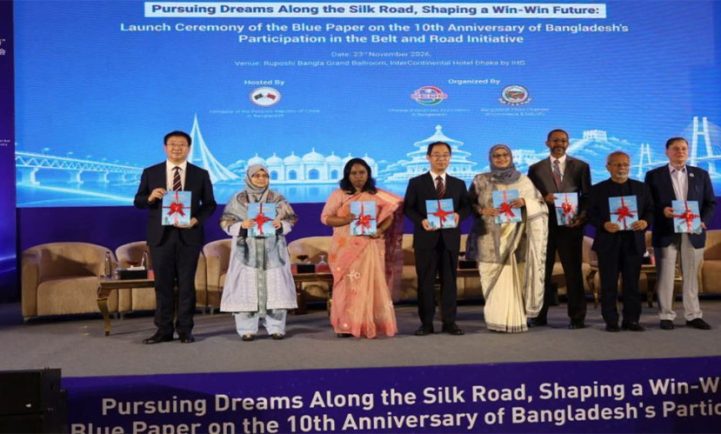
China believes in the principle of non-interference in the internal affairs of other countries and respects the right of the people of Bangladesh to choose their own development path, said Dr Liu Yuyin, Chargé d’Affaires of the Chinese Embassy in Bangladesh.
He made the remarks on Monday at a ceremony at Hotel InterContinental Dhaka marking the launch of a ‘Blue Paper’ commemorating the 10th anniversary of the Belt and Road Initiative (BRI) in Bangladesh.
Recalling the beginning of the cooperation, Liu said China and Bangladesh signed a memorandum of understanding on BRI cooperation on October 14, 2016, during Chinese President Xi Jinping’s historic visit to Dhaka.
It was China’s first intergovernmental BRI cooperation agreement with a South Asian country, he noted.
The Chinese diplomat identified three key driving forces behind the achievements of the bilateral cooperation over the past decade.
The first was political guidance from the top leadership of both countries.
He said the strong commitment of President Xi Jinping and Bangladeshi leaders had helped elevate bilateral relations from a strategic partnership in 2016 to a comprehensive strategic cooperative partnership in 2024, and, this year, to a China-Bangladesh community with a shared future in a new era.
Reaffirming China’s firm support for Bangladesh’s independence, sovereignty and territorial integrity, Liu said Beijing respected Bangladesh’s right to determine its own development path and would not interfere in its internal affairs.
He also noted that Bangladesh had consistently upheld the One-China policy and opposed any form of ‘Taiwan independence’.
Such mutual support on issues involving each country’s fundamental interests had laid the foundation for long-term project financing and policy coordination, he said.
The second driving force, according to Liu, was the enduring strength of shared principles and development philosophies.
He said China followed the principles of sincerity, mutual benefit and inclusiveness in its neighbourhood diplomacy.
China neither imposed its development model on other countries nor attached political conditions to economic cooperation, he added.
He stressed that China-Bangladesh cooperation was not directed against any third party and did not seek to create exclusive blocs. Rather, Beijing welcomed Bangladesh’s efforts to expand cooperation with other countries.
He also highlighted China’s Global Development Initiative (GDI), proposed by President Xi Jinping, saying it was supporting capacity-building and sustainable development in Bangladesh, with the government and people of Bangladesh remaining in the driving seat of their development.
The third driving force was the strength of China’s economic fundamentals and its long-term positive growth prospects.
Liu said China’s economy had maintained stable growth despite repeated downward revisions to global economic growth forecasts.
He added that China’s expanding economy, innovation and open-market policies were creating direct income and employment opportunities for Bangladeshi farmers, workers and small entrepreneurs.