


 Play store

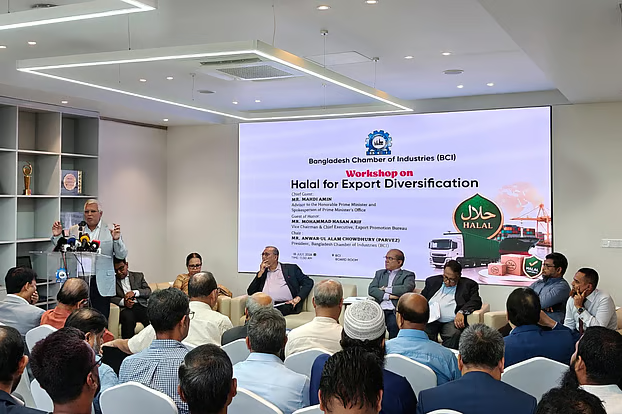
Business leaders have alleged that officials demand bribes, including cars and cash, to issue halal certificates for products, calling for the certification process to be made free and transparent.
The complain was raised on Saturday at a workshop titled “Halal for Export Diversification”, organised by the Bangladesh Chamber of Industries (BCI) in Tejgaon, Dhaka.
The session was chaired by BCI President Anwar-ul Alam Chowdhury Parvez, while Export Promotion Bureau (EPB) Vice Chairman and CEO Mohammad Hasan Arif attended as the chief guest.
Speaking at the event, BCI Director and Easy Food Chairman Zia Haider claimed that businesses are asked to provide car and money as bribes to obtain halal certification. “They even demand payments based on export volume,” he said.
He added that such practices discourage foreign buyers, many of whom prefer simply labeling products as “halal” without going through the costly and complicated certification process. He urged authorities to ensure that halal certificates are issued free of cost.
Echoing similar concerns, Khurshid Alam, General Manager of Bombay Sweets Limited, said obtaining certification can cost between Tk 1.6 million and Tk 1.8 million, although fees have recently been reduced.
He also noted that certificates issued locally are not recognised in Saudi Arabia due to the absence of bilateral agreements, forcing companies to obtain certification from countries like India, Thailand and Singapore.
In his speech, BCI President Parvez highlighted the untapped potential of the global halal market.
He said Bangladesh’s halal exports currently stand at around $850 million, whereas global demand reached $3.3 trillion in 2025 and is projected to grow to $9.45 trillion by 2034, with an annual growth rate exceeding 12 percent.
He stressed the need for stronger branding of Bangladeshi halal products to tap into this expanding market and boost exports.
Chief guest Mohammad Hasan Arif said efforts are underway to connect Bangladeshi businesses with the global halal market, including support for participation in international trade fairs. However, he emphasised the need for better coordination in the certification process.
Speakers at the workshop also called for bringing the halal certification process under a single authority, noting that both the Bangladesh Standards and Testing Institution (BSTI) and the Islamic Foundation currently issue certificates separately, leading to confusion and inefficiencies.