Play store

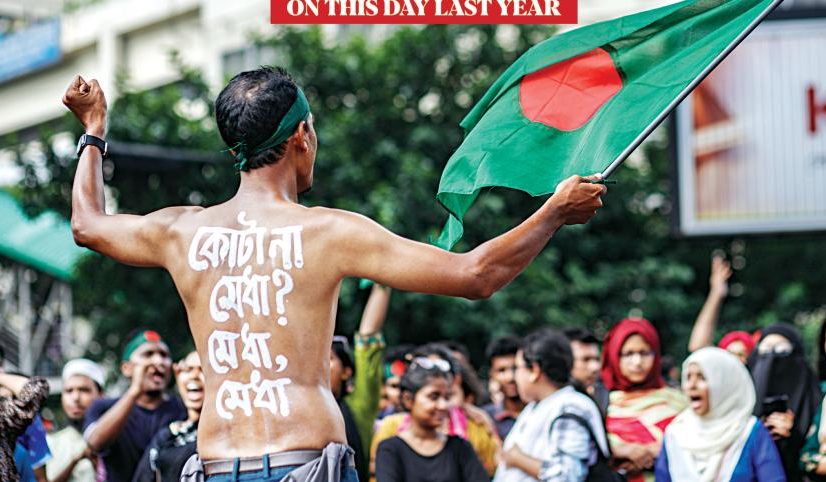
The historic Anti-quota movement that paved the way for ouster of the long 15-year autocratic regime of Sheikh Hasina assumed further pace on 4 July 2024 with a higher court verdict adding fuel to fire. The ongoing agitations spearheaded by university students under the banner “Boishommobirodhi Chhatra Andolon” (Students Against Discrimination) gained more ground amid acts of sabotage and political undercuts.
The streets of the capital Dhaka were once again filled with chants against discrimination as students enforced a five-and-half hour blockade at the city’s Shahbag intersection — marking the fourth consecutive day of marches for the reinstatement of the 2018 circular that abolished the quota system in the public service jobs.
The day’s events began with the spark caused by a ruling of the Supreme Court’s Appellate Division declining to stay the High Court’s verdict that reinstated the quota system. Instead, it asked the authorities to file a formal leave-to-appeal petition after the full text of the High Court judgement is released. As the higher court decision spread swiftly across social media and campus networks, students came down on the streets.
At around 11:00am infuriated students started gathering in front of the Dhaka University’s central library before marching to Shahbagh. Thousands of demonstrators, under the banner “Boishommobirodhi Chhatra Andolon” brought traffic to a complete halt from noon to evening.
Defying inclement weather, they captured the streets, waving banners and shouting slogans such as “Quota na medha, medha medha,” (Quota or merit, merit, merit), “Ekattorer Banglay boishommor thai nai” (There is no place for discrimination in 71’s Bangla), and “Quotar kobor dao” (Bury the quota), as they renewed their call for an end to what they termed an unjust system.
The agitating students also announced fresh programmes: mass processions on July 6 from all universities and colleges and a countrywide student strike on July 7, boycotting classes and exams.
Addressing the crowd before lifting the blockade at 6:10pm, the organizers blasted the government saying, “The executive branch still holds the authority to reissue the 2018 circular. We call on the government to act decisively, and we hope the court will also consider the voices of the youth …. This is not about opposing the freedom fighters; it is about upholding the spirit of the Liberation War; ensuring equal opportunity for all.”
Large contingents of law enforcers were deployed across the city, but they refrained from direct intervention. However, tensions flared briefly around 5:00pm when helmet-donning police officials seemed poised for action. Protesters formed a human shield but the situation de-escalated peacefully.
Beyond the capital, the anti-quota wave intensified across Bangladesh.
Students from Sher-e-Bangla Agricultural University blocked the Agargaon road, while Jagannath University students staged sit-ins near Ray Saheb Bazar. Jahangirnagar University protesters took to the Dhaka-Aricha Highway, causing temporary traffic standstills.
Cumilla University students blocked the Dhaka-Chattogram Highway for three hours. The mobilisation spread further as Rajshahi University students braved heavy rain to occupy the Dhaka-Rajshahi Highway.
Similar blockades were enforced by the students at Chittagong University, where the Chattogram-Khagrachhari Highway was blocked. Barishal University students also blocked the Barishal-Kuakata Highway for five hours.
Reiterating their various demands, the demonstrators urged the government to uphold the 2018 circular abolishing quotas, form a commission to review the quota system ensuring only constitutionally mandated reservations remain, stop multiple uses of quota privileges, fill vacant quota posts with merit-based candidates, and ensure a corruption-free, meritocratic civil service.
On the other hand, pro-government Chhatra League activists were seen positioned in various dormitories to discourage participation in the quota-reform protests. That same day, student leaders from the ruling party’s student wing, Bangladesh Chhatra League (BCL), attempted to obstruct students from joining the protests by locking dormitory gates at Dhaka University.
Some students were even confined in so-called “guest rooms.” Protesters later broke the locks and freed fellow students to join the demonstration.
At Dhaka University, one of the protest organizers Sarjis Alam was forced to vacate his dorm, prompting an overnight gathering of fellow students demanding justice.
Meanwhile, the strike by public university teachers and staffers against the government’s new pension scheme continued, adding another layer of unrest to an already charged atmosphere.
As night fell over Shahbagh, the energy of the day’s protests lingered. Students dispersed with renewed determination; eyes set on the upcoming mass demonstrations and the promised student strike