


 Play store

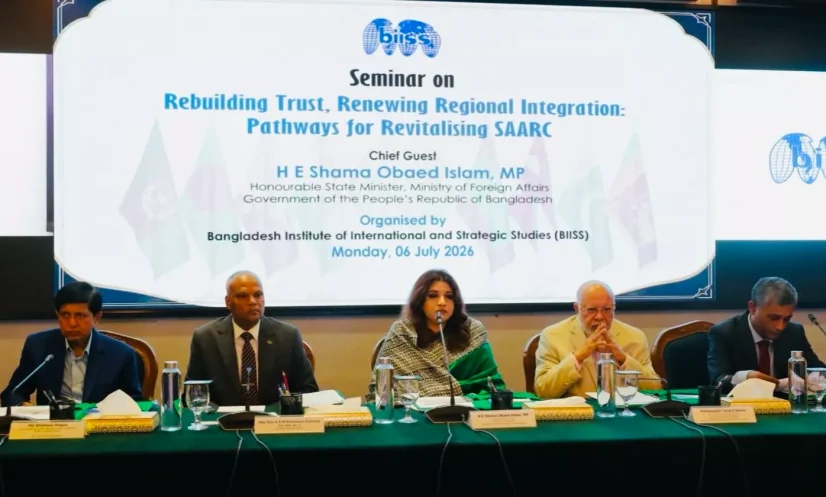
State Minister for Foreign Affairs Shama Obaed Islam has said on Monday Bangladesh does not need to choose between SAARC and BIMSTEC, stressing that the two regional platforms should work in tandem to advance shared goals.
“Under the leadership of Prime Minister Tarique Rahman, a confident Bangladesh can support both SAARC and BIMSTEC, as each serves the national interest in connectivity, stability, prosperity and development,” she said at a seminar in Dhaka.
The seminar, titled “Rebuilding Trust, Renewing Regional Integration: Pathways for Revitalising SAARC,” was organised by the Bangladesh Institute of International and Strategic Studies (BIISS).
Shama Obaed said BIMSTEC connects South Asia with the Bay of Bengal and Southeast Asia, while SAARC reflects the broader South Asian identity. Sub-regional initiatives, she added, should complement—not undermine—SAARC’s role.
As part of efforts to revitalise SAARC, she proposed maintaining the platform at an “optimal functional level” until conditions allow for full political revival.
“This does not mean keeping SAARC alive symbolically. It means doing the maximum that is realistically possible—being ambitious in spirit, but practical in method,” she said.
She said this approach would include regular technical meetings, a predictable activity calendar, stronger regional institutions and visible, people-centred outcomes.
Flexible, project-based cooperation among willing member states should also be encouraged, allowing progress even if all members are not ready to participate simultaneously.
The state minister emphasised that SAARC should remain an inclusive platform and not be used to force bilateral political dialogue.
“The goal is to ensure that bilateral tensions do not paralyse regional cooperation,” she said, adding that SAARC allows smaller states to act collectively while enabling constructive regional leadership.
She noted that Bangladesh has received positive signals from member states regarding SAARC’s revival and called for translating that intent into action.
“Our approach is hopeful but realistic. Much can still be achieved through technical, people-focused cooperation,” she added.
In his keynote presentation, former ambassador Tariq A. Karim compared SAARC to a car that cannot move without both political will and energy resources.
“You have the engine, but it won’t run unless the politics functions. And even if it does, you need fuel—energy security—to move forward,” he said.
The event also featured a brief exchange over a map depiction during the presentation, which was clarified as illustrative rather than political.
Speakers at the seminar discussed structural challenges facing SAARC, regional geopolitical dynamics and opportunities to advance cooperation despite political differences. Participants included policymakers, diplomats, academics and researchers.